
When upgrading a home with smart technology, many people want convenience without the hassle of construction. Rewiring walls for smart lighting or appliances can be costly and disruptive. Fortunately, two popular solutions—smart plugs and smart switches—offer wireless control over devices while avoiding invasive electrical work. But which one delivers more control? The answer depends on your goals, existing setup, and how deeply you want to integrate automation into your daily life.
Both options connect to Wi-Fi, support voice assistants like Alexa and Google Assistant, and allow remote scheduling through smartphone apps. Yet their capabilities, limitations, and ideal use cases differ significantly. Understanding these differences helps you make an informed decision that maximizes both function and flexibility.
How Smart Plugs Work
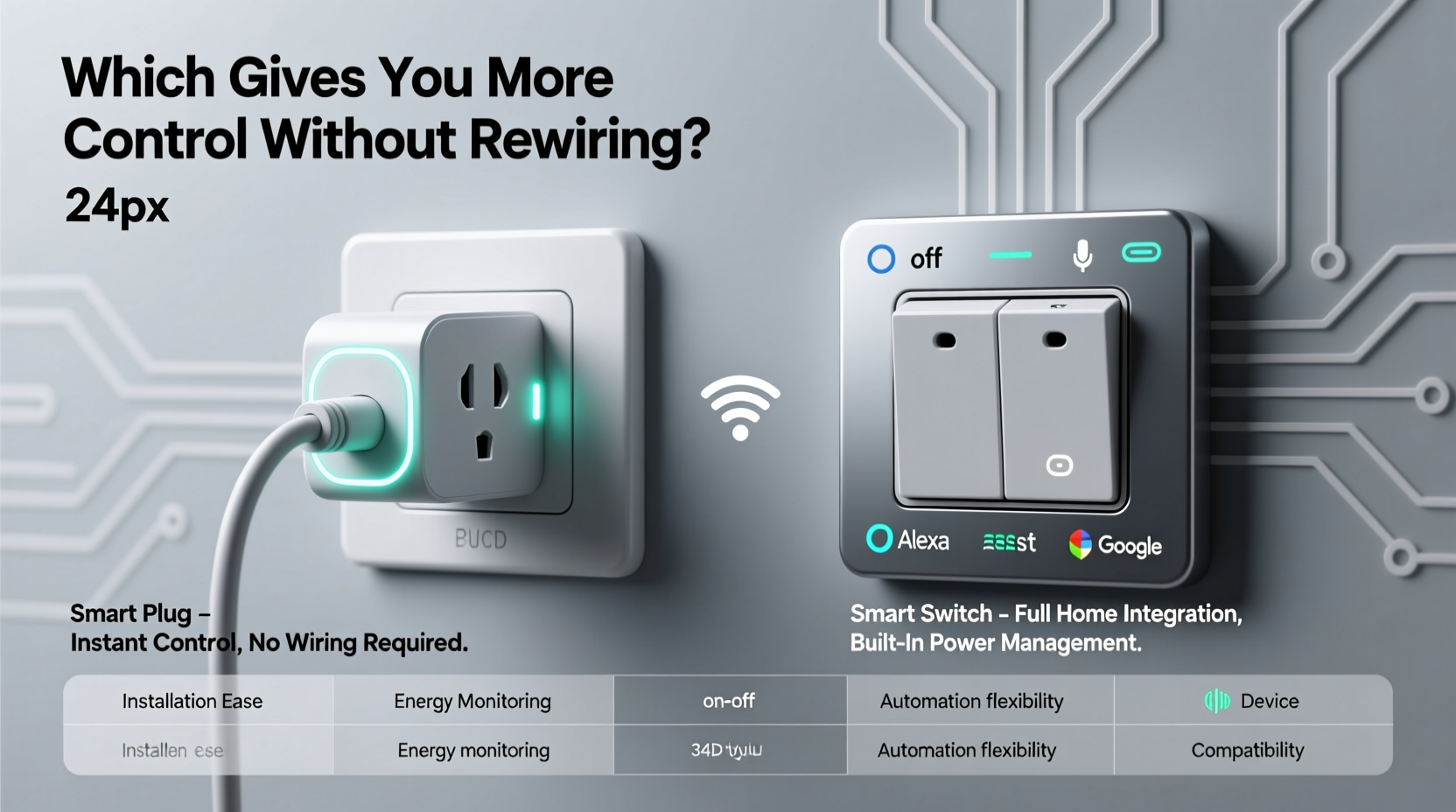
A smart plug is a simple device that fits between a wall outlet and any appliance plugged into it. Once connected, it turns standard electronics—like lamps, coffee makers, fans, or space heaters—into smart devices. You control them via app commands, voice prompts, or automated routines based on time, location, or sensor triggers.
Installation takes seconds: just plug it in, download the companion app, connect it to your network, and pair it with your preferred voice assistant. No tools, no permits, no electrician required. This ease of use makes smart plugs ideal for renters or anyone hesitant to modify their living space.
Most models support energy monitoring, letting you track power consumption over time. Some even offer dual outlets with independent controls, so you can manage two separate devices from a single unit. However, smart plugs only work with devices that have their own physical on/off switch. If the appliance is hardwired or permanently powered, a plug won’t help.
Understanding Smart Switches (No Rewiring Required)
Smart switches replace traditional light switches but are designed for retrofitting. These \"no-neutral\" or \"self-powered\" models draw minimal electricity from the load (e.g., a connected bulb) to operate their internal circuitry, eliminating the need for complex wiring upgrades. They install directly into existing switch boxes, maintaining the familiar wall-mounted interface while adding smart features.
Unlike smart plugs, they control lighting circuits at the source. This means you can automate ceiling lights, under-cabinet fixtures, or outdoor porch lights—all without running new wires. Installation requires basic electrical knowledge: turning off the breaker, removing the old switch, connecting wires (usually line, load, and ground), and securing the new unit. While not as simple as plugging in a device, it’s manageable for DIYers comfortable with household wiring.
Once installed, smart switches integrate seamlessly with home ecosystems. Many support dimming, color temperature adjustment, and scene activation. Because they’re built into the wall, they look more polished than external adapters and don’t block adjacent outlets—a common issue with bulky smart plugs.
“Smart switches provide a cleaner aesthetic and deeper integration with home lighting systems. For whole-room automation, they outperform plug-based solutions.” — David Lin, Home Automation Engineer at NestAware Systems
Comparing Control: Features and Capabilities
The real distinction between smart plugs and smart switches lies in the level and type of control they offer. Below is a detailed comparison across key performance areas:
| Feature | Smart Plug | Smart Switch |
|---|---|---|
| Installation Complexity | Very low – plug and play | Moderate – requires wiring |
| Device Compatibility | Only works with plug-in appliances | Best for fixed lighting circuits |
| Wall Aesthetic | Bulky; may block nearby outlets | Clean, flush-mounted finish |
| Manual Override | Yes – via device switch | Yes – toggle switch remains functional |
| Energy Monitoring | Common on mid-to-high-end models | Limited; available on select brands |
| Dimming Support | Rare; mostly on/off only | Widely supported with compatible bulbs |
| Voice & App Control | Full support | Full support |
| Scheduling & Automation | Yes, via app | Yes, often with geofencing and sensors |
| Works During Power Outage | No – loses connection when unplugged | Depends on model; some retain state |
While both platforms support core smart functions, smart switches generally deliver superior control for lighting environments. Their ability to dim, sync with motion detectors, and blend into room design offers a more refined experience. Smart plugs, meanwhile, excel in versatility—especially for non-lighting applications.
Real-World Example: Automating a Living Room
Consider Sarah, who rents an apartment and wants to create a cozy evening routine. She uses a smart plug for her floor lamp and sound machine. Each night at 7:30 PM, both turn on automatically. When she says, “Alexa, movie time,” the lamp dims (via a compatible dimmable smart bulb inside the lamp), and the speaker starts ambient noise.
However, her ceiling light remains uncontrolled because it’s hardwired and lacks a neutral wire in the switch box. After consulting a guide, she installs a no-neutral smart switch compatible with her circuit. Now, all three lights—the ceiling fixture, floor lamp, and accent strip—are synchronized. She creates scenes like “Relax” (soft overhead glow + warm lamp) and “Good Morning” (gradual brightening).
In this case, the smart switch provided the missing piece: centralized, architectural-level control that a plug couldn’t replicate. Yet the smart plug still plays a vital role in managing movable, plug-dependent devices.
Choosing Based on Your Needs: A Step-by-Step Guide
Selecting the right solution isn’t about which is better overall—it’s about matching technology to your specific needs. Follow this sequence to determine the optimal path:
- Identify what you want to control. Is it a table lamp, fan, or TV (plug-compatible)? Or ceiling lights, stairwell fixtures, or outdoor floodlights (switch-controlled)?
- Check physical access. Can you reach the outlet easily? Are there obstructions like furniture or tight spaces behind appliances?
- Assess wiring conditions. Do your switches have a neutral wire? If not, confirm whether the smart switch brand supports no-neutral installations (e.g., Lutron Caseta, GE Cync, or Kasa Smart). Older homes often lack neutrals in switch boxes.
- Evaluate aesthetic priorities. Will visible smart plugs disrupt the room’s look? Are guests likely to unplug them accidentally?
- Determine desired functionality. Need dimming, color tuning, or multi-way switching (e.g., controlling one light from two locations)? Smart switches handle this better.
- Review budget and scalability. Smart plugs typically cost $15–$30 each; smart switches range from $25–$60. Factor in potential labor if hiring help for installation.
- Test one first. Buy a single smart plug and a compatible smart switch to compare usability before committing to a full rollout.
Hybrid Approach: Get the Best of Both Worlds
For maximum control without rewiring, many homeowners adopt a hybrid strategy. Use smart switches for primary lighting circuits—especially those used daily—and smart plugs for secondary, mobile, or seasonal devices.
- Install smart switches in bedrooms, hallways, and kitchens where consistent lighting control matters.
- Use smart plugs for holiday decorations, garage tools, air purifiers, or bathroom exhaust fans.
- Combine both in media rooms: smart switch for ambient lighting, smart plug for powering the entertainment center with auto-off after inactivity.
This layered approach ensures comprehensive coverage. It also future-proofs your system—you can start with plugs and gradually upgrade to switches as confidence and needs grow.
Frequently Asked Questions
Can I use a smart plug with a lamp that has no manual switch?
Yes, but with caution. Most lamps must remain switched on at the base for the smart plug to deliver power. If the lamp lacks a switch, ensure it stays constantly powered so the smart plug can interrupt the flow. Otherwise, the plug cannot turn the lamp off.
Do smart switches work without a neutral wire?
Some do. Brands like Lutron Caseta and GE Enbrighten offer models specifically designed for homes without neutral wires at the switch. These use alternative power-sourcing methods, such as drawing micro-current through the bulb. Check product specifications carefully before purchasing.
Are smart plugs safe for high-wattage appliances like space heaters?
Only if the plug is rated for the appliance’s wattage. Standard smart plugs usually max out at 15A/1800W. High-power models exist, but always verify compatibility. Never overload a smart plug—overheating risks fire hazards.
Final Recommendation: Which Gives More Control?
When evaluating pure control, **smart switches win**—but only within their domain. They offer smoother integration, advanced lighting features, and a seamless user experience that mimics traditional switches while enabling modern automation. For whole-home lighting orchestration, scene creation, and multi-location control, they are unmatched.
Yet smart plugs provide unmatched flexibility. They let you smart-enable almost any small appliance instantly, anywhere there’s an outlet. Their plug-and-play nature makes them perfect for experimentation and temporary setups.
If your goal is broad, deep control over lighting systems without rewiring, invest in compatible no-neutral smart switches. If you prioritize speed, affordability, and adaptability across various devices, begin with smart plugs. Ideally, use both strategically to build a responsive, intelligent environment tailored to how you live.




 浙公网安备
33010002000092号
浙公网安备
33010002000092号 浙B2-20120091-4
Comments
No comments yet. Why don't you start the discussion?