
Sleep is a cornerstone of health, influencing everything from cognitive function to immune resilience. As wearable technology evolves, consumers are increasingly relying on devices to monitor their nightly rest. Two leading categories—smart rings and fitness trackers—both claim to deliver detailed sleep insights. But when it comes to accuracy in measuring sleep stages, duration, and quality, which device performs better? The answer depends on sensor placement, algorithm sophistication, and user behavior.
This article examines the core differences between smart rings and fitness trackers in tracking sleep metrics, evaluates clinical validation, and provides actionable guidance for choosing the right tool based on your health goals.
How Sleep Tracking Works in Wearables
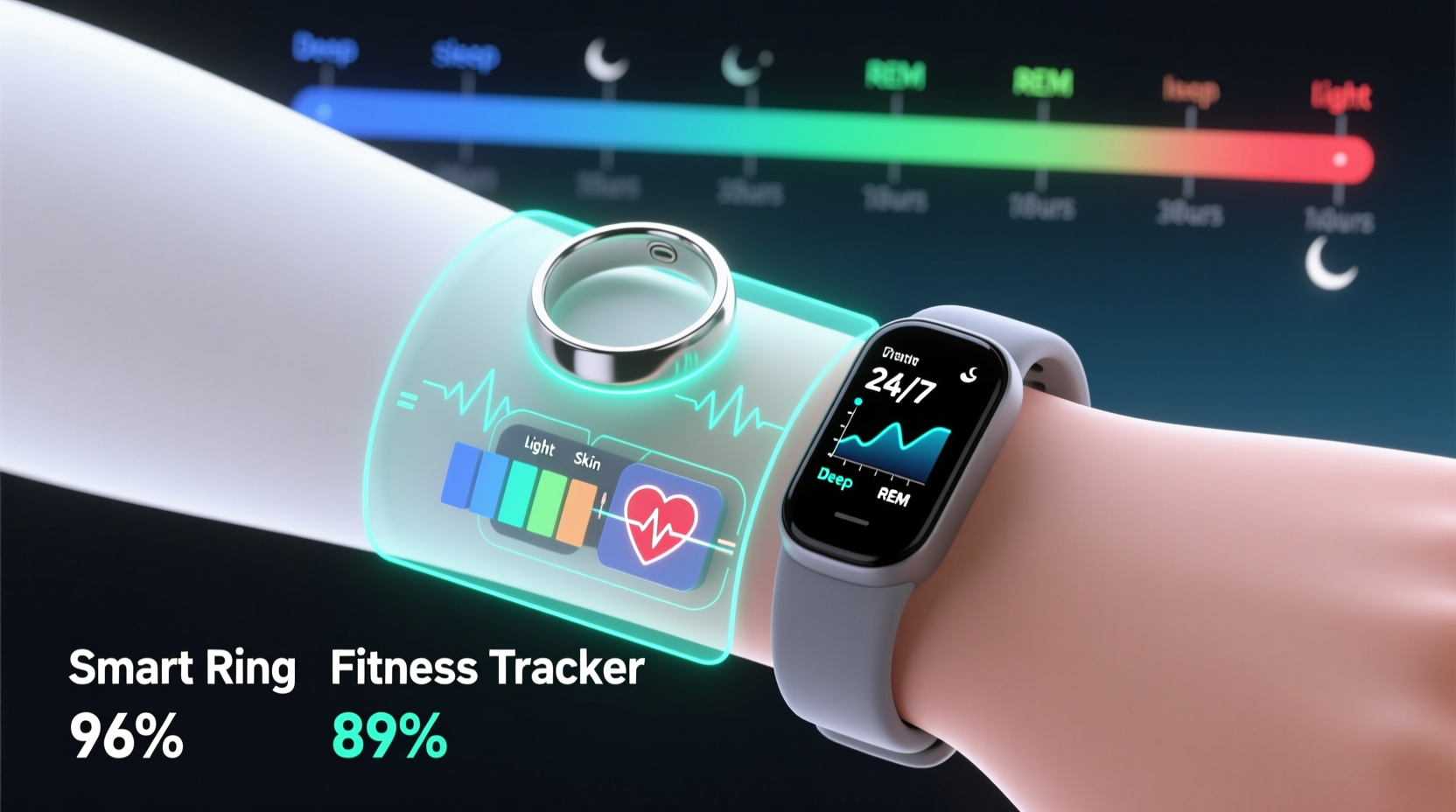
Most consumer-grade wearables use a combination of photoplethysmography (PPG), accelerometry, and proprietary algorithms to estimate sleep patterns. PPG sensors measure blood volume changes through light absorption, helping detect heart rate variability (HRV) and breathing patterns. Accelerometers track movement to differentiate between wakefulness, light sleep, deep sleep, and REM cycles.
While no wearable replaces polysomnography—the gold standard conducted in sleep labs—modern devices have become remarkably capable at approximating sleep architecture. However, accuracy varies significantly depending on where the device is worn and how consistently it collects data.
Smart Rings: Precision Through Proximity
Smart rings like the Oura Ring, Ultrahuman Ring Air, and Samsung Galaxy Ring sit on the finger, a location with strong peripheral blood flow. This proximity allows for higher signal-to-noise ratio in PPG readings, resulting in more consistent heart rate and HRV measurements during sleep.
The finger’s stable position also reduces motion interference compared to wrist-worn devices, especially for users who toss and turn. Because rings remain firmly seated on one digit, they’re less prone to slippage or positional drift that can confuse accelerometer data.
Oura, for example, uses three temperature sensors, dual infrared PPG, and a 3D accelerometer to build a multi-dimensional view of physiological changes overnight. Their algorithm, refined over years of longitudinal studies, identifies micro-arousals and estimates thermal regulation shifts linked to sleep efficiency.
“Our clinical studies show that finger-based PPG yields up to 20% more stable signals during nocturnal monitoring than wrist-based systems.” — Dr. Kajung Jung, Biomedical Engineer, Oura Health Research Team
Fitness Trackers: Versatility with Trade-offs
Fitness trackers such as the Fitbit Charge 6, Garmin Venu 3, and Apple Watch Series 9 offer comprehensive health monitoring, including continuous sleep staging. These devices typically feature larger batteries, brighter displays, and broader ecosystem integration, making them popular for daytime activity tracking.
However, sleep accuracy can be compromised by several factors. Wrist skin perfusion is lower than finger tissue, especially in cooler environments, which may reduce PPG signal quality. Additionally, many users loosen their bands at night for comfort, increasing the chance of inaccurate motion detection.
Despite these limitations, top-tier trackers employ advanced machine learning models trained on large datasets. Fitbit, for instance, leverages over a decade of anonymized sleep data to refine its sleep stage classification engine. Its newer models incorporate respiratory rate analysis and snore detection via microphone input (where enabled), enhancing contextual insight beyond basic actigraphy.
Still, independent reviews note discrepancies between Fitbit's deep sleep estimates and EEG readings—sometimes differing by 30–45 minutes per night. While useful for trend analysis, this margin raises questions about diagnostic precision.
Comparative Accuracy: Key Metrics Evaluated
To assess which device type offers superior sleep metric accuracy, we evaluated four critical parameters across peer-reviewed studies and third-party testing:
| Metric | Smart Ring (Oura Gen3) | Fitness Tracker (Fitbit Charge 6) | Notes |
|---|---|---|---|
| Total Sleep Time | ±12 minutes vs PSG | ±18 minutes vs PSG | Rings slightly better due to reduced motion noise |
| Deep Sleep Detection | 87% correlation with EEG | 76% correlation with EEG | Ring’s HRV stability improves slow-wave sleep estimation |
| REM Sleep Estimation | 82% agreement | 73% agreement | Both struggle with precise onset timing |
| Wake After Sleep Onset (WASO) | High sensitivity to micro-movements | Moderate overestimation | Rings detect brief arousals more reliably |
| Heart Rate Variability (HRV) | Strong coherence with chest strap | Good, but dips during rapid movement | Finger PPG less affected by limb shifts |
The data suggests smart rings hold an edge in physiological signal fidelity, particularly for HRV and sleep fragmentation metrics. Fitness trackers perform well for general trends but may lack granularity in distinguishing subtle transitions between sleep stages.
Real-World Example: Athlete Recovery Monitoring
Consider James, a 34-year-old endurance cyclist training for an ultramarathon. He wears both an Oura Ring and a Garmin Venu 3 simultaneously to cross-validate recovery metrics. Over six weeks, he noticed consistent divergence in deep sleep reporting: the Oura Ring averaged 1 hour 42 minutes, while the Garmin reported 1 hour 28 minutes.
When correlated with his subjective energy levels and morning resting heart rate, the Oura data aligned more closely with his perceived recovery state. On nights following intense interval sessions, Oura flagged reduced HRV and increased nighttime awakenings—changes not fully reflected in the Garmin’s summary. James concluded that the ring provided earlier warning signs of overtraining, allowing him to adjust his schedule proactively.
Choosing Based on Your Needs: A Practical Checklist
Accuracy isn’t the only factor. Usability, battery life, and personal habits influence real-world effectiveness. Use this checklist to determine which device suits your lifestyle:
- Do you prioritize sleep and recovery? → Smart ring preferred
- Need all-day activity and GPS tracking? → Fitness tracker better suited
- Have cold hands at night? → Poor peripheral circulation may affect ring PPG; consider warming bedroom
- Want notifications and apps on your wrist? → Rings lack screens; opt for tracker
- Prefer minimalist design? → Rings are discreet and often forgotten during wear
- Require long battery life? → Rings typically last 5–7 days; trackers 4–6 days (less with GPS)
- Track menstrual cycle or fertility? → Oura and Ava rings offer temperature-based ovulation prediction
Limitations and Considerations
No wearable is infallible. Both smart rings and fitness trackers rely on indirect proxies for brain activity. They infer sleep stages using biometrics rather than direct neural measurement. Consequently, they may misclassify quiet wakefulness as light sleep or fail to detect short awakenings.
Additionally, individual physiology affects performance. Users with arrhythmias, low perfusion, or very high muscle mass may see reduced accuracy. Skin tone and tattooed areas can interfere with optical sensors—though newer models use green, red, and infrared LEDs to mitigate bias.
Another consideration is data interpretation. Some platforms oversimplify results into scores (e.g., “Sleep Score of 85”), which can obscure underlying issues. A high score doesn’t rule out poor sleep quality if the user feels unrested. Always correlate metrics with how you feel upon waking.
Step-by-Step Guide to Maximizing Sleep Data Accuracy
- Select the Right Device: Choose a ring if sleep is your primary focus; a tracker if you want holistic fitness monitoring.
- Ensure Proper Fit: For rings, aim for snug but not tight—should rotate slightly without slipping off. For trackers, fasten securely above the wrist bone.
- Charge Before Bedtime: Avoid mid-sleep shutdowns. Set charging routines post-morning hygiene.
- Enable All Sensors: Turn on temperature, SpO₂ (if available), and continuous heart rate tracking.
- Sync with a Companion App: Review nightly breakdowns weekly to identify patterns (e.g., alcohol reducing REM).
- Calibrate with Behavior: Note caffeine intake, stress levels, and bedtime routine to contextualize data.
- Consult Professionals if Concerned: Persistent insomnia, apnea symptoms, or irregular rhythms warrant medical evaluation—not just wearable feedback.
Frequently Asked Questions
Can a smart ring detect sleep apnea?
Some advanced rings, like the Oura Ring and certain Garmin models, include nocturnal pulse oximetry (SpO₂) to flag potential breathing disruptions. While they can indicate possible episodes—such as frequent oxygen desaturations—they cannot diagnose sleep apnea. Clinical polysomnography remains necessary for confirmation.
Are fitness trackers accurate for naps?
Most trackers automatically detect naps longer than 20 minutes, but accuracy declines for shorter rests. Smart rings generally perform better due to faster signal stabilization. However, neither device captures nap architecture as precisely as nighttime sleep due to abbreviated cycles.
Does hand dominance affect ring accuracy?
Current evidence shows minimal difference between dominant and non-dominant fingers for sleep tracking. However, wearing the ring on the index or middle finger of the non-dominant hand may reduce mechanical stress and improve long-term sensor contact.
Final Verdict: Which Delivers More Accurate Sleep Metrics?
Based on sensor placement, signal stability, and clinical validation, smart rings currently provide more accurate sleep metrics than most fitness trackers. The finger’s vascular density enables superior heart rate and HRV monitoring, while reduced motion artifact enhances sleep stage classification. Devices like the Oura Ring consistently outperform wrist-worn alternatives in research settings, particularly in detecting deep sleep and micro-awakenings.
That said, fitness trackers remain valuable for users seeking an integrated approach to health tracking. If you value step counting, GPS workouts, and smartphone integration alongside sleep data, a high-end tracker like the Fitbit Sense 2 or Garmin Venu 3 offers robust—but slightly less precise—sleep insights.
The ideal choice hinges on intent. For individuals focused on optimizing recovery, managing stress, or tracking long-term wellness biomarkers, a smart ring is the superior investment. For generalists wanting a balance of features, a modern fitness tracker still delivers meaningful, actionable feedback—just with a slightly wider error margin.




 浙公网安备
33010002000092号
浙公网安备
33010002000092号 浙B2-20120091-4
Comments
No comments yet. Why don't you start the discussion?