
In the rapidly evolving world of wearable technology, two dominant forms have emerged: the smartwatch and the smart ring. While both promise continuous health monitoring, fitness tracking, and lifestyle insights, their design differences lead to significant variations in data accuracy. As consumers increasingly rely on these devices for personal health decisions—such as detecting irregular heart rhythms or optimizing sleep—the precision of collected data becomes critical. This article dives deep into how smart rings and smart watches compare across key biometric measurements, examining scientific studies, user experiences, and technological limitations.
Core Biometrics Tracked by Wearables
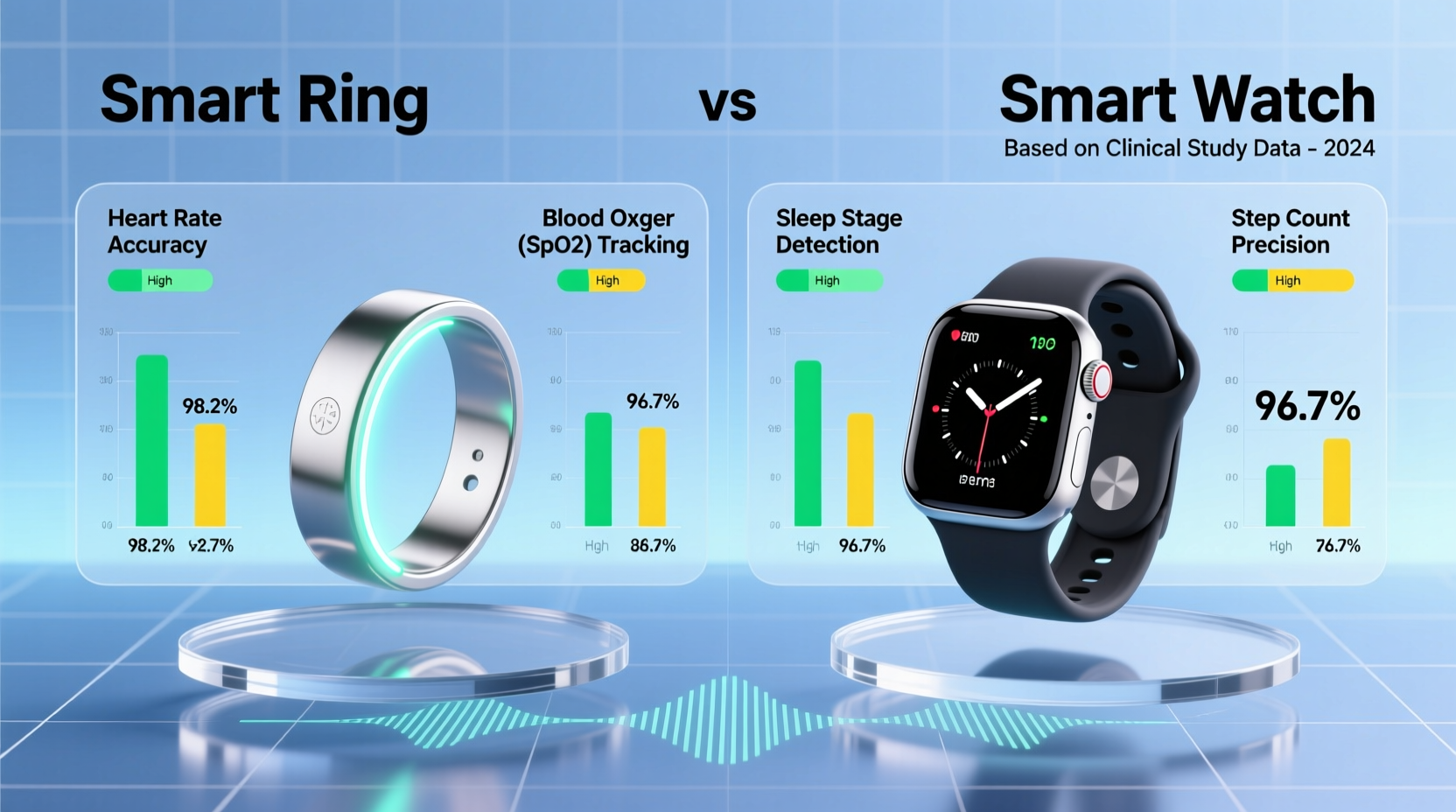
Both smart rings and smartwatches monitor a range of vital signs, including:
- Heart rate (HR) and heart rate variability (HRV)
- Sleep stages (light, deep, REM)
- Blood oxygen saturation (SpO2)
- Body temperature trends
- Physical activity and step count
- Respiratory rate
Despite tracking similar metrics, the placement of sensors—on the finger versus the wrist—affects signal quality, motion artifacts, and overall reliability. The anatomy of each location plays a crucial role in optical sensor performance, particularly for photoplethysmography (PPG), which measures blood flow changes using light.
Heart Rate Accuracy: Wrist vs Finger
Heart rate monitoring is one of the most commonly used features in wearables. Smartwatches typically use green LED PPG sensors on the underside of the device, pressed against the radial artery in the wrist. Smart rings, like the Oura Ring or Ultrahuman Ring Air, place red and infrared LEDs closer to the capillary bed in the finger’s pulp, where blood flow is more consistent and less affected by arm movement.
Studies suggest that finger-based sensors may offer superior stability during rest and sleep due to reduced motion artifact. A 2022 study published in *npj Digital Medicine* found that certain smart rings demonstrated up to 15% higher consistency in resting heart rate readings compared to mainstream smartwatches during nocturnal monitoring.
However, during high-intensity workouts, smartwatches often outperform smart rings. The larger battery and advanced algorithms in devices like the Apple Watch Series 9 or Garmin Forerunner allow for faster sampling rates and multi-wavelength sensing. Additionally, wrist-worn devices can leverage accelerometer data more effectively to filter out motion noise.
“While finger-based PPG shows promise for passive monitoring, dynamic conditions still favor the computational power and sensor fusion available in modern smartwatches.” — Dr. Lena Patel, Biomedical Engineer at Stanford Health Innovation Lab
Sleep Tracking Precision and Stage Detection
Sleep tracking has become a major selling point for both categories. Smart rings excel here due to their discreet design and ability to remain undisturbed throughout the night. Because they are worn on the finger, they experience less positional shift than wristbands, which can loosen or rotate during tossing and turning.
The Oura Ring Gen3, for example, uses a combination of infrared PPG, temperature sensors, and 3D accelerometry to estimate sleep architecture. Independent validation studies show its sleep staging accuracy reaches approximately 80–85% when compared to polysomnography (the clinical gold standard), particularly excelling in detecting deep sleep and wake periods.
In contrast, while Apple Watch and Fitbit devices also provide detailed sleep reports, their accuracy varies more significantly between users. Factors such as skin tone, tattoo coverage, and habitual sleeping positions can interfere with optical readings on the wrist. Moreover, some users remove their watches before bed to charge them, leading to incomplete datasets.
Temperature sensing further differentiates smart rings. The ring's close contact with the fingertip—a thermally stable site—allows for precise detection of subtle circadian shifts. This capability supports early illness detection and menstrual cycle prediction with greater sensitivity than wrist-based thermometers.
SpO2 and Respiratory Monitoring: Location Matters
Blood oxygen levels (SpO2) are measured using red and infrared light absorption through tissue. Fingertips naturally contain dense vascular networks and thinner skin layers, making them ideal for pulse oximetry. Clinical-grade pulse oximeters are placed on fingers for this reason.
As expected, smart rings tend to deliver more consistent SpO2 readings than smartwatches. In low-perfusion scenarios—such as cold environments or poor circulation—finger sensors maintain better signal integrity. However, most consumer wearables, regardless of form factor, are not medical devices and should not be relied upon for diagnosing hypoxemia.
Respiratory rate estimation benefits from stable heart rate signals. Since smart rings capture cleaner PPG waveforms during sleep, they often report smoother respiratory trends. Devices like the Ultrahuman Ring Air use machine learning models trained on long-duration finger PPG to infer breathing patterns with minimal disruption from body movements.
Data Consistency Across Demographics
A growing concern in wearable tech is equity in measurement accuracy across diverse populations. Research from the University of California, San Francisco, highlights that darker skin pigmentation can reduce PPG signal strength due to increased light absorption. This affects both smart rings and watches, but the impact appears less pronounced in finger-based systems.
The reason lies in the optical path: the fingertip’s translucent nail bed allows for transmissive PPG (light passing through tissue), whereas wrist devices rely on reflective PPG, which is more susceptible to melanin interference. Transmissive setups, though technically challenging to miniaturize, offer inherently better signal-to-noise ratios in varied skin tones.
That said, no consumer wearable currently matches the accuracy of medical equipment across all demographics. Users with darker skin should validate critical readings—like elevated heart rate—with alternative methods when possible.
Comparative Accuracy Summary
| Metric | Smart Ring Advantage | Smart Watch Advantage | Notes |
|---|---|---|---|
| Resting Heart Rate | ✅ Higher consistency during sleep | ❌ More variable due to movement | Finger PPG offers stable baseline |
| Exercise Heart Rate | ❌ Lags during rapid changes | ✅ Faster response, better filtering | Watches use advanced motion compensation |
| Sleep Staging | ✅ Superior wake/deep sleep detection | ⚠️ Moderate accuracy, user-dependent | Rings less likely to be removed at night |
| SpO2 Readings | ✅ More reliable in low perfusion | ⚠️ Affected by skin tone and motion | Fingertip mimics clinical oximeter placement |
| Body Temperature | ✅ Continuous, sensitive trend tracking | ⚠️ Limited unless equipped with sensors | Only select watches (e.g., Garmin, Withings) include thermal sensing |
| Step Count & Activity | ❌ Inferior due to limited motion data | ✅ Highly accurate with GPS integration | Watches dominate in fitness logging |
Real-World Example: Athlete Recovery Monitoring
Consider Maria, a professional triathlete who uses both an Oura Ring and a Garmin Fenix 7. During intense training blocks, she noticed discrepancies in her HRV readings between devices. Her morning HRV from the ring showed a gradual decline over three days, signaling accumulating fatigue. Meanwhile, the watch reported fluctuating values with no clear trend.
Upon consulting her sports scientist, Maria learned that the ring’s nighttime-only HRV calculation—based on stable parasympathetic activity during deep sleep—was more reflective of true autonomic recovery. The watch, collecting intermittent daytime samples influenced by stress and caffeine, introduced noise into the dataset.
She now relies primarily on the ring for recovery insights while using the watch for real-time workout feedback. This hybrid approach leverages the strengths of both platforms without over-relying on either.
Expert Tips for Maximizing Accuracy
- Calibrate regularly: Pair your wearable with a chest strap heart rate monitor once a week to verify accuracy.
- Avoid extreme temperatures: Cold hands reduce peripheral blood flow, impairing PPG signals in both rings and watches.
- Update firmware: Manufacturers frequently release algorithm improvements that enhance data processing.
- Check fit daily: A loose ring or watch band creates motion artifacts and unreliable baselines.
- Use multiple sources: Cross-reference wearable data with subjective feelings of energy, mood, and performance.
Frequently Asked Questions
Can smart rings detect atrial fibrillation?
Currently, no smart ring has FDA clearance for AFib detection. While some models flag unusually high or irregular heart rates, they lack the electrocardiogram (ECG) functionality present in Apple Watch, Samsung Galaxy Watch, and others. If AFib screening is a priority, a smartwatch with ECG support is the better choice.
Are smart rings worth it if I already own a smartwatch?
It depends on your goals. If you prioritize sleep optimization, recovery tracking, and passive health monitoring, a smart ring adds value by filling gaps left by wrist-based devices. However, if you want notifications, GPS, music control, and active workout coaching, the smartwatch remains indispensable. Many users opt for both, reserving the ring for sleep and recovery analytics.
Do smart rings work for people with small or large fingers?
Most brands offer sizing kits or adjustable bands. Oura, for instance, provides free size exchanges within the first month. Some models, like the RingConn, use flexible materials to accommodate a wider range of finger sizes. Proper fit is essential—not just for comfort, but for maintaining consistent sensor contact.
Action Plan: Choosing Based on Your Needs
- Define your primary goal: Is it sleep improvement, fitness training, heart health, or general wellness?
- Evaluate your lifestyle: Do you forget to charge devices? Are you comfortable wearing something on your finger 24/7?
- Assess medical relevance: Do you need ECG, fall detection, or FDA-cleared arrhythmia alerts?
- Test compatibility: Ensure the device syncs with your smartphone OS and preferred health apps (Apple Health, Google Fit, etc.).
- Review independent studies: Look for peer-reviewed validations of accuracy claims rather than relying solely on manufacturer marketing.
Final Verdict: Complementary, Not Competitive
The debate between smart rings and smartwatches isn't about declaring a single winner—it's about understanding their complementary roles. Smart rings shine in passive, continuous monitoring, especially during sleep, thanks to anatomical advantages and unobtrusive design. They deliver high-fidelity data for recovery, temperature trends, and nocturnal physiology.
Smartwatches, meanwhile, dominate in active tracking, offering richer interaction, broader sensor arrays, and immediate feedback during exercise. Their larger batteries support more frequent sampling and advanced features like GPS and voice assistants.
For holistic health insight, the future may lie not in choosing one over the other, but in integrating both. By combining the quiet vigilance of a smart ring with the dynamic responsiveness of a smartwatch, users gain a fuller picture of their well-being—one grounded in more accurate, context-rich data.




 浙公网安备
33010002000092号
浙公网安备
33010002000092号 浙B2-20120091-4
Comments
No comments yet. Why don't you start the discussion?