
In the age of voice assistants and wireless audio, choosing between a smart speaker and a Bluetooth speaker isn't just about price or brand—it's a decision rooted in priorities. Do you want seamless voice control and home automation, or are you chasing pristine audio fidelity for music lovers? The answer depends on how you use your speaker, where you place it, and what you're willing to compromise.
Smart speakers like the Amazon Echo, Google Nest Audio, and Apple HomePod offer built-in AI assistants, enabling hands-free commands, smart home integration, and internet connectivity. Bluetooth speakers such as the JBL Charge 5, Sony SRS-XB43, or Ultimate Ears BOOM 3 focus on portability, durability, and superior sound output. But when one excels in intelligence, the other often wins in acoustics. So, is the convenience of voice control worth potentially lower audio quality?
The Core Differences: Functionality vs Fidelity
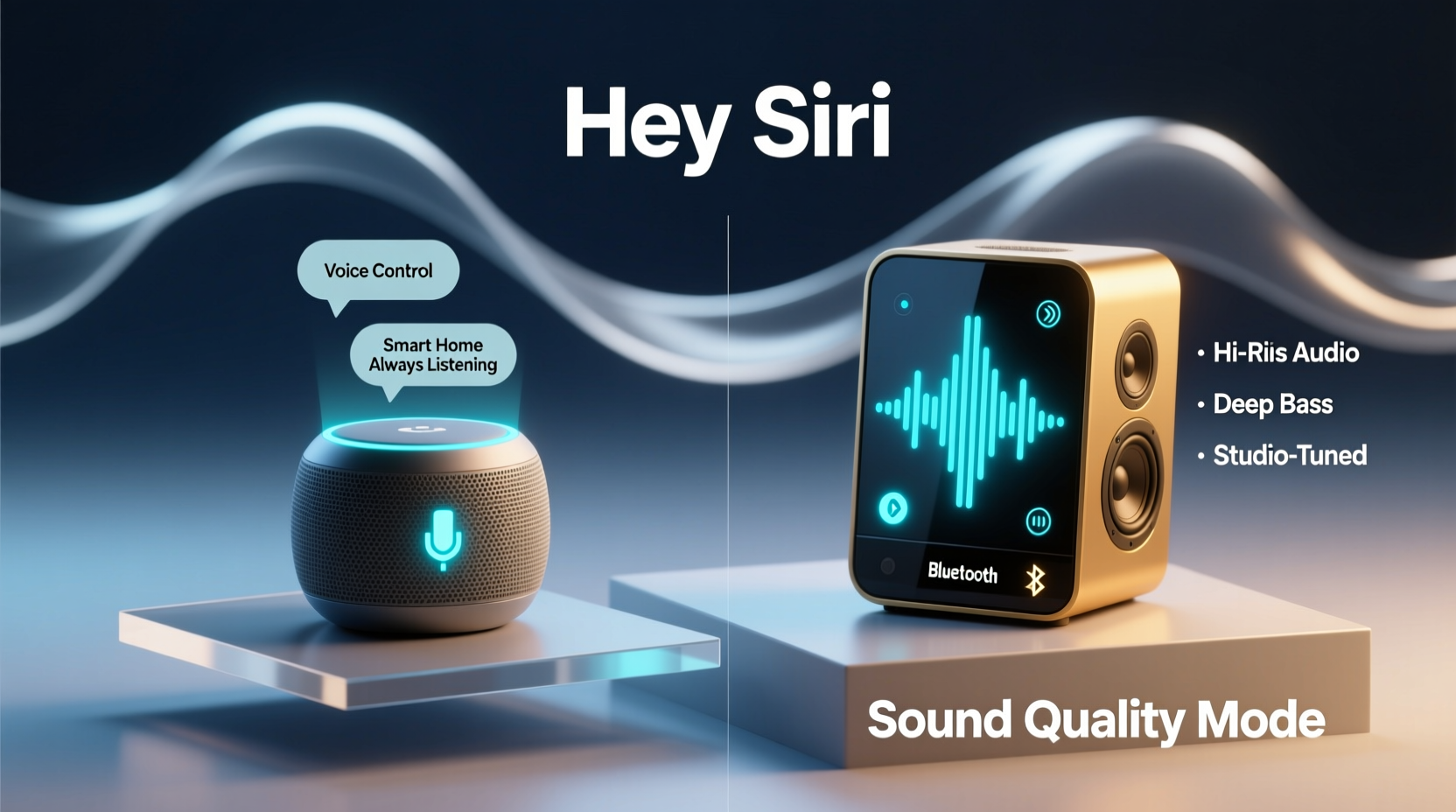
At their core, smart speakers and Bluetooth speakers serve overlapping but distinct purposes. Understanding their design philosophies helps clarify the trade-offs.
- Smart speakers prioritize connectivity, voice recognition, and ecosystem integration. They act as hubs for smart homes—controlling lights, thermostats, alarms, and streaming services through voice commands.
- Bluetooth speakers emphasize audio performance, battery life, and ruggedness. Many are waterproof, shock-resistant, and engineered for high-volume outdoor use.
This divergence leads to hardware compromises. Smart speakers typically include multiple microphones for far-field voice pickup, which takes up internal space that could otherwise be used for larger drivers or passive radiators. Conversely, dedicated Bluetooth speakers allocate more room to audio components, resulting in richer bass, clearer mids, and wider stereo separation.
“While smart speakers have improved dramatically in sound quality, they still lag behind premium Bluetooth models in dynamic range and clarity—especially at higher volumes.” — David Lin, Senior Audio Engineer at SoundLabs Research
Audio Quality: Where the Rubber Meets the Road
Sound quality isn’t just about volume; it’s about balance, detail, and spatial reproduction. Let’s break down key performance areas:
| Feature | Smart Speakers (e.g., Echo Studio) | Bluetooth Speakers (e.g., JBL PartyBox 310) |
|---|---|---|
| Bass Response | Moderate; enhanced via digital processing | Deep, physical bass with dedicated subwoofers |
| Midrange Clarity | Good for speech and podcasts | Excellent for vocals and instruments |
| Treble Definition | Adequate, sometimes harsh at high volumes | Crisp and detailed without sibilance |
| Max Volume & Distortion | Limited headroom; distortion above 70% | High output with minimal distortion |
| Stereo Imaging | Narrow; single-unit directional output | Wider soundstage, especially in dual-speaker setups |
If you listen primarily to podcasts, audiobooks, or background music while cooking or working, a smart speaker delivers more than enough sonic quality. But if you value immersive listening experiences—whether it’s live recordings, classical compositions, or bass-heavy electronic music—a high-end Bluetooth speaker will outperform even flagship smart speakers.
Convenience and Use Case Scenarios
Voice control adds tangible benefits in daily routines. Imagine setting timers while your hands are covered in flour, checking traffic before leaving work, or dimming lights without reaching for your phone. These conveniences make smart speakers ideal for kitchens, bedrooms, and home offices.
Bluetooth speakers, however, shine in environments where mobility and audio dominance matter: picnics, pool parties, camping trips, or backyard barbecues. Their lack of Wi-Fi dependency means they work anywhere—no router required.
Real Example: The Weekend Host dilemma
Consider Mark, who hosts weekly gatherings. He initially bought an Amazon Echo Studio for its “spatial audio” claims and Alexa integration. While guests appreciated being able to request songs by voice, many complained the music lacked punch during peak moments. After switching to a pair of JBL Xtreme 4s connected via Bluetooth, the energy changed instantly—fuller bass, louder output, and no dropouts. He now uses Alexa on a tablet for voice commands but relies on standalone speakers for playback.
This illustrates a growing trend: hybrid setups. Users keep smart speakers for control and information, but route actual music output to external, higher-fidelity Bluetooth systems.
Hybrid Solutions: Best of Both Worlds?
You don’t always have to choose. Many modern devices bridge the gap:
- Multi-room audio pairing: Link smart speakers across rooms using AirPlay 2, Chromecast, or Sonos compatibility.
- Bluetooth passthrough: Some smart speakers allow Bluetooth input from phones or tablets, letting you bypass voice-driven streaming when quality matters.
- Grouping with external speakers: Devices like the HomePod mini can act as controllers for larger, non-smart audio systems.
Additionally, platforms like Spotify Connect and Apple’s AirPlay let you initiate playback via voice command on a smart device, then seamlessly transfer audio to a higher-quality Bluetooth or wired speaker.
“Voice is the remote control, not the TV. It should start the experience—not limit it.” — Lena Park, UX Designer at AudioFlow Technologies
Checklist: Choosing the Right Speaker for Your Needs
Use this checklist to determine which type aligns best with your lifestyle:
- ✅ Do you frequently use voice assistants for tasks beyond music (alarms, weather, shopping)? → Favor smart speaker
- ✅ Is your primary use case music listening at high volume or critical listening? → Favor Bluetooth speaker
- ✅ Will the speaker be used outdoors or in wet environments? → Favor Bluetooth (IP-rated models)
- ✅ Do you already have a smart home ecosystem (lights, locks, cameras)? → Favor smart speaker
- ✅ Do you travel often or need long battery life? → Favor portable Bluetooth speaker
- ✅ Are you open to using multiple devices together? → Consider hybrid setup
FAQ
Can I connect a Bluetooth speaker to a smart speaker?
No, most smart speakers cannot act as Bluetooth transmitters to send audio to another speaker. However, you can pair a Bluetooth speaker directly with your smartphone or tablet and use voice commands on that device to control playback.
Do any smart speakers offer truly high-fidelity sound?
Yes—models like the Apple HomePod (2nd gen), Sonos One, and Amazon Echo Studio deliver impressive audio for their size, supporting lossless streaming, spatial audio, and room calibration. Still, they generally don’t match the raw power and clarity of top-tier standalone Bluetooth options.
Is Wi-Fi better than Bluetooth for audio quality?
Wi-Fi enables higher bandwidth, allowing lossless or high-bitrate streaming (e.g., Apple Lossless, Spotify Hi-Fi). Bluetooth traditionally uses compressed codecs (like SBC), though newer standards like LDAC and aptX Adaptive close the gap significantly.
Final Verdict: Is Voice Control Worth the Trade-Off?
For casual listeners and smart home enthusiasts, the convenience of voice control absolutely justifies a moderate dip in sound quality. Being able to ask for news updates, manage calendars, or control lights with a simple phrase adds real value to everyday life.
But for audiophiles, party hosts, or anyone who treats music as a centerpiece rather than background noise, sacrificing audio performance for voice features may feel like giving up too much. In these cases, a high-performance Bluetooth speaker—or a combination of both types—delivers a more satisfying experience.
The good news is that technology is converging. As voice processing becomes more efficient and compact, manufacturers are finding ways to pack better drivers into smart speakers without compromising microphone arrays. We’re moving toward a future where you won’t have to choose.




 浙公网安备
33010002000092号
浙公网安备
33010002000092号 浙B2-20120091-4
Comments
No comments yet. Why don't you start the discussion?