
In today’s hyper-connected world, mobile data is as essential as electricity. Whether you're streaming music during a commute, working remotely, or simply browsing social media, running out of data can disrupt your day—and inflating your bill shouldn’t be the price of staying online. The good news? You don’t need to pay premium rates for reliable connectivity. With the right approach, you can significantly increase your data allowance while keeping costs under control.
Many consumers unknowingly overpay due to outdated plans, lack of competition awareness, or failure to leverage promotions. By applying strategic habits and understanding how carriers operate, you can access more data at a fraction of the cost.
Understand Your Current Usage Patterns
Before making any changes, assess how much data you actually use. Most smartphones have built-in tools that track monthly usage. On iOS, go to Settings > Cellular; on Android, navigate to Network & Internet > Data Usage. Review this data over two to three billing cycles to identify trends.
You might discover you're consistently using only 5GB when you're paying for 15GB—or worse, you’re exceeding your limit and incurring overage fees. Either way, knowledge empowers better decisions.
If your usage fluctuates seasonally (e.g., higher during travel months), consider a flexible plan or one with rollover data. Some providers like T-Mobile and Verizon allow unused high-speed data to carry over to the next month, which adds long-term value.
Switch to a Value-Focused Carrier or MVNO
Major carriers aren't always the best deal. Mobile Virtual Network Operators (MVNOs) lease network access from giants like AT&T, Verizon, and T-Mobile but offer lower prices by cutting overhead and marketing costs. Many deliver comparable speeds and coverage at half the price.
| Carrier Type | Avg. Monthly Cost (10–20GB) | Network Quality | Best For |
|---|---|---|---|
| Major Carrier (Verizon, AT&T) | $70–$90 | Excellent | Power users needing max reliability |
| MVNO (Mint Mobile, Visible) | $15–$30 | Very Good | Budget-conscious users |
| Regional Carrier | $40–$60 | Good | Local users with strong regional coverage |
For example, Mint Mobile offers unlimited plans starting at $15/month when billed annually. Visible, owned by Verizon, provides nationwide 5G access for $25/month. These savings add up to hundreds per year—without sacrificing performance for most everyday tasks.
“Consumers who switch to an MVNO typically save between $400 and $600 annually without noticing a drop in service quality.” — James Reed, Telecom Analyst at Connect Insights
Leverage Promotions and Prepaid Plans
Carriers frequently run limited-time deals, especially around holidays or back-to-school seasons. These can include:
- Free months of service
- Doubled data for the first six months
- Discounts for bringing your own device
- Family plan incentives (e.g., “Get 4 lines for $40 each”)
Prepaid plans often come with better short-term flexibility. Instead of being locked into a two-year contract, you can test a provider for a month and leave if coverage is poor. Providers like Consumer Cellular and US Mobile let you customize data tiers down to the gigabyte, so you only pay for what you need.
Optimize Wi-Fi and Data-Saving Features
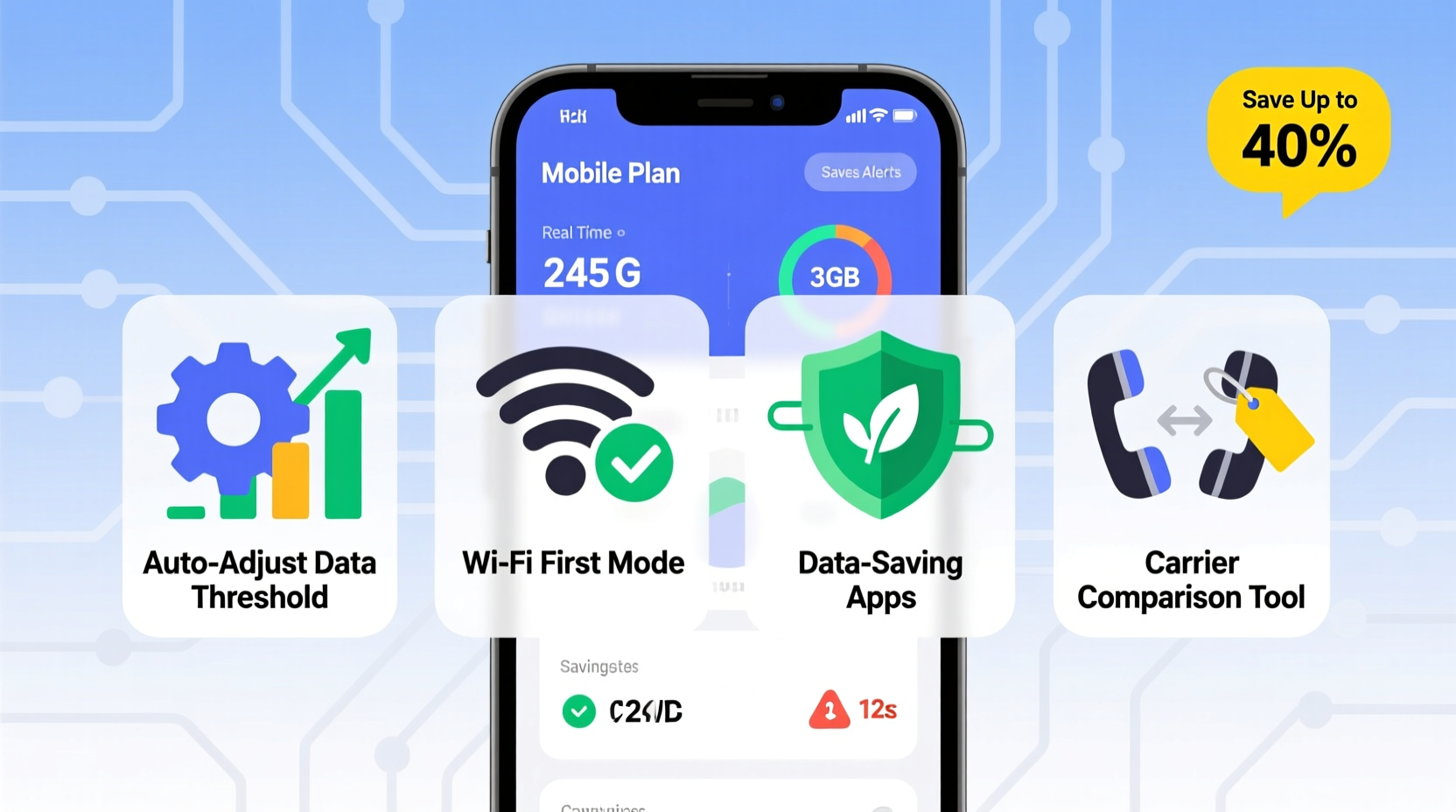
One of the smartest ways to stretch your data is to reduce reliance on it. Use Wi-Fi whenever available—at home, work, cafes, or public hotspots. Enable auto-connect to trusted networks and turn off mobile data when Wi-Fi is active.
Additionally, activate built-in data-saving modes:
- iOS: Settings > Cellular > Cellular Data Options > Data Mode (set to \"Low Data Mode\")
- Android: Settings > Network & Internet > Data Usage > Data Saver (turn on)
These settings restrict background app refresh, lower video streaming quality, and defer large downloads until connected to Wi-Fi. Streaming services like YouTube and Netflix also offer data-efficient playback options—set them manually to “Data Saver” mode.
Mini Case Study: How Sarah Cut Her Bill by 60%
Sarah, a freelance graphic designer in Denver, was paying $85/month for an unlimited AT&T plan. She used about 12GB monthly, mostly for cloud backups and Zoom calls. After researching MVNOs, she switched to Google Fi, which uses both T-Mobile and US Cellular networks. Her new plan costs $40/month for 15GB of high-speed data, with unlimited slower data after that.
She also enabled Wi-Fi assist on her tablet and scheduled large file syncs for nighttime, when her home internet is idle. Within three months, her phone data usage dropped to 8GB. She now has room to add a second line for her business tablet—all for less than her original single-line cost.
Step-by-Step Guide to Upgrading Your Plan Without Overspending
- Analyze your last 3 months of data usage via phone settings or carrier portal.
- List your priorities: speed, coverage, customer service, international roaming?
- Research MVNOs that use the same network as your current carrier for seamless transition.
- Compare promotional deals—especially those offering free months or discounted annual billing.
- Port your number during a weekend to minimize downtime.
- Test coverage in your regular locations (home, office, gym) over 1–2 weeks.
- Adjust settings to enable data saving and Wi-Fi priority.
- Monitor usage monthly and re-evaluate every 6 months.
- ✅ Check MVNO compatibility with your phone
- ✅ Confirm network coverage in your area
- ✅ Unlock your phone if needed
- ✅ Back up contacts and messages
- ✅ Note down account and PIN details for porting
- ✅ Cancel old plan only after new service is confirmed
Frequently Asked Questions
Can I keep my phone number when switching to an MVNO?
Yes, all carriers are required to allow number portability. Provide your number, account info, and PIN to the new provider—they’ll handle the transfer, usually within 24 hours.
Do MVNOs throttle data after a certain limit?
Some do, but policies vary. For example, Mint Mobile doesn’t throttle but reduces priority during congestion after 35GB. Visible slows video to 480p after 5GB on its cheapest plan. Always read the fine print on speed management.
Is prepaid less reliable than postpaid?
No. Prepaid plans use the same towers and infrastructure. Reliability depends on the underlying network (e.g., T-Mobile vs. AT&T), not the payment model. Customer support may be more limited, however.
Conclusion: Take Control of Your Data Spend
Overpaying for mobile data isn’t inevitable—it’s a habit. By auditing your usage, exploring affordable alternatives, and optimizing your device settings, you can gain more data for less money. The telecom market is more competitive than ever, giving consumers unprecedented power to choose wisely.
Don’t let inertia drain your wallet. A few hours of research and a simple number port could save you hundreds each year. Start today: pull up your last bill, check your actual usage, and explore one MVNO option. Small steps lead to big savings.




 浙公网安备
33010002000092号
浙公网安备
33010002000092号 浙B2-20120091-4
Comments
No comments yet. Why don't you start the discussion?