
Carrying everything you need in a compact backpack is both a challenge and an art. Whether you're a commuter, student, urban explorer, or minimalist traveler, the ability to pack efficiently without sacrificing access or comfort is essential. A small backpack limits volume but doesn’t have to limit functionality. With intentional organization, you can carry all your essentials—laptop, water bottle, snacks, jacket, notebook, and more—without clutter or frustration. The key lies not in how much you own, but in how thoughtfully you arrange it.
Assess Your Essentials: Know What You Really Need
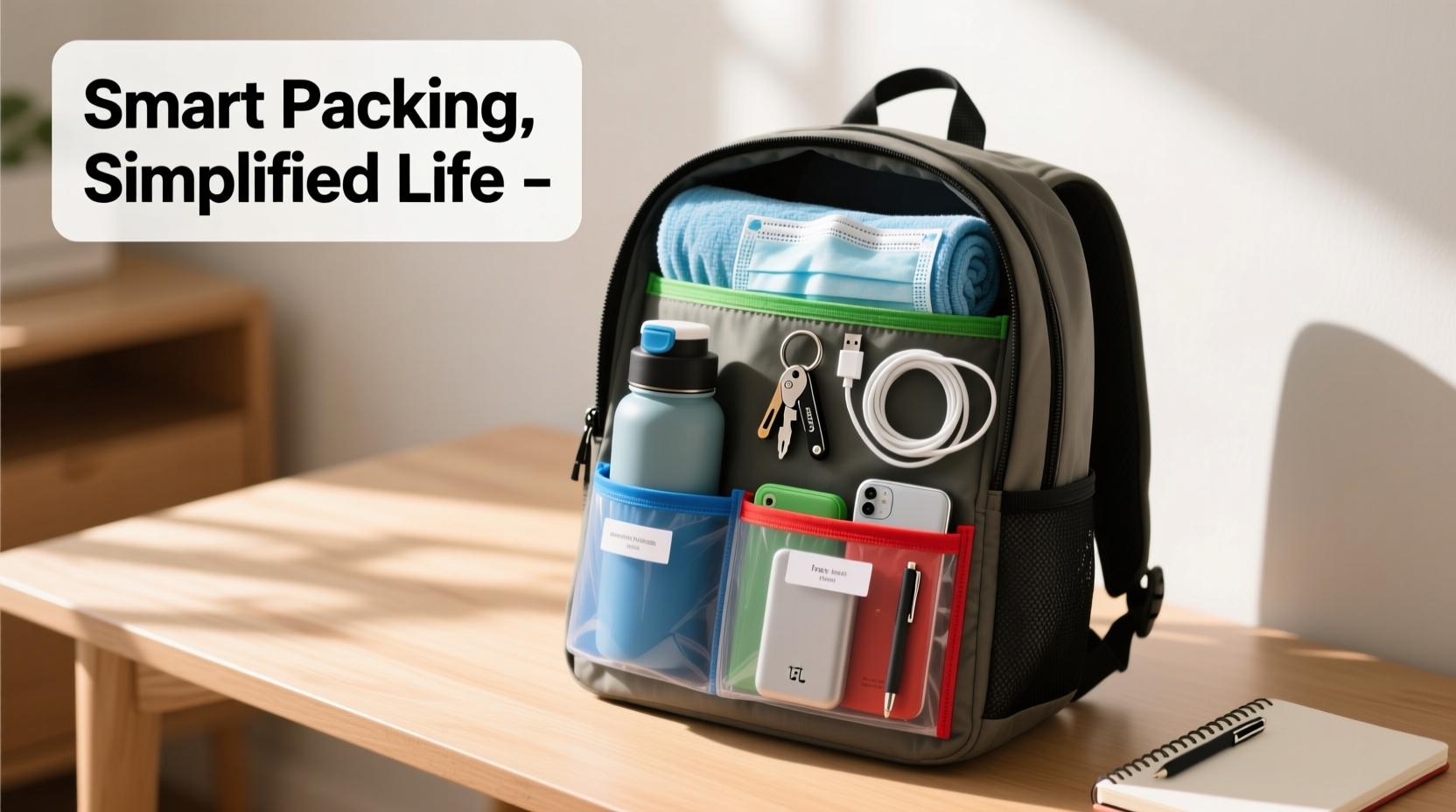
Before organizing, audit what you actually use. Most people overpack due to habit, not necessity. Begin by laying out everything you typically carry. Then, categorize each item: must-have, nice-to-have, and rarely used. Eliminate anything that doesn’t serve a clear purpose or hasn’t been used in the past two weeks.
For example, instead of carrying multiple pens, choose one reliable multi-function pen. Replace bulky notebooks with a slim pocket journal or digital note-taking app. This curation reduces weight and creates breathing room for smarter packing.
Use a Layered Packing System
Efficient organization follows a logical layering method, similar to how airlines load cargo: heavy items at the center, frequently accessed items near the top, and flat objects against the back panel for balance.
- Base Layer: Place heavier, less-accessed items like books, power banks, or extra layers flat at the bottom.
- Middle Layer: Position your laptop or tablet in its dedicated sleeve, centered close to your back for balanced weight distribution.
- Top Layer: Store daily-use items—wallet, keys, phone, sunglasses—in outer pockets for quick retrieval.
- Front & Side Pockets: Reserve for high-frequency tools: hand sanitizer, mask, transit card, or earbuds.
This system prevents digging, maintains posture, and ensures you’re not shifting weight unevenly—a common cause of shoulder strain.
Mini Case Study: The Urban Commuter’s Transformation
Jamal, a software developer in Chicago, used to carry a disorganized 20L backpack crammed with gadgets, snacks, gym clothes, and paperwork. He often arrived late because he couldn’t find his transit pass. After applying layered packing, he restructured his load: gym clothes rolled tightly and placed at the base, laptop in the middle, and a slim wallet in a zippered front pocket. He added a small pouch for earbuds and sanitizer. Within a week, his morning routine shortened by 12 minutes, and he reported reduced back discomfort. The change wasn’t in gear—it was in organization.
Invest in Space-Saving Accessories
Maximizing a small backpack isn't just about discipline—it's also about using smart tools. Compact organizers turn chaos into order. Consider these accessories:
- Compression cubes: Ideal for clothing or soft items; they reduce volume by up to 50%.
- Slip pockets: Thin, expandable sleeves for chargers, cables, or documents.
- Modular pouches: Zippered fabric containers labeled by function (e.g., “Tech,” “Snacks,” “Hygiene”).
- Roll-top dry bags: Water-resistant and collapsible, perfect for damp items like towels or rainwear.
These tools compartmentalize without adding bulk, making contents visible and accessible at a glance.
| Accessory | Best For | Space Saved |
|---|---|---|
| Compression Cube (Small) | T-shirts, socks, underwear | ~40% |
| Flat Cable Organizer | Chargers, USB cords | ~60% |
| Mini Pouch (3x5 in) | Earbuds, SIM tool, lip balm | ~30% |
| Roll-Top Dry Bag | Wet shoes, toiletries | Variable, up to 50% |
Adopt the One-In, One-Out Rule
To maintain efficiency, prevent gradual overfilling. Implement a personal rule: for every new item added to your backpack, remove one. This forces continuous evaluation and prevents accumulation creep—the slow build-up of unnecessary items.
For instance, if you add a portable coffee mug, remove a spare notebook or duplicate charger. This practice sustains balance and reinforces mindful consumption.
“Minimalism isn’t about owning less—it’s about making room for what matters. A well-organized backpack reflects clarity of purpose.” — Lena Torres, Productivity Coach and Author of *Lighter Days*
Create a Daily Setup Routine
Consistency beats improvisation. At the end of each day, reset your backpack for the next morning. Follow this step-by-step timeline:
- 8:00 PM: Empty all contents onto a clean surface.
- 8:10 PM: Wipe down interior with a microfiber cloth; check for crumbs or moisture.
- 8:15 PM: Recharge devices and return them to designated pouches.
- 8:20 PM: Restock consumables (tissues, hand wipes, reusable bag).
- 8:25 PM: Layer items using the system described earlier.
- 8:30 PM: Zip up and place near the exit door or by your keys.
This nightly ritual takes under 15 minutes and eliminates morning stress. Over time, it becomes automatic—like brushing your teeth.
Checklist: Backpack Reset Routine
- Empty all compartments
- Remove trash and unused items
- Wipe interior surfaces
- Charge all devices
- Refill hygiene kit (sanitizer, tissues)
- Repack using layered system
- Verify weather-appropriate items (umbrella, sunscreen)
- Place backpack in designated spot
Frequently Asked Questions
How do I keep my backpack from becoming unbalanced?
Distribute weight evenly along the vertical centerline. Always place heavy items (laptop, water bottle) close to your back and midway between shoulders and hips. Avoid loading one side more than the other. Use symmetrical pockets for equal-weight items like headphones and wallet.
Can I fit a lunch container in a small backpack?
Yes, but choose wisely. Use a slim, leak-proof bento box no larger than 6x4 inches. Place it in the main compartment against the back panel, ideally above the laptop sleeve to avoid pressure. Pair with a foldable silicone cup to save space. Avoid bulky insulated bags unless necessary.
What’s the best way to organize cables?
Use a flat cable organizer with elastic loops or a padded sleeve. Wrap each cable neatly and label them with colored tape (e.g., red for phone, blue for laptop). Alternatively, store them in a mini pouch with a Velcro strap to prevent tangling.
Final Thoughts: Mastery Through Simplicity
A small backpack is not a limitation—it’s an invitation to refine your priorities. When space is constrained, every item must earn its place. By applying layered packing, using smart accessories, maintaining a reset routine, and adhering to disciplined rules, you transform a simple bag into a finely tuned extension of your daily rhythm.
Efficiency isn’t achieved overnight. It grows through repetition and reflection. Try one strategy this week—perhaps the nightly reset or the one-in-one-out rule—and observe the difference. Small changes compound into significant gains in time, energy, and peace of mind.




 浙公网安备
33010002000092号
浙公网安备
33010002000092号 浙B2-20120091-4
Comments
No comments yet. Why don't you start the discussion?