
Heating and cooling account for nearly half of the average home’s energy use. For decades, homeowners relied on basic manual thermostats—simple dials that required physical adjustment and routine discipline. Today, smart thermostats promise to automate comfort and cut costs using learning algorithms, remote access, and occupancy detection. But with prices ranging from $100 to $250, a critical question emerges: does the learning feature in smart thermostats actually save money compared to a well-managed manual dial?
The answer isn’t as straightforward as marketing claims suggest. While many users report lower bills, others see minimal change—or even higher usage. The real cost savings depend on lifestyle, climate, home insulation, and how actively (or passively) the system is used. This article breaks down the technology, analyzes real-world data, and evaluates whether the intelligence behind smart thermostats delivers measurable financial returns.
How Smart Thermostats Work—and What “Learning” Really Means
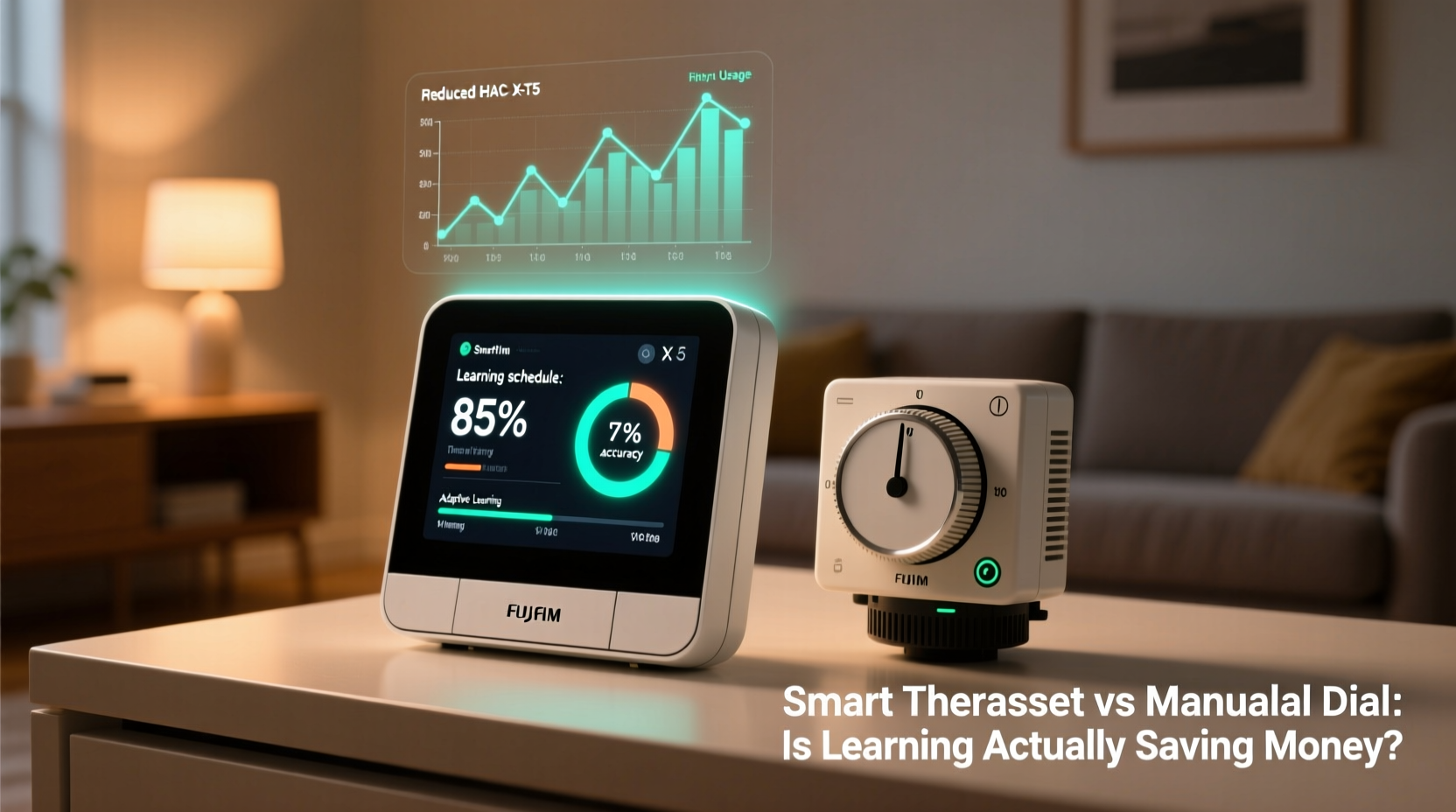
Unlike traditional thermostats that simply turn HVAC systems on or off at set temperatures, smart thermostats collect data to optimize performance. They use Wi-Fi connectivity, motion sensors, geofencing (via smartphone location), and machine learning to adjust settings based on patterns.
For example, a Nest Learning Thermostat observes when you adjust the temperature over several days. If you consistently lower the heat at 10 p.m., it begins to automate that action. Over time, it builds a schedule tailored to your household’s rhythm. Some models also factor in local weather forecasts and equipment runtime to prevent short cycling and improve efficiency.
However, “learning” doesn’t mean artificial intelligence making independent decisions. It’s pattern recognition—not intuition. The thermostat adapts only if users make consistent changes. If no adjustments are made, the system defaults to a generic schedule or remains static.
“Most smart thermostats don’t reduce energy by magic—they reduce waste caused by human inconsistency.” — Dr. Laura Simmons, Energy Efficiency Researcher at Rocky Mountain Institute
Manual Dial Thermostats: Simpler, But Demand Discipline
A manual dial thermostat offers full control but requires active management. To maximize savings, users must manually adjust temperatures based on occupancy, season, and daily routines. For instance, lowering the heat by 7–10°F for eight hours a day can reduce heating bills by up to 10% annually, according to the U.S. Department of Energy.
The challenge? Most people don’t do it consistently. Life gets busy. Vacations happen. Schedules shift. Without automation, the potential savings vanish. Studies show that only about 30% of households with manual thermostats actually implement effective setback strategies.
In contrast, programmable thermostats were introduced to solve this issue—but research from the Consumer Federation of America found that up to 50% of owners either didn’t program them or did so incorrectly. This gap in usability is where smart thermostats aim to deliver value: not just through technology, but through behavioral nudges and frictionless automation.
Do Smart Thermostats Actually Save Money? The Data Behind the Claims
Manufacturers often cite energy savings of 10–12% on heating and 15% on cooling. Google, which owns Nest, claims its Learning Thermostat saves users an average of 10–12% on heating and 15% on cooling. But independent studies reveal a more nuanced picture.
| Study / Source | Average Savings Claimed | Conditions & Limitations |
|---|---|---|
| Nest Customer Data (2011–2015) | 10–12% heating, 15% cooling | Self-reported; includes ideal-use cases |
| Lawrence Berkeley National Lab (2016) | ~8% heating, ~4% cooling | Real-world field study across diverse climates |
| Pacific Northwest National Laboratory (2018) | No net savings in some homes | Savings depended heavily on pre-existing habits |
| Consumer Reports (2020) | Up to $131/year in optimal conditions | Highly dependent on local energy rates and climate |
The data suggests that savings are real—but not universal. Homes with erratic schedules benefit most. Those already practicing disciplined setback routines may see little improvement. In fact, one study found that users who previously optimized their manual thermostats sometimes saw increased energy use after switching to smart models, likely due to over-reliance on automation or comfort creep (setting tighter tolerances because “the system will handle it”).
Real-World Example: Two Households, Two Outcomes
Consider two similar homes in suburban Chicago, both 2,000 sq ft with gas furnaces and central AC.
- Household A: A retired couple with fixed routines. They lowered the heat to 62°F every night and during weekday mornings. They used a manual dial and adjusted it twice daily. Their annual HVAC cost: $1,400.
- Household B: A young family with unpredictable schedules. Parents worked variable shifts, kids had after-school activities. They rarely adjusted the thermostat, leaving it at 70°F year-round. Annual HVAC cost: $2,100.
Both installed Nest Learning Thermostats.
After six months, Household A saw a $50 reduction—mostly from slight optimization of fan runtime and better humidity management. Their disciplined habits limited the room for improvement.
Household B, however, saved $320 annually. The thermostat learned when the house was empty and automatically set back temperatures by 8–10°F. Geofencing prevented premature heating when delays occurred. Remote access allowed adjustments during unexpected stays.
This case illustrates a key insight: smart thermostats shine not by being smarter than humans, but by compensating for human inconsistency. The greater the variability in routine, the higher the potential savings.
When Smart Thermostats Don’t Save—And May Even Cost More
Despite their promise, smart thermostats aren’t always economical. Several factors can negate or reverse expected savings:
- Comfort creep: Users may set narrower temperature bands (“I want it exactly 72°F”) because the system feels more precise, leading to more frequent cycling.
- Overriding automation: Frequent manual overrides teach the system conflicting patterns, reducing efficiency.
- Poor installation: Incorrect wiring or placement near heat sources (e.g., sunlight, appliances) leads to inaccurate readings.
- Short payback period expectations: At $130–$250 per unit, a $100 annual saving means a 1.3- to 2.5-year payback. In milder climates or efficient homes, payback can stretch to five years or more.
Additionally, rental properties or second homes with irregular occupancy may not allow enough data collection for learning features to activate effectively. In such cases, the premium paid for “smart” functionality delivers little added value.
Step-by-Step: How to Determine If a Smart Thermostat Will Save You Money
Before investing, assess your situation with this practical timeline:
- Track your current HVAC usage: Review 12 months of utility bills to establish a baseline. Note seasonal peaks and total annual cost.
- Assess your routine: Are your comings and goings predictable? Do you forget to adjust the temperature when leaving?
- Evaluate your home: Older, poorly insulated homes benefit more from setbacks. New, tight homes may see smaller gains.
- Calculate potential savings: Use the U.S. DOE estimate of 1% savings per degree setback over 8 hours. If you currently leave the heat at 70°F all day, dropping to 62°F during work hours could save ~8% on heating.
- Compare costs: Subtract estimated annual savings from the thermostat price. If it costs $180 and saves $90/year, break-even is two years.
- Test before committing: Try manually programming a schedule for one month. If you stick to it and save, a smart thermostat may offer only marginal improvement.
Checklist: Maximizing Savings with Any Thermostat
Whether you use a manual dial or a high-tech model, these practices boost efficiency:
- Set back temperatures when asleep or away (68°F down to 60–62°F in winter; 78°F up in summer)
- Maintain HVAC filters monthly during peak seasons
- Seal air leaks around windows and doors
- Use ceiling fans to enhance perceived comfort
- Ensure thermostat is placed away from direct sun or drafts
- Update outdated HVAC equipment (older than 15 years)
- Use humidity control—higher humidity feels warmer, lower feels cooler
FAQ
Can a smart thermostat save money in a mild climate?
Potential savings are smaller in regions with moderate temperatures, as HVAC systems run less frequently. However, if your schedule is irregular, automation can still prevent unnecessary cooling or heating. In places like San Diego or Portland, payback periods may exceed four years.
Do I need the learning feature, or is a basic smart thermostat enough?
If you’re comfortable setting a weekly schedule, a non-learning smart thermostat with remote access and energy reports (like Ecobee3 Lite or Honeywell Home T9) can deliver similar savings at a lower price. The learning feature mainly benefits those who dislike programming devices.
Are there rebates available for smart thermostats?
Yes—many utility companies offer $50–$100 rebates for installing ENERGY STAR-certified smart thermostats. Check programs through your provider or visit energystar.gov.
Conclusion: Intelligence That Pays—But Only Under the Right Conditions
The learning feature in smart thermostats isn’t a guaranteed money-saver. It’s a tool designed to correct inconsistent behavior, not replace sound energy practices. For households with chaotic routines, frequent travel, or a history of forgetting to adjust the temperature, the automation can yield meaningful reductions in energy bills—often paying for itself within two to three years.
But for disciplined users in well-insulated homes, the financial return may be negligible. In those cases, the convenience and remote control features become the primary benefit, not cost savings.
The real value lies in alignment: does the technology match your lifestyle? If you struggle with consistency, a learning thermostat acts as an invisible assistant, quietly trimming waste. If you already manage your system well, upgrading may be more about comfort than economy.




 浙公网安备
33010002000092号
浙公网安备
33010002000092号 浙B2-20120091-4
Comments
No comments yet. Why don't you start the discussion?