
Heating and cooling account for nearly half of the average home’s energy use. With energy prices rising and environmental concerns growing, homeowners are turning to smarter ways to manage their HVAC systems. Programmable thermostats have long been promoted as an efficient solution—set your schedule once, and let the device do the rest. But in recent years, smart thermostats with learning capabilities have entered the market, promising even greater savings through automation and artificial intelligence.
The question remains: does the “learning” feature of smart thermostats actually save more money than a well-programmed traditional model? Or is it just tech-driven marketing wrapped in convenience? To answer this, we need to examine how both types work, analyze real-world performance, consider user behavior, and evaluate long-term cost benefits.
How Programmable Thermostats Work—and Why They Often Fall Short
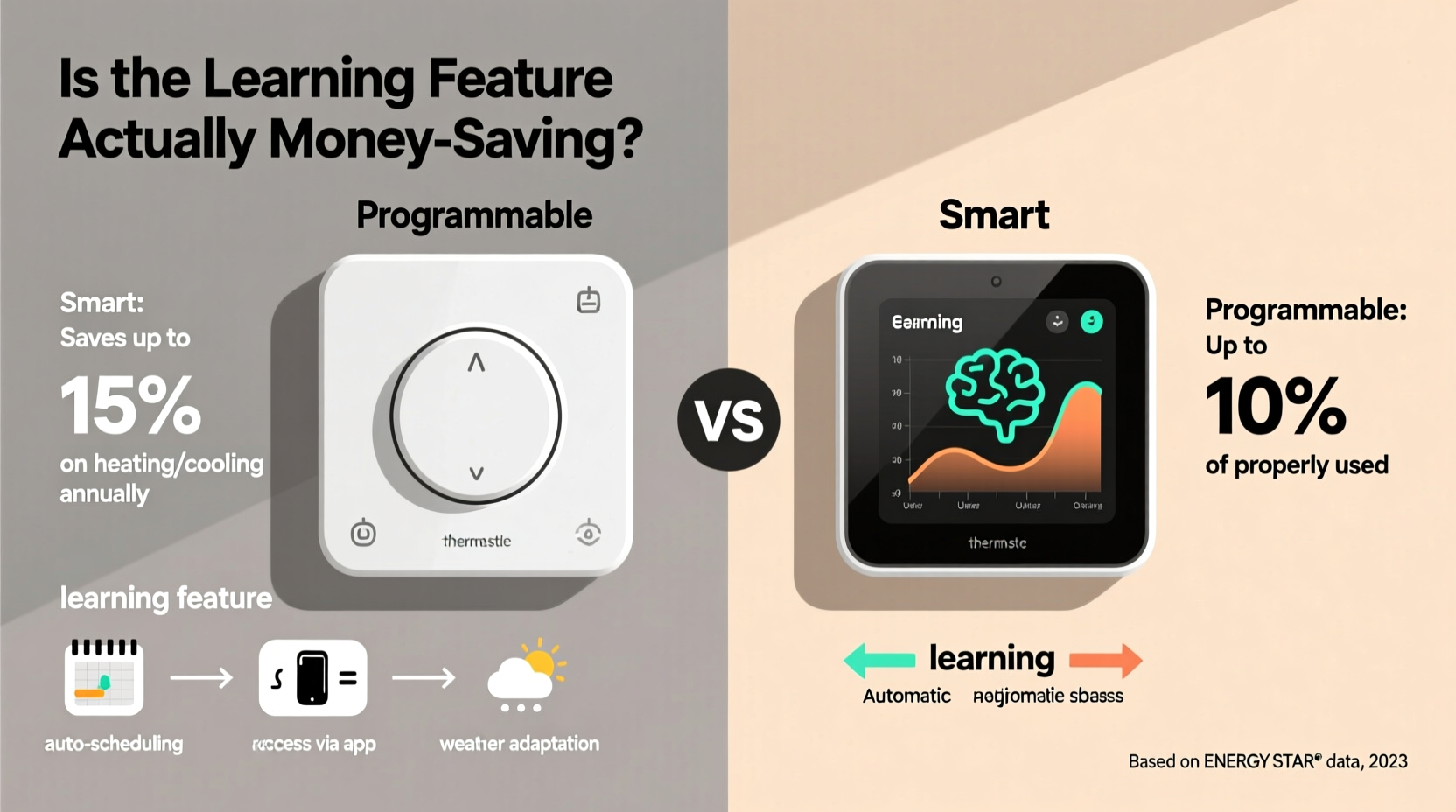
Programmable thermostats allow users to set temperature schedules based on time of day and day of the week. For example, you can program the system to lower the heat during work hours and warm up the house before you return. In theory, this reduces unnecessary heating or cooling when no one is home, leading to energy savings.
However, studies consistently show that many homeowners don’t use these devices effectively. According to the U.S. Department of Energy, only about 30% of programmable thermostats are properly programmed. The rest either remain on a default setting or are overridden frequently due to unpredictable routines.
A 2014 study by the National Bureau of Economic Research found that households with programmable thermostats saw no significant energy savings compared to those using manual thermostats—largely because users failed to maintain consistent programming.
Smart Thermostats: Learning Behavior for Optimal Efficiency
Smart thermostats like the Nest Learning Thermostat, Ecobee, and Honeywell T9 go beyond pre-set schedules. They use sensors, Wi-Fi connectivity, and machine learning algorithms to adapt to your lifestyle. Over time, they learn when you typically arrive home, when you sleep, and what temperatures you prefer in different conditions.
These devices also offer remote access via smartphone apps, geofencing (which detects when your phone leaves or approaches the house), and integration with voice assistants. Some models even provide energy usage reports and alert you to HVAC system issues.
The key difference lies in adaptability. While a programmable thermostat follows a rigid schedule, a smart thermostat adjusts dynamically. If you come home early from work, it can begin heating the house sooner. If you leave for vacation, it can enter an extended “away” mode automatically.
“Smart thermostats close the gap between intention and action. Most people want to save energy but forget to adjust settings. Learning technology removes that friction.” — Dr. Sarah Johnson, Energy Efficiency Researcher at the Rocky Mountain Institute
Do Smart Thermostats Actually Save More Money?
The answer depends on several factors: your climate, home insulation, HVAC system efficiency, and—most importantly—your lifestyle consistency.
Independent testing suggests that smart thermostats can deliver measurable savings, but the numbers vary. The EPA estimates that homeowners can save about 8% annually on heating and cooling costs—roughly $50 to $150 per year—with proper use of a smart thermostat. However, third-party studies paint a more nuanced picture.
- Nest claims its learning thermostat saves users an average of 10–12% on heating and 15% on cooling.
- A 2016 study by Energy Trust of Oregon found actual savings closer to 7–10%, with some users seeing no change or even increased usage due to over-reliance on comfort features.
- A 2020 report from Consumer Reports analyzed real-world data and concluded that while smart thermostats performed better than unprogrammed units, they only outperformed well-maintained programmable thermostats by about 3–5% in annual savings.
This suggests that the learning feature adds value—but not as much as advertised. The biggest gains occur in homes with irregular schedules or where occupants struggle with manual programming.
Case Study: The Martinez Family in Denver, Colorado
The Martinez family installed a Nest Learning Thermostat after years of using a basic programmable model. Both parents work variable shifts, and their two children have inconsistent after-school activities. Previously, they often returned to a cold house in winter or wasted energy heating an empty home.
Within two weeks, the Nest learned their patterns. It began adjusting temperatures based on arrival times detected through geofencing and motion sensors. When Mr. Martinez started working from home two days a week, the thermostat adapted without any input.
After one year, their utility bills showed a 14% reduction in HVAC-related energy use—about $180 saved annually. Their previous programmable thermostat had delivered only a 4% savings due to frequent overrides and forgotten adjustments.
In this case, the learning feature made a tangible difference—not because it was inherently superior, but because it accommodated a chaotic household schedule that resisted fixed programming.
Comparing Features: Smart vs. Programmable Thermostats
| Feature | Programmable Thermostat | Smart Thermostat |
|---|---|---|
| Temperature Scheduling | Yes – manual setup required | Yes – auto-schedules via learning |
| Remote Access | No | Yes – via app |
| Geofencing | No | Yes – adjusts based on phone location |
| Voice Control | No | Yes – compatible with Alexa, Google Assistant |
| Energy Usage Reports | No | Yes – monthly summaries and tips |
| HVAC Monitoring | No | Yes – alerts for system issues |
| Learning Capability | No | Yes – adapts to user behavior |
| Average Upfront Cost | $30–$70 | $100–$250 |
| Estimated Annual Savings | $40–$100 (if properly used) | $80–$150 (with learning optimization) |
When the Learning Feature Adds Real Value
The learning capability shines in specific scenarios:
- Irregular Schedules: Shift workers, remote employees, or families with unpredictable routines benefit most. A static schedule fails them; adaptive learning fills the gap.
- Multigenerational Homes: Where multiple people have conflicting comfort preferences, smart thermostats can balance usage based on occupancy patterns.
- Second Homes or Vacations: Geofencing ensures the house isn’t heated or cooled unnecessarily when unoccupied.
- Older HVAC Systems: Smart thermostats can detect short cycling or inefficient run times, prompting maintenance that prevents costly breakdowns.
Conversely, if your household follows a strict 9-to-5 routine, lives in a mild climate, or already optimizes a programmable thermostat effectively, the added intelligence may offer minimal financial return.
Step-by-Step Guide to Maximizing Savings with Either Type
Whether you choose a programmable or smart thermostat, follow this sequence to ensure optimal savings:
- Assess Your Routine (Week 1): Track when people are home, sleeping, and away. Note variations between weekdays and weekends.
- Set Baseline Temperatures: Aim for 68°F (20°C) when awake and at home; lower to 60–62°F (15–17°C) at night or when away. In summer, set cooling to 78°F (26°C) when present, higher when absent.
- Install and Configure: Mount the thermostat away from direct sunlight or drafts. Input your schedule (for programmable) or allow learning period (for smart models).
- Enable Away Modes: Use motion detection or geofencing to trigger energy-saving modes when the house is empty.
- Review Monthly Reports: Check energy dashboards (available on smart models) to identify inefficiencies or override patterns.
- Maintain Year-Round: Replace HVAC filters monthly, clean thermostat sensors quarterly, and recalibrate schedules with seasonal changes.
Common Misconceptions About Smart Thermostats
Despite their popularity, several myths persist:
- Myth: They pay for themselves in a year. Reality: At $100–$150 extra cost, breakeven takes 5–10 years unless combined with rebates.
- Myth: They always save energy. Reality: Some users increase comfort settings because they feel “automated,” negating savings.
- Myth: Installation is complicated. Most models are DIY-friendly, taking under 30 minutes with basic tools.
Additionally, privacy concerns exist—some smart thermostats collect detailed occupancy data. Always review privacy settings and disable non-essential tracking if desired.
Frequently Asked Questions
Can I save money with a programmable thermostat if I never change the schedule?
Only if your current schedule matches your actual lifestyle. If you frequently override it or deviate from the plan, savings will be negligible. Regular updates are essential for efficiency.
Do utility companies offer rebates for smart thermostats?
Yes, many electric and gas providers offer $50–$100 rebates for ENERGY STAR-certified smart thermostats. Check programs like Dominion Energy, PG&E, or Con Edison for eligibility.
Are smart thermostats worth it for renters?
They can be, especially if you move infrequently. Many models allow easy removal and reinstallation. Plus, improved comfort and lower bills benefit you directly, even if you don’t own the property.
Final Verdict: Is the Learning Feature Worth the Investment?
The learning feature of smart thermostats does lead to modestly higher energy savings—typically 3–8% more than a poorly used programmable model. However, compared to a well-managed programmable thermostat, the financial advantage narrows significantly.
Where smart thermostats truly excel is in usability and adaptation. They reduce the cognitive load of managing home temperature, which translates into sustained efficiency over time. For households with inconsistent routines, the learning function isn’t just convenient—it’s economically justified.
For others, a high-end programmable thermostat paired with disciplined habits can achieve similar results at a fraction of the cost. The key is consistency, not complexity.




 浙公网安备
33010002000092号
浙公网安备
33010002000092号 浙B2-20120091-4
Comments
No comments yet. Why don't you start the discussion?