
In an era where home automation is rapidly evolving, many homeowners are drawn to smart thermostats for their promise of convenience, energy savings, and climate control tailored to personal habits. However, one common pain point remains: reliance on a stable WiFi connection. Frequent disconnections, router outages, or spotty signals can disrupt functionality, leaving users frustrated when their “smart” device suddenly behaves like a dumb thermostat.
The good news? Not all smart thermostats require continuous internet access to deliver intelligent performance. A growing number of models are engineered with onboard learning algorithms and local processing power, allowing them to adapt to your daily routines even when disconnected from the web. These devices blend machine learning with offline resilience, offering both autonomy and reliability.
This guide explores how certain smart thermostats operate independently of constant WiFi, which models excel in this area, and why such independence matters for real-world usability, privacy, and long-term efficiency.
How Learning Thermostats Work Without Constant Internet
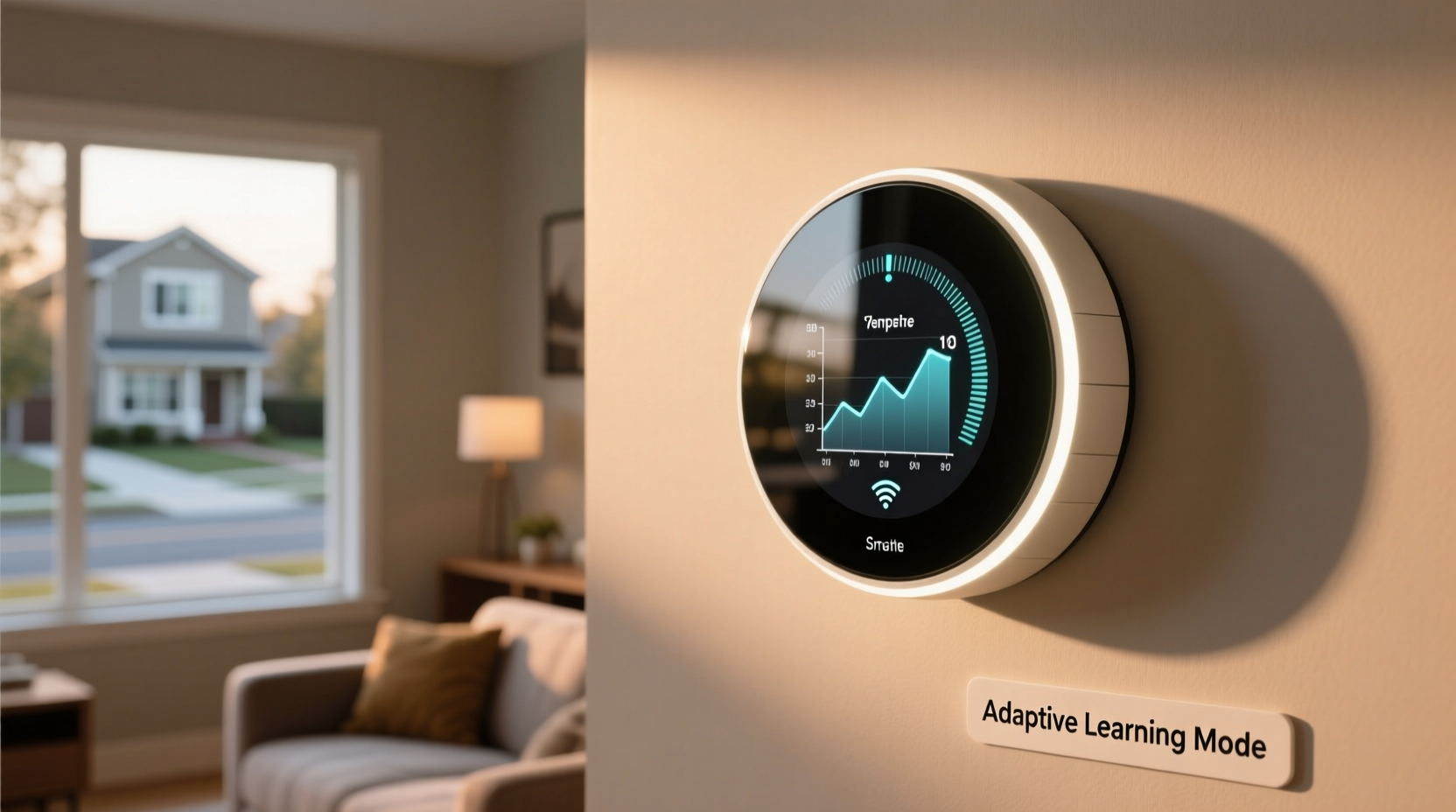
At first glance, it may seem counterintuitive: how can a device \"learn\" without being connected to the cloud? The answer lies in embedded intelligence. Modern smart thermostats equipped with onboard processors use local sensors and user interaction patterns to build behavioral models directly on the device.
These thermostats monitor several inputs over time:
- Temperature changes in different rooms
- Occupancy detection via motion or proximity
- Manual adjustments made by users (e.g., turning heat up at 7 a.m.)
- Daily timing patterns across weekdays vs. weekends
Using this data, the thermostat identifies recurring behaviors—like waking up at 6:30 a.m. during the week or lowering the temperature when no movement is detected for two hours. Once a pattern is recognized, the system creates a heating and cooling schedule autonomously. All of this computation happens locally, meaning no internet is required after initial setup.
“True smart home devices should work reliably even when the network fails. Local processing ensures functionality isn’t tied to a router’s uptime.” — Dr. Lena Torres, IoT Systems Engineer at GreenTech Labs
While WiFi is still useful for remote access via smartphone apps, software updates, and integration with voice assistants, it's not essential for core learning features in these advanced models. This design philosophy prioritizes function over connectivity, ensuring comfort isn't compromised during internet outages.
Top Smart Thermostats That Learn Offline
Not all smart thermostats offer robust offline capabilities. Below is a comparison of leading models known for maintaining intelligent operation without requiring persistent WiFi.
| Model | Learning Capability | Offline Operation | Remote Access | Setup Requirements |
|---|---|---|---|---|
| Nest Learning Thermostat (3rd Gen) | Yes – learns schedule in about a week | Fully functional offline once trained | Requires WiFi for app control | Initial WiFi setup needed |
| Ecobee SmartThermostat Premium | Yes – uses occupancy & routines | Maintains learned settings offline | Available only with active WiFi | WiFi + app setup required |
| Honeywell T9 TrueZone | Limited self-learning; relies on manual input | Operates normally offline | No learning without cloud sync | Works without WiFi but less adaptive |
| Emerson Sensi Touch Smart Thermostat | No automatic learning | Full operation offline | Basic scheduling only | No WiFi needed for basic functions |
| Wiser Air by Johnson Controls | Yes – adaptive scheduling via local AI | Full learning and adjustment offline | Optional for geofencing | Can be configured without internet |
Among these, the **Nest Learning Thermostat** stands out as the most proven solution for autonomous learning. After approximately seven days of user behavior observation, it establishes a reliable schedule that persists through WiFi dropouts. Similarly, the **Wiser Air** model emphasizes decentralized intelligence, making it ideal for homes with unreliable broadband.
Why WiFi Independence Matters
Reliance on internet connectivity introduces several risks that impact both usability and security. Devices that depend heavily on cloud servers may fail when connections falter, leading to uncomfortable indoor climates or unnecessary energy waste.
Consider the following scenarios:
- A storm knocks out your internet for 12 hours—your thermostat reverts to default settings, overheating the house.
- Your ISP performs maintenance overnight, disrupting communication between your phone and HVAC system.
- You're traveling and want to adjust the temperature remotely, but your home network goes down.
With a thermostat that operates intelligently offline, these situations become manageable. The device continues running the last known effective schedule, adjusting based on internal logic rather than waiting for external commands.
Beyond reliability, there are also privacy benefits. When data stays on-device instead of being uploaded to corporate servers, sensitive information about your daily routine remains protected. For users concerned about digital surveillance or data harvesting, locally processed learning offers peace of mind.
Setting Up a Self-Learning Thermostat Without Constant WiFi
Even though some thermostats need temporary internet for initial configuration, they don’t require ongoing connectivity to function intelligently. Follow this step-by-step process to maximize offline performance.
- Install the thermostat with temporary WiFi access. Connect your phone to the thermostat’s hotspot or use a neighbor’s network if yours is unstable.
- Complete the initial setup using the manufacturer’s app. Input your preferences, set basic temperatures, and enable occupancy sensing if available.
- Allow one full week of consistent usage. Maintain your regular wake-up, departure, return, and bedtime routines so the thermostat can detect patterns.
- Disable WiFi after training completes. On most models, you can disconnect the thermostat from WiFi while preserving its learned schedule.
- Monitor performance manually. Check weekly to ensure temperature shifts align with your habits. Make minor manual corrections if needed.
This approach works particularly well with the Nest thermostat, which stores learned behaviors in non-volatile memory. Even if power is lost or WiFi disabled, the schedule remains intact.
Mini Case Study: Off-Grid Living in Vermont
Mark and Sarah Thompson renovated a 19th-century farmhouse in rural Vermont, where broadband service is inconsistent. They installed a Nest Learning Thermostat during a brief window of satellite internet availability. Over the next ten days, they followed their normal winter routine—waking at 6:45 a.m., leaving for work by 8:30, returning around 5:15 p.m., and sleeping by 10 p.m.
By day eight, the thermostat had adjusted morning heat-ups to begin at 6:15 a.m. and reduced heating during midday. When their Starlink connection dropped for three days due to heavy snowfall, the system continued operating flawlessly, maintaining comfort without intervention. Manual overrides were rare, and energy bills decreased by 14% compared to the previous oil-based system.
\"We didn’t realize how much we depended on ‘set and forget’ until the internet went out,\" Mark said. \"But the Nest kept working exactly as it should. It felt like having a silent partner who knew our rhythm.\"
Key Features to Look For
When shopping for a smart thermostat that learns without constant WiFi, focus on these technical and functional traits:
- Onboard Machine Learning – Ensure the product explicitly states it learns locally, not just in the cloud.
- Non-Volatile Memory Storage – Learned schedules should persist through power outages or disconnections.
- Occupancy Sensors – Built-in motion or room sensors help detect presence without relying on phone location.
- Adaptive Recovery Mode – Automatically starts heating/cooling early to reach target temps on time, even offline.
- Manual Override Retention – Adjustments should influence future behavior, reinforcing personalized patterns.
Avoid models marketed as “smart” solely because they connect to Alexa or Google Home. True intelligence lies in adaptation, not connectivity.
FAQ
Can a smart thermostat learn my schedule if I never use WiFi?
Some models, like the Wiser Air, allow complete offline setup and learning. Others, including Nest, require initial WiFi for setup but can function independently afterward. Always check manufacturer specifications before purchase.
Will I lose my settings if the internet goes down?
No—if your thermostat has local processing capability. Devices like the Nest retain learned behaviors and continue executing the established schedule during outages. Only remote access is affected.
Do I need a C-wire for these thermostats to work properly?
Most self-learning thermostats perform best with a common (C) wire to ensure continuous power. Without one, battery drain or intermittent shutdowns could disrupt learning cycles. Some models include power-extending kits for C-wire-free installations.
Checklist: Choosing a WiFi-Resilient Smart Thermostat
- ✅ Verify local learning capabilities (not cloud-dependent)
- ✅ Confirm offline functionality is supported
- ✅ Check for built-in occupancy or motion sensors
- ✅ Review memory retention during power/internet loss
- ✅ Assess ease of manual override and feedback integration
- ✅ Evaluate compatibility with your HVAC system
- ✅ Determine whether remote access is essential for your lifestyle
Conclusion
Smart thermostats that learn your schedule without needing WiFi constantly represent the next evolution in home automation—where intelligence meets reliability. By leveraging local processing and adaptive algorithms, these devices offer seamless comfort regardless of internet stability. Whether you're in a remote cabin, an older home with spotty coverage, or simply value privacy and autonomy, choosing a resilient, self-sufficient thermostat makes practical sense.
The goal of smart technology shouldn’t be dependency, but empowerment. With the right device, your home learns you—not the other way around—and keeps functioning intelligently, even when the world goes offline.




 浙公网安备
33010002000092号
浙公网安备
33010002000092号 浙B2-20120091-4
Comments
No comments yet. Why don't you start the discussion?