
Choosing between a smartwatch and a fitness tracker isn't just about price or brand—it's about aligning technology with your personal objectives. Whether you're training for a marathon, managing stress, or simply trying to stay connected without checking your phone every five minutes, the right wearable can make a meaningful difference. While both devices track activity and monitor health metrics, their strengths diverge significantly when it comes to functionality, design, and long-term usability.
The confusion often stems from overlapping features. Many modern fitness trackers now include heart rate monitoring, sleep analysis, and even basic notifications. At the same time, high-end smartwatches have adopted advanced fitness sensors that rival dedicated trackers. But despite these convergences, each category excels in distinct areas. Understanding those differences allows you to invest wisely—based not on marketing hype, but on how well a device serves your actual daily life.
Core Differences: Design, Functionality, and Purpose
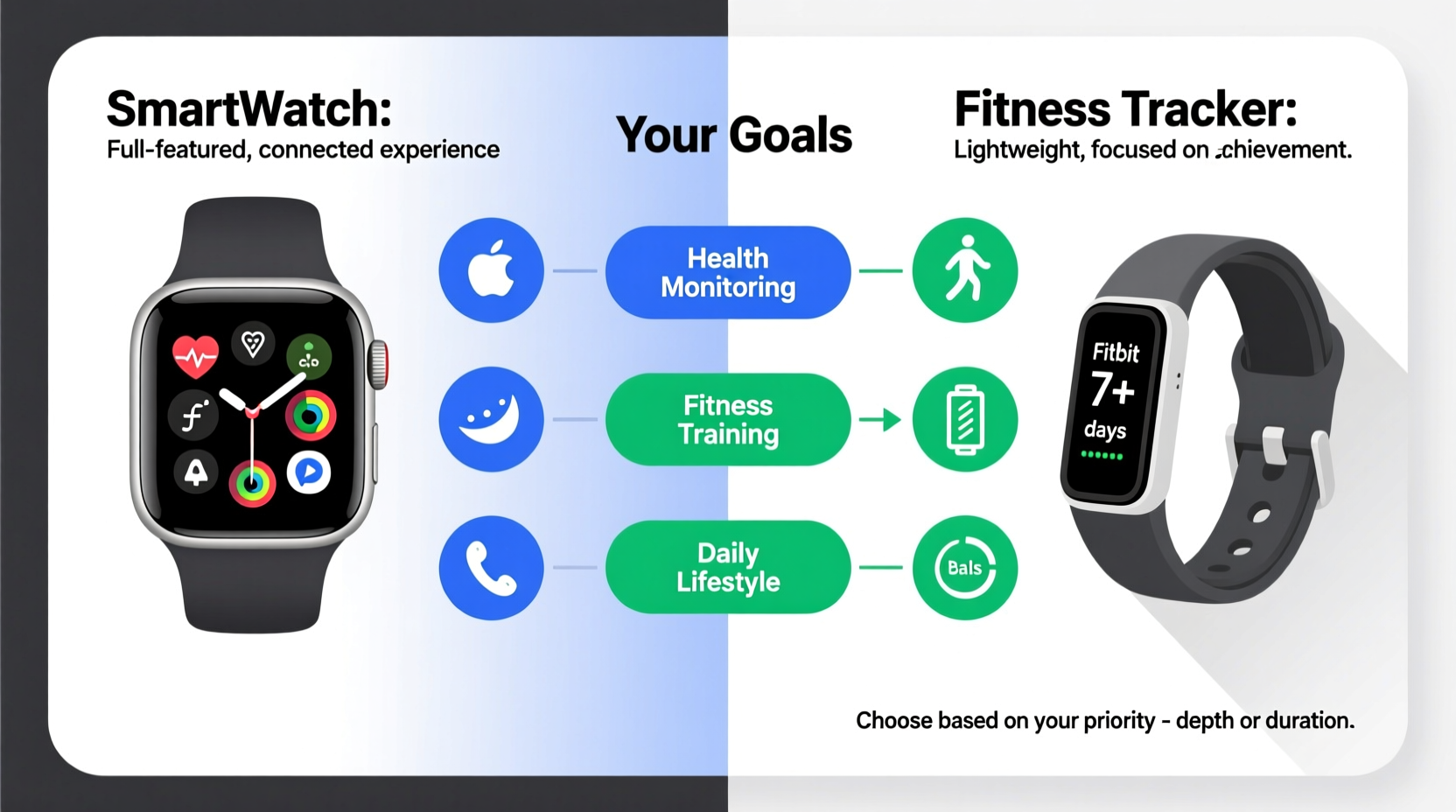
A fitness tracker is typically designed as a lightweight band focused primarily on health and activity tracking. It emphasizes battery life, comfort during extended wear (including while sleeping), and continuous biometric monitoring. Most models feature small monochrome or grayscale displays and prioritize simplicity over interactivity.
In contrast, a smartwatch functions more like a mini-computer on your wrist. With full-color touchscreens, app ecosystems, voice assistants, and cellular connectivity options, smartwatches offer robust digital integration. They allow users to reply to messages, control music, navigate using GPS, and even make payments—all without pulling out their phones.
These fundamental distinctions shape how each device performs across key use cases:
- Fitness tracking precision: Both track steps and heart rate, but depth of analysis varies.
- Battery longevity: Trackers last days or weeks; most smartwatches need daily charging.
- Daily utility: Smartwatches enhance productivity; trackers minimize distraction.
- Sleep monitoring: Due to lighter weight and longer battery life, trackers are often preferred for overnight use.
Where Fitness Trackers Shine: Health, Simplicity, and Endurance
Fitness trackers are purpose-built for one thing: monitoring your body’s response to movement, rest, and lifestyle patterns. Their streamlined design removes distractions so you can focus on consistency rather than constant interaction.
Modern trackers like the Fitbit Charge series or Garmin Vivosmart line deliver surprisingly sophisticated insights. These include:
- Continuous heart rate monitoring with resting HR trends
- Detailed sleep staging (light, deep, REM) with sleep score algorithms
- Stress tracking via HRV (heart rate variability)
- Menstrual cycle tracking and fertility predictions
- Automatic workout detection for common activities like walking, running, and swimming
Because they consume less power, fitness trackers often last 5–7 days on a single charge—some up to two weeks. This reliability ensures uninterrupted data collection, which is essential for identifying long-term health patterns. For someone aiming to improve sleep quality or manage chronic stress, consistent nighttime wear is non-negotiable.
“Accurate longitudinal health data requires continuity. Devices worn only sporadically miss crucial context.” — Dr. Lena Torres, Digital Health Researcher, Stanford Medicine
Fitness trackers also tend to be more affordable, making them accessible entry points into personal health tech. Entry-level models start under $50, while premium versions with built-in GPS hover around $150—still far below most smartwatches.
Real Example: Sarah’s Weight Loss Journey
Sarah, a 38-year-old teacher, wanted to lose 30 pounds and build sustainable habits. She chose a mid-tier fitness tracker because she didn’t want phone-like distractions. Over six months, she used her device to monitor daily step counts, track meals through synced apps, and analyze sleep efficiency.
The tracker’s silent alarm helped her wake up earlier without disturbing her partner. Weekly summaries showed correlations between poor sleep and increased cravings—insights that guided behavioral changes. By focusing on consistency and leveraging passive tracking, Sarah lost 28 pounds and improved her resting heart rate by 12 BPM.
She credits the device’s simplicity: “I never had to think about charging it, and I wasn’t tempted to scroll through notifications. It felt like a coach, not another screen.”
Smartwatches Excel in Connectivity, Customization, and Advanced Training
If your goals involve staying productive, navigating frequently, or engaging in structured athletic training, a smartwatch becomes far more valuable. Devices like the Apple Watch, Samsung Galaxy Watch, or Garmin Forerunner series integrate seamlessly with smartphones and offer rich feedback loops for performance optimization.
Key advantages include:
- On-wrist GPS: Accurate distance and pace tracking without carrying a phone.
- Advanced workout modes: Interval timers, elevation profiles, cadence, and VO₂ max estimates.
- Third-party apps: Integration with Strava, MyFitnessPal, Spotify, and meditation platforms.
- Real-time coaching: Audio cues during runs, breathing prompts during stress spikes.
- Contactless payments and transit passes: Useful for runners who prefer leaving phones behind.
For athletes or busy professionals, this level of integration reduces friction. Imagine finishing a morning run, glancing at your watch to see route mapping and heart rate zones, then hopping on a call with your team—all before your phone leaves your pocket.
Moreover, smartwatches provide richer contextual awareness. Notifications can be filtered to show only urgent messages, helping maintain focus while ensuring you don’t miss important updates. Some models even detect falls or irregular heart rhythms and alert emergency contacts automatically.
Case Study: James, the Marathon Trainer
James, an amateur runner preparing for his first marathon, needed precise pacing and terrain feedback. He invested in a GPS-enabled smartwatch with customizable dashboards. During training, he programmed interval alerts for tempo runs and reviewed post-run analytics including vertical oscillation and ground contact time—metrics unavailable on basic trackers.
When his resting heart rate rose unexpectedly over three consecutive days, the watch flagged potential overtraining. He adjusted his schedule accordingly, avoiding injury. On race day, he used offline maps and live elevation tracking to pace himself effectively on hilly sections.
“My old fitness band told me I walked 10K steps,” James said. “This watch tells me *how well* I moved—and that makes all the difference.”
Comparison Table: Key Features Side-by-Side
| Feature | Fitness Tracker | Smartwatch |
|---|---|---|
| Battery Life | 5–14 days | 1–3 days (up to 7 in power-saving mode) |
| Display Type | Small, low-power OLED or LCD | Full-color touchscreen (AMOLED/LTPS) |
| GPS Built-in | Rare (usually phone-dependent) | Common in mid-to-high-end models |
| Sleep Tracking Accuracy | High (optimized for comfort & duration) | Moderate to high (bulkier for some sleepers) |
| Heart Rate Monitoring | Good (continuous passive tracking) | Excellent (with enhanced sensor arrays) |
| Notifications & Apps | Limited (call/text alerts only) | Full ecosystem (apps, replies, payments) |
| Price Range | $50–$180 | $200–$800+ |
| Best For | Everyday health monitoring, weight management, sleep improvement | Athletes, tech-savvy users, multitaskers, frequent travelers |
Choosing Based on Your Goals: A Practical Checklist
Instead of defaulting to popular brands or peer recommendations, ask yourself what outcomes matter most. Use this checklist to clarify your priorities:
- I want to understand my overall health trends → Consider a fitness tracker with strong sleep and HRV reporting.
- I exercise regularly and want detailed performance feedback → Choose a smartwatch with GPS, training load metrics, and sport-specific modes.
- I struggle with phone addiction and want minimal distractions → A fitness tracker limits interruptions while still offering accountability.
- I travel often or commute without a bag → A smartwatch with NFC payments and navigation simplifies logistics.
- I need reminders for hydration, medication, or mindfulness → Smartwatches support customizable alerts and third-party wellness apps.
- I work night shifts or have irregular sleep patterns → Prioritize a lightweight tracker that won’t disrupt rest.
- I already own a smartphone I check constantly → Adding a smartwatch may increase screen time unnecessarily—opt for subtle nudges instead.
Frequently Asked Questions
Can a fitness tracker do everything a smartwatch can?
No. While some trackers offer limited notifications and music control, they lack full app ecosystems, voice assistants, and interactive interfaces. They’re optimized for passive monitoring, not active engagement.
Are smartwatches accurate for medical-grade readings?
Most consumer smartwatches provide clinically relevant estimates—not diagnostic-level precision. ECG and blood oxygen readings should inform discussions with healthcare providers but not replace professional testing.
Do I need both a smartwatch and a fitness tracker?
Generally, no. Using both creates redundant data and complicates syncing. Choose one primary device aligned with your dominant goal: health insight (tracker) or performance + connectivity (smartwatch).
Final Recommendation: Match Device to Lifestyle, Not Hype
The best wearable isn’t the one with the most features—it’s the one you’ll actually use consistently. A fitness tracker wins when your aim is holistic health improvement through steady, unobtrusive monitoring. Its endurance, comfort, and focused feedback loop foster lasting habit formation.
Conversely, a smartwatch proves its worth when you demand versatility: navigating cities, training rigorously, or managing a packed schedule. The ability to act directly from your wrist saves time and enhances situational awareness.
Technology should serve human goals, not complicate them. Before purchasing, define what success looks like for you. Is it lowering resting heart rate? Running a faster 5K? Reducing screen time? Improving sleep consistency? Each objective pairs better with a specific tool.
“The most effective wearable is invisible in its operation—present when needed, forgotten when not.” — Dr. Arun Patel, Human-Computer Interaction Lab, MIT
Take Action Today
Review your past month: How many times did you check your phone upon waking? Did you skip workouts due to poor planning? Have you noticed fatigue or disrupted sleep? Answer honestly, then revisit the checklist above.
Your ideal device should feel less like a gadget and more like an extension of your intentions. Whether you choose a minimalist tracker or a powerful smartwatch, let it amplify your efforts—not distract from them.




 浙公网安备
33010002000092号
浙公网安备
33010002000092号 浙B2-20120091-4
Comments
No comments yet. Why don't you start the discussion?