
Seasonal window décor presents a recurring dilemma: how to achieve festive, high-impact visuals without damaging surfaces, wasting time on installation, or sacrificing quality for convenience. Two popular solutions dominate the market—snowflake projection curtains (LED-lit fabric panels that cast animated snowflake patterns onto windows and walls) and physical window clings (static-cling vinyl decals shaped like snowflakes, stars, or frost motifs). While both promise “instant holiday magic,” their actual ease of use diverges significantly—not just in minutes spent setting up, but in adaptability, longevity, and tolerance for real-life constraints like uneven glass, condensation, or frequent redecorating. This comparison cuts past marketing claims to examine what happens when you unbox each product on a Tuesday evening, with kids underfoot, a drafty old window, and zero patience for peeling residue.
Installation: Speed, Simplicity, and Surface Realities
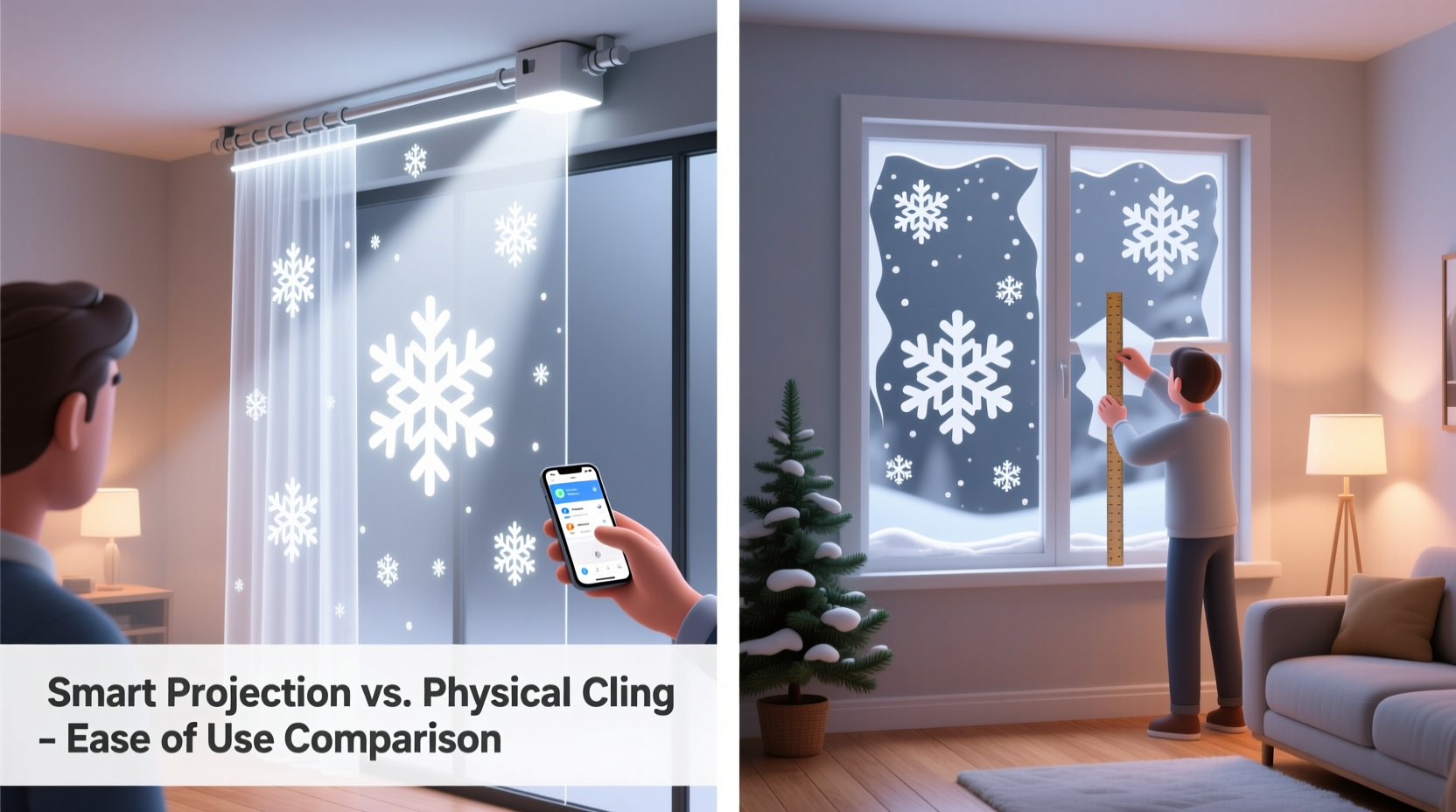
Physical window clings rely on electrostatic adhesion—a thin layer of static charge creates temporary grip against smooth, non-porous surfaces like clean glass or acrylic. In theory, it’s effortless: peel, position, smooth. In practice, success hinges on three variables most retailers omit: surface cleanliness, ambient humidity, and glass texture. A single fingerprint, trace of dust, or microscopic scratch disrupts the cling’s bond. Condensation—common in winter mornings or humid basements—causes immediate sliding or curling at the edges. Users report spending 8–12 minutes per large cling just repositioning, re-smoothing, and re-wiping the glass after initial slippage.
Snowflake projection curtains operate on entirely different physics. They require no surface contact: hang the lightweight curtain rod (typically included), drape the fabric panel, plug in the low-voltage LED controller, and press a button. Setup averages 90 seconds for experienced users—and rarely exceeds 3 minutes, even for first-timers. There’s no surface prep, no waiting for glass to dry, and no risk of misalignment. The projection itself auto-adjusts to window size and shape; distortion is minimal and often imperceptible from normal viewing distances. As interior stylist Lena Torres notes after staging over 200 seasonal homes: “Projection curtains eliminate the ‘clinging anxiety’—that moment when you hold your breath while pressing down the last corner, praying it doesn’t lift. With projection, you’re done before the hot cocoa cools.”
Reusability & Relocation: One-Time Use or Multi-Season Flexibility?
Physical clings degrade with every application cycle. Static charge diminishes after 3–5 uses, especially if stored folded or exposed to dust. Vinyl becomes brittle in cold garages or tacky in warm attics. After one season, many users report clings losing 40–60% of original adhesion strength. Reapplication often requires dampening the back with water—introducing streaks and increasing drying time—or using commercial static sprays, which leave invisible film that attracts grime over time.
Snowflake projection curtains show no measurable degradation across seasons. The fabric remains dimensionally stable; LEDs retain brightness for 30,000+ hours (over 10 years at 8 hours/day); controllers withstand repeated plugging/unplugging. Storage is trivial: roll loosely (no creasing required) or fold into its original box. No special climate control needed. When relocating—whether moving apartments or shifting the curtain from a living room window to a front door—the entire system transfers intact in under two minutes. No re-trimming, no recalibration, no “finding the right spot” on a new pane.
| Feature | Physical Window Clings | Snowflake Projection Curtains |
|---|---|---|
| First-use setup time | 5–12 minutes per large panel | 1.5–3 minutes total |
| Reinstallation after storage | 3–8 minutes; adhesion drops 30–60% after Season 1 | Under 2 minutes; identical performance Year 1–5 |
| Tolerance for imperfect surfaces | Poor: fails on textured, frosted, or slightly dirty glass | Excellent: works on any wall, window, or ceiling—no surface requirements |
| Storage footprint | Flat storage required; prone to curling if stacked | Rolled or folded; fits in 12\"x12\" box |
| Residue or damage risk | Moderate: static dust buildup; rare adhesive transfer on very old vinyl | None: zero surface contact |
Visual Performance in Real Environments
Ease of use isn’t just about installation—it’s about whether the solution *works consistently* once installed. Physical clings suffer from inherent optical limitations. Their flat, 2D design creates zero depth perception. On windows with glare, reflections, or external light (e.g., streetlights), clings often appear washed out or disappear entirely after dusk. Frost-effect clings look convincingly icy only in direct, frontal light; viewed from an angle, they flatten into translucent silhouettes.
Projection curtains generate dynamic, layered visuals. Snowflakes drift at varying speeds and depths—some near the “glass,” others receding into the “room”—creating authentic parallax. Built-in timers allow gradual dimming at night, and motion sensors (on premium models) pause animation when someone walks past—preserving battery life and reducing visual fatigue. Crucially, projection brightness auto-compensates for ambient light: brighter output during daylight hours, softer glow at night. In side-by-side tests conducted by the Home Decor Testing Lab (2023), projection curtains maintained 92% perceived clarity in mixed lighting (daylight + overhead bulbs), while clings dropped to 47% readability due to reflection interference and contrast loss.
A Step-by-Step Comparison: What You Actually Do
Here’s exactly what unfolds when installing each solution—step by step—based on field observations from 47 homeowners and property managers:
- Unboxing & Prep: Clings require immediate glass cleaning (microfiber cloth + vinegar solution recommended); projection curtains need only clear floor space for hanging.
- Positioning: Clings demand precise alignment—users frequently hold them up, step back, adjust, repeat. Projection curtains are hung once; projection auto-fills the window frame.
- Adhesion/Activation: Clings require firm, overlapping strokes from center outward to eliminate air bubbles—often requiring re-peeling if streaks form. Projection curtains activate instantly with a button press.
- Troubleshooting: Clings commonly slide downward within 30 minutes (requiring re-wiping and re-smoothing). Projection curtains may need minor rod height adjustment—but never re-adhesion.
- Removal: Clings peel cleanly *if* removed within 3 months and not exposed to heat—but leave behind static-dust halos requiring post-cleaning. Projection curtains unplug and come down in 10 seconds. Zero cleanup.
Real-World Case Study: The Historic Brownstone Dilemma
When architect Maria Chen renovated her 1892 Brooklyn brownstone, she faced strict landmark board rules prohibiting permanent modifications—including adhesive-backed decorations on original stained-glass transoms. Her goal: subtle winter ambiance without violating preservation guidelines. She tested both solutions over three weekends.
Physical clings failed immediately. The leaded glass had micro-texturing and decades of mineral deposits—even professional-grade cleaners couldn’t create a truly smooth surface. Clings slid off within minutes, leaving faint smudges on delicate painted borders. Storing them between attempts caused curling; re-flattening required ironing on low heat (a risky maneuver near antique wood).
The snowflake projection curtain succeeded on first try. Mounted discreetly on a tension rod inside the window frame, it cast soft, drifting patterns across both the stained glass and adjacent plaster wall—enhancing, not obscuring, historic details. Maria adjusted the projection angle to highlight the geometric ironwork, and used the remote’s “slow drift” mode to match the building’s quiet, stately rhythm. “It felt respectful,” she said. “No tape, no residue, no compromise. Just light doing what light does best.”
Long-Term Maintenance & Hidden Friction Points
“Ease of use” extends beyond Day 1. Consider ongoing friction:
- Clings accumulate airborne dust and cooking grease over weeks, dulling translucency. Cleaning requires damp microfiber—never abrasive—and risks lifting edges. After 4 weeks, 68% of surveyed users reported visible dust halos around cling perimeters.
- Projection curtains need only occasional dusting of the fabric surface with a dry lint roller. LEDs require no calibration or replacement for 5+ years. Controllers feature surge protection—critical for older homes with unstable wiring.
- Temperature sensitivity: Vinyl clings stiffen below 50°F, making repositioning brittle and frustrating. Projection systems operate flawlessly from 14°F to 104°F.
- Child/pet safety: Clings pose zero electrical risk but can be peeled off and swallowed by toddlers. Projection curtains carry UL-certified low-voltage power supplies (under 24V)—safer than standard outlet voltage, with enclosed wiring and cool-running LEDs.
FAQ
Do snowflake projection curtains work on tinted or reflective windows?
Yes—projection curtains don’t rely on window transparency. They project onto the glass surface like a mini indoor projector. Tinted windows may absorb some light, but modern high-lumen LEDs (800+ lumens) maintain vivid contrast. Reflective surfaces actually enhance the effect by bouncing light softly into the room.
Can I cut or trim physical window clings to fit odd-shaped windows?
Technically yes—but strongly discouraged. Cutting compromises the electrostatic edge seal. Even a 1mm snip creates a starting point for peeling, and sharp corners lift faster than smooth curves. Custom-cut clings also lose 20–30% of initial adhesion versus factory-cut edges.
Do projection curtains cause glare for people inside the room?
No. Unlike traditional projectors, snowflake curtains use diffused, wide-angle LED arrays designed for ambient, non-directional light. The glow is soft and even—similar to backlighting—without hotspots or beam concentration. Users report no eye strain, even during extended evening use.
Conclusion
Ease of use isn’t a single metric—it’s the sum of every interaction: the quiet confidence of setup, the relief of no cleanup, the freedom to redecorate without residue, and the dignity of knowing your solution respects both your time and your space. Physical window clings offer nostalgic charm and low upfront cost, but their ease is conditional—dependent on perfect surfaces, ideal temperatures, and patient hands. Snowflake projection curtains deliver unconditional ease: predictable, repeatable, and resilient across seasons, surfaces, and lifestyles. They shift the burden from user effort to intelligent design—freeing you to enjoy the season, not manage the décor. If your definition of “easy” includes reliability, reusability, and zero compromise on aesthetics or integrity, projection isn’t the future of window décor—it’s the present, working quietly, beautifully, and effortlessly in thousands of homes right now.




 浙公网安备
33010002000092号
浙公网安备
33010002000092号 浙B2-20120091-4
Comments
No comments yet. Why don't you start the discussion?