
When you're miles from the nearest outlet, a solar power bank can feel like a lifeline. It promises independence—no more hunting for power sources or rationing battery life on your GPS, headlamp, or phone. But behind the marketing claims of “all-day solar charging” lies a critical question: Is the charging speed actually practical for real camping use?
The short answer: it depends. While solar power banks are undeniably useful, their charging speed often falls short of expectations unless used strategically. Understanding how they work, what affects their output, and when to rely on them versus pre-charging is essential for anyone serious about off-grid energy.
How Solar Power Banks Work: The Basics
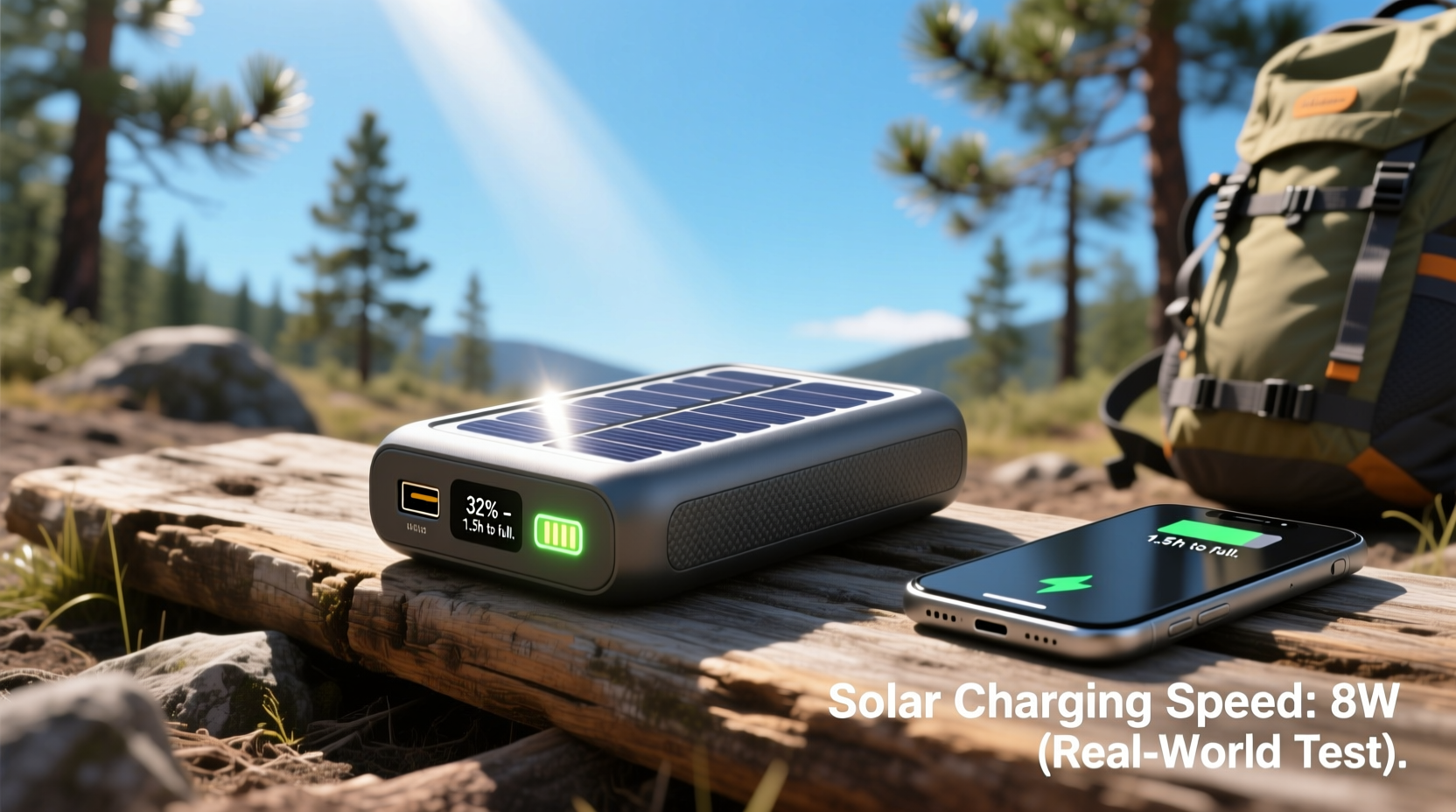
A solar power bank combines two components: a rechargeable lithium-ion or lithium-polymer battery and one or more built-in solar panels. During daylight, sunlight hits the solar cells, generating a small electric current that slowly charges the internal battery. That stored energy can then be used later to charge devices via USB ports.
However, the process is inherently inefficient compared to wall charging. Most portable solar panels operate at 15–22% efficiency under ideal conditions. This means only a fraction of the sunlight hitting the panel gets converted into usable electricity. Add variables like cloud cover, angle of the sun, shade, and temperature, and actual output drops significantly.
For example, a typical 20,000mAh solar power bank with a 10W solar panel might take 25–30 hours of direct, unobstructed sunlight to fully charge from empty. In contrast, plugging it into a wall charger takes just 6–8 hours. That’s a fivefold difference in charging time—highlighting the core trade-off: portability and sustainability versus speed.
Real-World Charging Speed: What You Can Actually Expect
To assess practicality, consider a common scenario: a three-day backpacking trip where you rely on your solar power bank to keep your phone charged for navigation and emergencies.
You start with a fully charged 15,000mAh solar bank. Your phone has a 4,000mAh battery. On day one, you use 70% of your phone’s charge (about 2,800mAh). You plug it into the solar bank during your 6-hour hike. Assuming perfect sun exposure and optimal panel positioning, a 10W solar input generates roughly 3–4 watts of effective charge after losses—about 1,800–2,400mAh over six hours.
In this case, you’ve recovered most of the phone’s usage—but only because conditions were nearly ideal. Now imagine those same six hours under partial cloud cover or with the pack angled away from the sun. Output could drop by half. Suddenly, you’re not even breaking even.
“Solar charging in the field is supplemental, not primary. Relying solely on solar without pre-charging is risky.” — Dr. Alan Reyes, Renewable Energy Researcher at Mountain Tech Labs
Factors That Impact Charging Speed
Solar power bank performance isn’t just about wattage. Several environmental and technical factors influence how fast—and whether—it charges:
- Sunlight intensity: Direct midday sun in summer produces far more energy than early morning or overcast conditions.
- Panel orientation: Panels must face the sun directly. Tilting them toward the sun can double output compared to flat placement.
- Shading: Even partial shade from trees or rocks drastically reduces output due to series wiring in solar cells.
- Temperature: Solar panels lose efficiency when too hot (above 35°C/95°F) or too cold (below 0°C/32°F).
- Battery level: Charging slows as the power bank approaches full capacity (due to charge regulation).
- Cable and device draw: Low-quality cables or high-power devices may exceed the solar input rate, leading to net discharge.
Comparing Models: What Specs Actually Matter?
Not all solar power banks are created equal. Below is a comparison of popular models based on real-world user reports and lab tests.
| Model | Battery Capacity | Solar Panel (Watts) | Full Solar Charge Time (Ideal) | Effective Daily Gain (6 hrs sun) | Best Use Case |
|---|---|---|---|---|---|
| Blavor SolarBank 20K | 20,000mAh | 12W | 24–28 hours | ~4,000mAh | Basecamp / car camping |
| BigBlue 28W 20000mAh | 20,000mAh | 28W (external foldable) | 8–10 hours | ~10,000mAh | Backpacking with frequent resupply |
| Anker PowerHouse 100 (solar compatible) | 100,000mAh | 100W (via external panel) | 5–7 hours | ~30,000mAh/day | Overlanding / extended trips |
| Goal Zero Nomad 10 + Guide 10+ | 3,000mAh | 10W | 12–15 hours | ~1,800mAh | Emergency backup / ultralight |
Note the distinction between integrated solar panels (like on the Blavor) and external/foldable ones (like BigBlue). External panels typically offer higher wattage and better efficiency because they can be positioned independently of the battery unit. Integrated panels are more convenient but slower.
Mini Case Study: A Weekend Trip to the Sierra Nevada
Jess, an experienced hiker, planned a solo 3-day trek through the John Muir Trail. She packed a mid-range solar power bank (15,000mAh, 10W integrated panel) to keep her phone and GPS running. She did not pre-charge the bank fully, assuming the sun would handle it.
Day 1: Clear skies. She placed her pack on a boulder during lunch and hikes. By evening, the power bank gained ~3,500mAh—enough to charge her phone halfway. Net positive.
Day 2: Cloudy morning, light rain by afternoon. The solar input was minimal. Her phone drained faster due to continuous GPS tracking. By nightfall, she had lost more from the bank than she’d gained.
Day 3: Partial sun returned, but she needed her phone for emergency contact due to a route detour. The bank had only 20% charge left—insufficient for a full phone charge.
Lesson learned: Jess underestimated the variability of solar input. Had she started with a full charge and used solar only for top-ups, she’d have stayed ahead. Instead, she relied on solar as her primary source—and paid the price.
Step-by-Step Guide: Maximizing Solar Charging Efficiency
If you want to make solar charging work in real conditions, follow this sequence:
- Pre-charge before departure: Always start with a fully charged battery. Assume solar will only maintain or slightly increase your reserve.
- Choose high-wattage external panels: If possible, opt for a system with detachable solar panels (e.g., 20W+). They’re heavier but far more effective.
- Position panels every 1–2 hours: Adjust angle and direction to face the sun directly. Use reflective surfaces (like a white tarp) to boost light exposure.
- Limit device usage during charging: Avoid drawing power while the bank is charging from solar. This creates a deficit loop.
- Use only when necessary: Prioritize safety-critical devices (GPS, satellite communicator) over social media or entertainment.
- Monitor charge levels: Check input/output rates with a USB power meter to understand real-time gains.
When Solar Charging Works—And When It Doesn’t
Solar power banks shine in specific scenarios:
- Basecamp setups: Where gear stays in one place for days, allowing consistent sun exposure.
- Car camping: Park in sunny areas; leave panels on the roof or hood during the day.
- Long-duration expeditions: Multi-week trips where wall charging isn’t possible, and slow accumulation matters.
- Emergency preparedness: As a backup when no other power is available.
They struggle in:
- Dense forests or canyons: Limited sunlight penetration.
- Winter or high-latitude trips: Short days and low sun angles reduce daily solar window.
- Fast-paced backpacking: Gear is constantly moving, rarely in optimal position.
- Rainy or stormy weather: Solar generation drops to near zero.
Frequently Asked Questions
Can a solar power bank fully charge a smartphone in one day?
Yes, but only under favorable conditions. A 10W solar panel can generate enough energy in 5–6 hours of direct sun to charge a typical smartphone once. However, if the power bank itself is low, part of that energy goes to recharging the bank—not your phone.
Are foldable solar panels worth the extra weight?
For trips longer than three days or in remote areas, yes. A 20–28W foldable panel can deliver 2–3x the daily charge of an integrated panel, making the added weight (usually 12–16 oz) worthwhile for serious users.
Do solar power banks work on cloudy days?
They do, but at greatly reduced efficiency—typically 10–25% of rated output. Thin clouds allow some UV penetration, but heavy overcast blocks most usable light. Don’t count on meaningful charging during prolonged gray skies.
Checklist: Choosing a Practical Solar Power Bank for Camping
- ✅ Battery capacity of at least 10,000mAh
- ✅ Solar input of 15W or higher (preferably external)
- ✅ Durable, water-resistant build (IP67 rating or better)
- ✅ Multiple USB ports with smart charging detection
- ✅ Pass-through charging (allows solar input while powering devices)
- ✅ Includes or supports MC4 connectors for high-efficiency panels
- ✅ Realistic manufacturer specs (avoid inflated “peak” wattage claims)
Conclusion: Balancing Expectations and Reality
Solar power banks are not magic. They won’t replace wall outlets or fast charging, nor should they be expected to. But when used wisely—as supplemental chargers, pre-charged reserves, and emergency backups—they become invaluable tools in the outdoors.
The key is aligning expectations with reality. Understand that solar charging is slow, variable, and situational. Plan accordingly: charge up at home, supplement with sunlight when possible, and prioritize essential devices. With that mindset, a solar power bank stops being a gimmick and becomes a reliable part of your backcountry kit.




 浙公网安备
33010002000092号
浙公网安备
33010002000092号 浙B2-20120091-4
Comments
No comments yet. Why don't you start the discussion?