
Choosing a soundbar often comes down to balancing performance, ecosystem compatibility, and long-term value. The Sonos Beam (Gen 2) and the Samsung HW-S60B represent two distinct approaches: one built around seamless multi-room integration and premium audio design, the other focused on delivering strong Dolby Atmos performance at a competitive price. While both enhance TV audio significantly over built-in speakers, the decision hinges on more than just sound quality. It’s about how you use your home entertainment system, what smart features matter to you, and whether future-proofing is a priority.
Sound Quality and Audio Performance
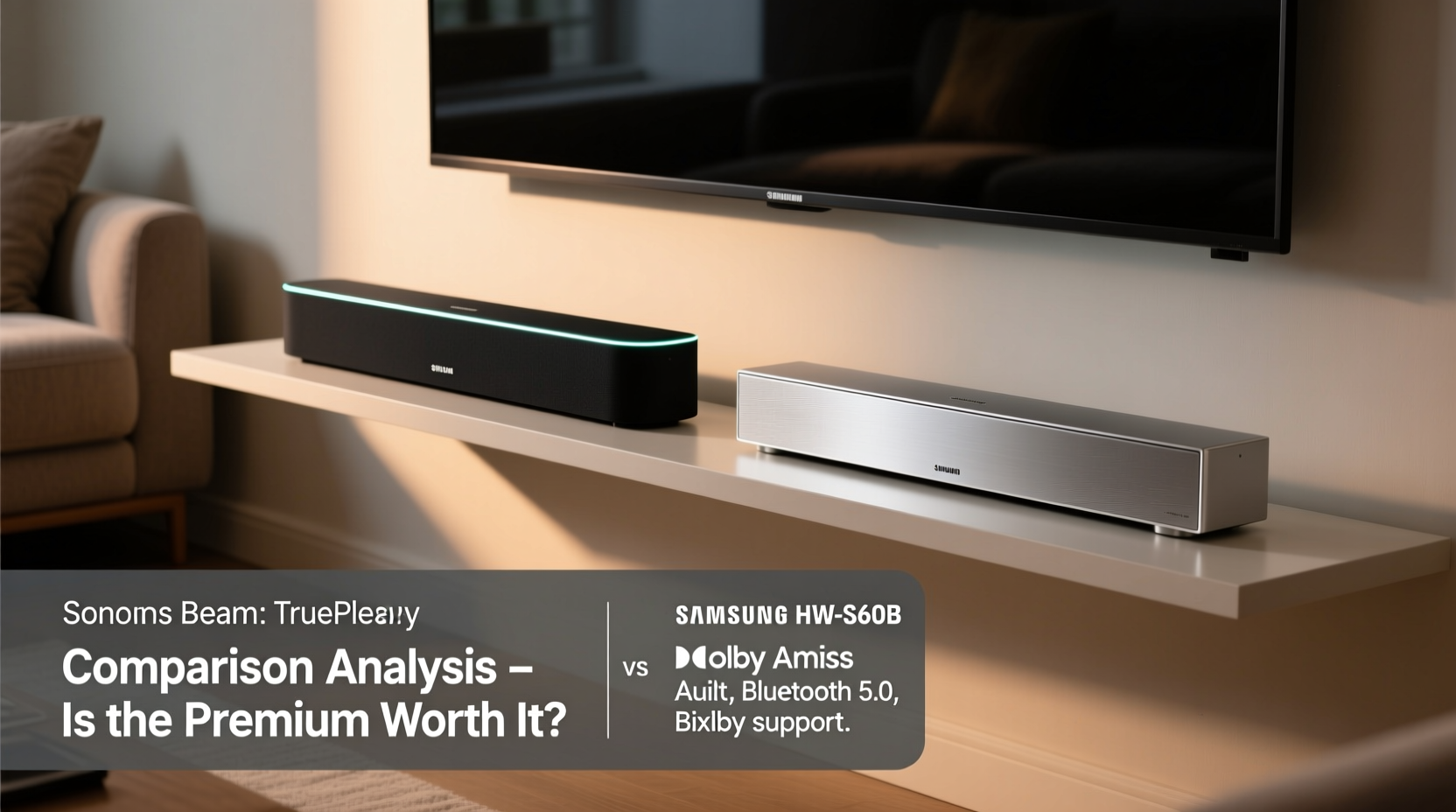
The Sonos Beam (Gen 2) supports Dolby Atmos with upward-firing drivers designed to reflect sound off the ceiling for a sense of height and immersion. Its five-driver array — including tweeters, mid-woofers, and passive radiators — delivers balanced audio with crisp dialogue and surprisingly full bass for its compact size. However, without a subwoofer, deep bass response is limited, especially in action-heavy scenes or music with heavy low-end.
In contrast, the Samsung HW-S60B includes a wired external subwoofer right out of the box. This gives it an immediate advantage in low-frequency impact. It also supports Dolby Atmos via virtualization, though it lacks physical upward-firing drivers. Instead, it uses psychoacoustic processing to simulate overhead effects. In practice, this means a wider and deeper soundstage than the Beam alone, particularly in larger rooms or when watching explosive content like sci-fi films or live concerts.
That said, the Beam excels in clarity and spatial accuracy. Its tuning prioritizes vocal intelligibility, making it ideal for dialogue-heavy shows and podcasts. When paired with a Sonos Sub, the Beam becomes a far more competitive system — but that adds significant cost.
Smart Features and Voice Integration
This is where the Sonos Beam pulls decisively ahead. It comes with built-in Amazon Alexa and Google Assistant, allowing full voice control without needing a separate smart speaker. You can adjust volume, skip tracks, check the weather, or control smart home devices — all hands-free. The microphones can be physically disabled with a mute button, addressing privacy concerns.
The Samsung HW-S60B does not have built-in voice assistants. It relies on external devices like a Galaxy phone, Bixby-enabled TV, or a separate smart speaker for voice commands. While it supports Bluetooth and basic remote app control via SmartThings, its smart functionality feels tacked-on rather than integrated.
“Voice integration isn’t just convenience — it’s the foundation of a modern living room experience.” — David Lin, Home Audio Systems Analyst at TechRoom Insights
If you use voice assistants regularly, the Beam’s always-on, high-quality mic array makes daily interaction effortless. For households already invested in Alexa or Google ecosystems, this is a major selling point.
Ecosystem and Expandability
Sonos builds products around a unified ecosystem. Once you own a Beam, adding rear speakers (like Sonos Era 100s or Ones) or a Sub creates a true 5.1 or 5.2 surround system with precise synchronization. All components are managed through the intuitive Sonos app, which supports multi-room audio, grouping, and fine-tuned EQ adjustments.
The Samsung HW-S60B is part of Samsung’s broader audio lineup, but expansion options are limited. It pairs with select Samsung wireless rear speakers (like the SWA-8500S), but only if your TV supports eARC and the specific connection protocol. Compatibility is less universal, and the setup process is more complex. Most users treat the HW-S60B as a standalone unit.
| Feature | Sonos Beam (Gen 2) | Samsung HW-S60B |
|---|---|---|
| Subwoofer Included | No (sold separately) | Yes |
| Rear Speaker Support | Yes (via Sonos ecosystem) | Limited (Samsung-specific models) |
| Multi-Room Audio | Full support via Sonos app | No |
| Smart Voice Assistant | Alexa & Google Assistant built-in | None (requires external device) |
| Connectivity | HDMI eARC, Wi-Fi, Ethernet | HDMI ARC, Optical, Bluetooth |
| Music Services | Spotify, Apple Music, Amazon Music, Tidal, etc. | Spotify, Samsung Music, limited third-party |
Setup and Connectivity
The Sonos Beam requires a power outlet and connects via HDMI eARC for best results. It must be set up using the Sonos app, which walks you through room calibration (Trueplay) using your phone’s microphone to optimize sound based on your room’s acoustics. This feature alone can dramatically improve audio performance in uneven spaces.
The Samsung HW-S60B connects via HDMI ARC or optical cable, making it compatible with older TVs that lack eARC. It doesn’t require an app for basic operation, which simplifies initial setup for less tech-savvy users. However, advanced settings are buried in menus, and there’s no room calibration tool.
While the Beam demands a bit more effort upfront, the payoff is a tailored listening experience and smoother long-term management. The Samsung unit is “plug and play” but offers fewer refinement options.
Real-World Example: The Family Living Room
Consider a household with a 4K Samsung QLED TV, multiple streaming accounts, and two teenagers who use Spotify daily. The parents love movie nights, while the kids want quick access to music. They initially lean toward the HW-S60B because it’s $100 cheaper and includes a subwoofer.
After six months, they realize limitations: no voice control means fumbling for remotes, the soundbar can’t play music independently of the TV, and they can’t sync it with outdoor speakers. They end up buying a separate smart speaker and feel the system is fragmented. Meanwhile, a neighbor with the Sonos Beam uses voice commands to play morning news, streams music to multiple rooms during parties, and upgraded to rear speakers for immersive movie nights — all within one cohesive system.
The extra cost of the Sonos solution paid off in flexibility and ease of use.
Is the Extra Money for Sonos Worth It?
On paper, the Samsung HW-S60B wins on raw specs per dollar: included subwoofer, louder output, and stronger bass. But value isn’t just about specs — it’s about longevity, usability, and integration.
The Sonos Beam costs more initially, but its strength lies in being a long-term investment. If you plan to expand your audio setup, use voice assistants, or enjoy multi-room music, the Beam grows with you. Its software updates ensure continued compatibility with new services and standards. Sonos also maintains resale value better than most consumer audio brands.
However, if your needs are simple — better TV sound with decent bass, minimal setup, and no interest in smart features or future upgrades — the HW-S60B delivers excellent performance at a lower entry point.
Checklist: Choosing Between Beam and HW-S60B
- ✅ Need a subwoofer included? → Samsung HW-S60B
- ✅ Want voice control without extra devices? → Sonos Beam
- ✅ Planning to add rear speakers later? → Sonos Beam
- ✅ Use multiple music services (Apple Music, Spotify, etc.)? → Sonos Beam
- ✅ Have an older TV without eARC? → Samsung HW-S60B
- ✅ Value simple plug-and-play setup? → Samsung HW-S60B
- ✅ Interested in whole-home audio? → Sonos Beam
Frequently Asked Questions
Can the Sonos Beam work without Wi-Fi?
Yes, for direct TV audio via HDMI. However, you lose access to streaming services, voice control, and app-based features. Wi-Fi is required for full functionality.
Does the Samsung HW-S60B support Apple AirPlay?
No. It lacks AirPlay 2 and Chromecast support, limiting direct streaming from iOS devices or casting from apps.
Which has better dialogue clarity?
The Sonos Beam edges ahead due to its dedicated midrange drivers and speech-enhancing processing. It automatically adjusts dialogue levels in noisy scenes.
Final Verdict
The Sonos Beam isn’t just a soundbar — it’s a hub for modern home audio. The extra cost buys you a smarter, more scalable system with superior software support and ecosystem depth. For users who value simplicity, integration, and future upgrades, that premium is justified.
The Samsung HW-S60B is a compelling choice for budget-conscious buyers who prioritize immediate bass impact and don’t plan to expand. It sounds powerful out of the box and suits smaller to medium-sized rooms well.
In the end, the “worth it” question depends on your lifestyle. If you’re building a connected home, the Sonos Beam pays dividends over time. If you just want better TV sound today, the Samsung delivers without overcomplicating things.




 浙公网安备
33010002000092号
浙公网安备
33010002000092号 浙B2-20120091-4
Comments
No comments yet. Why don't you start the discussion?