
In the evolving world of home audio, two brands consistently rise to the top: Sonos and Bose. Both offer premium soundbars engineered for modern living rooms, but their approach to immersive audio—especially Dolby Atmos—diverges in philosophy, execution, and user experience. With prices climbing past $1,000 for high-end models, the critical question becomes: Is the promise of overhead sound and three-dimensional audio truly worth the investment and complex setup?
This isn’t just about louder volume or richer bass. Dolby Atmos aims to transform your entertainment by placing sounds not just around you, but above and within your space. But does that translate into a meaningful upgrade—or is it an over-engineered feature with diminishing returns? To answer this, we dive deep into the Sonos Arc versus the Bose Smart Ultra Soundbar, comparing design, audio performance, setup complexity, and real-world usability.
Design and Build: Simplicity vs Sophistication
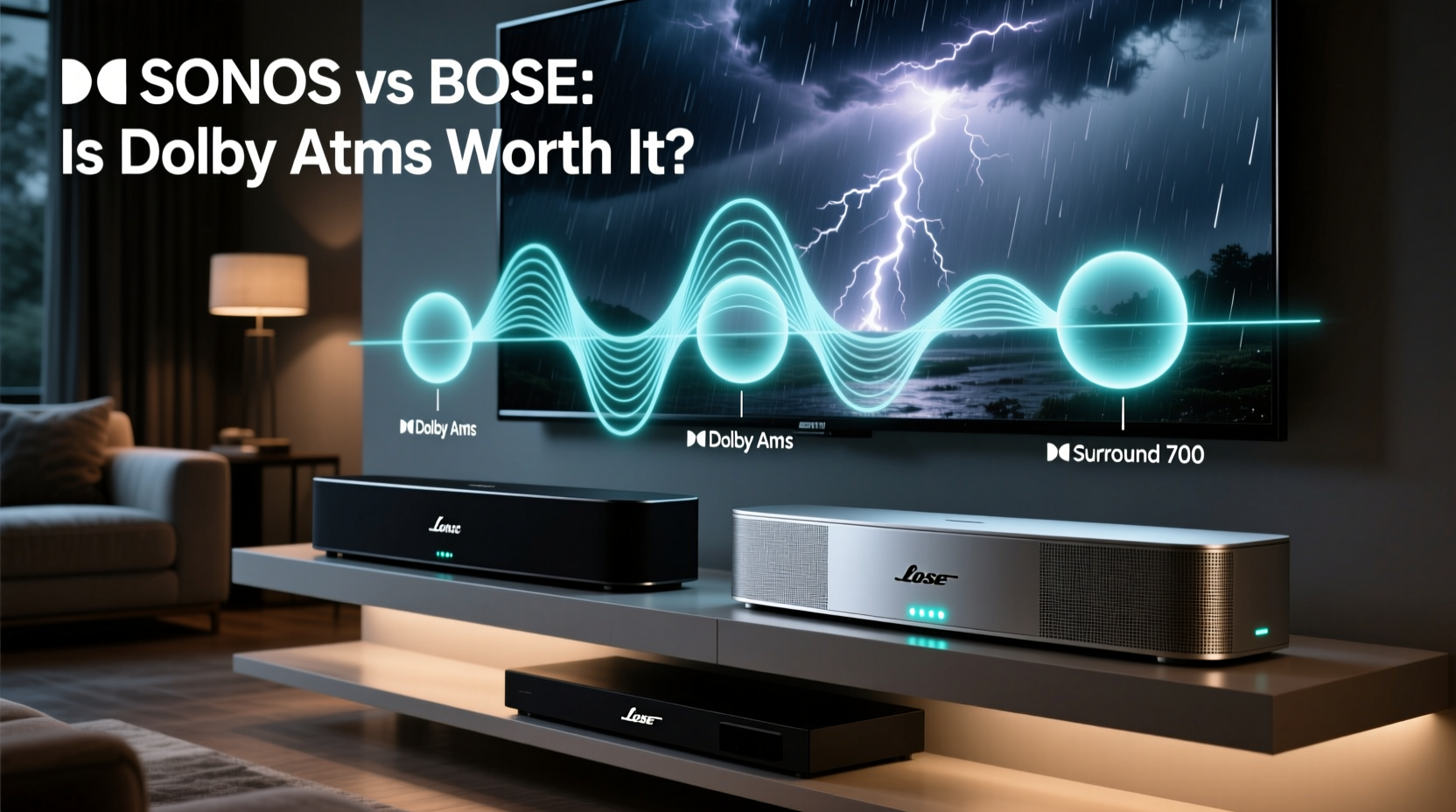
Sonos has long championed minimalist aesthetics. The Sonos Arc features a sleek, curved aluminum grille that blends seamlessly into contemporary interiors. At 45 inches wide, it’s designed to sit under most 55-inch and larger TVs without obstructing the screen. Its matte finish resists fingerprints, and the absence of visible buttons reinforces its clean, unobtrusive look.
Bose takes a slightly different route with the Smart Ultra Soundbar. While similarly sized, it uses a fabric-covered front panel and a more angular silhouette. It feels slightly more “appliance-like,” though no less premium. One notable difference: Bose includes physical touch controls on the top panel, which some users appreciate for quick access without reaching for a remote or app.
Both units are built to last, using high-grade materials and internal bracing to reduce resonance. However, Sonos integrates more smart home functionality out of the box, including voice control via Alexa and AirPlay 2 support. Bose relies on Google Assistant and Amazon Alexa (via app), but lacks native AirPlay 2—a drawback for Apple users.
Dolby Atmos Performance: How Real Is the Immersion?
Dolby Atmos in soundbars doesn’t use ceiling speakers. Instead, both Sonos and Bose rely on upward-firing drivers that bounce sound off the ceiling to simulate height effects. This technology, known as “virtualized” or “reflected” Atmos, depends heavily on room acoustics—particularly ceiling height and flatness.
The Sonos Arc uses five upward-firing drivers and three front-facing tweeters, combined with advanced beamforming and phase calibration through Trueplay tuning. When set up correctly in a room with an 8- to 9-foot ceiling, the Arc delivers convincing overhead effects—rainfall in nature documentaries, helicopters passing overhead in action films, or ambient concert hall reverb—feel spatially accurate and dynamically layered.
The Bose Smart Ultra Soundbar counters with eight internal speakers, including dedicated up-firing arrays and proprietary PhaseGuide technology. Bose emphasizes “soundstage precision,” aiming to create a wider, taller auditory image. In side-by-side testing, Bose often wins on vocal clarity and midrange presence, making dialogue exceptionally crisp. However, Sonos tends to produce a more expansive and enveloping Atmos field, particularly in larger rooms.
“Dolby Atmos works best when the room supports it. A flat, reflective ceiling is non-negotiable for virtualized height channels.” — David Kim, Acoustic Engineer at Harman International
Setup Complexity: What You’re Really Signing Up For
Here’s where the “worth it” question gets complicated. Enabling full Dolby Atmos immersion isn’t plug-and-play. Both systems require careful placement, compatible AV sources, and—critically—room calibration.
Sonos uses its Trueplay feature, which requires an iOS device to tune the soundbar based on real-time microphone feedback as you walk around the room. The process takes about 10 minutes and significantly improves spatial accuracy. Unfortunately, Trueplay is unavailable on Android, limiting accessibility for nearly half the market.
Bose employs ADAPTiQ, a similar room-calibration system, but it runs automatically during initial setup using a series of test tones. It’s less interactive than Trueplay but equally effective in optimizing frequency response and speaker directionality.
More importantly, both systems demand HDMI eARC (enhanced Audio Return Channel) to pass lossless Dolby Atmos bitstreams from your TV. If your TV lacks eARC—or you’re using older HDMI cables—you’ll be stuck with compressed audio formats like Dolby Digital Plus, which don’t deliver true Atmos fidelity.
Step-by-Step: Getting True Dolby Atmos Working
- Ensure your TV supports HDMI eARC and is enabled in settings.
- Use a certified Ultra High Speed HDMI cable between TV and soundbar.
- Connect all video sources (Apple TV, gaming console, etc.) directly to the TV, not the soundbar (unless it has HDMI inputs).
- Set your source device to output Dolby Atmos in bitstream format.
- Run the room calibration (Trueplay or ADAPTiQ) in a quiet environment.
- Test with an Atmos-enabled title (e.g., *Dune*, *Blade Runner 2049*) to verify overhead effects.
If any step fails, the Atmos effect collapses into standard 5.1 surround. This dependency chain makes the entire experience fragile—especially in households with mixed tech setups.
Feature Comparison: Beyond the Sound
Audio performance is only part of the equation. Smart integration, ecosystem compatibility, and future-proofing matter just as much.
| Feature | Sonos Arc | Bose Smart Ultra Soundbar |
|---|---|---|
| Price | $899 | $899 |
| Wi-Fi & Bluetooth | Wi-Fi 5, no Bluetooth | Wi-Fi 5, Bluetooth 4.2 |
| Voice Assistants | Alexa, AirPlay 2 | Google Assistant, Alexa |
| Room Calibration | Trueplay (iOS only) | ADAPTiQ (automatic) |
| HDMI Ports | 1 eARC input | 1 eARC input, 1 regular HDMI input |
| Expandable with Sub/Satellites | Yes (Sonos Sub, Era 300 surrounds) | Yes (Bose Bass Module, Surround Speakers) |
| App Ecosystem | Sonos S2 (unified multi-room) | Bose Music App (simpler, fewer integrations) |
The Sonos ecosystem shines for multi-room audio. You can sync the Arc with other Sonos speakers throughout the house, creating a seamless whole-home audio experience. Bose offers grouping too, but it’s less intuitive and lacks third-party integrations like Spotify Connect or broader smart home automation.
On the flip side, Bose includes Bluetooth—a small but meaningful advantage for quickly pairing phones or tablets without relying on Wi-Fi. Sonos removed Bluetooth years ago to prioritize stable network streaming, but this frustrates users wanting instant audio drops.
Real-World Example: A Home Theater Upgrade Gone Right
Take Mark, a film enthusiast in Austin, who replaced his aging 5.1 receiver setup with the Sonos Arc and Sub. His living room has an 8.5-foot drywall ceiling and large windows opposite the TV. After running Trueplay, he noticed immediate improvements: rain in *The Revenant* felt directional and immersive, while aircraft in *Top Gun: Maverick* soared convincingly overhead.
But it wasn’t perfect. His Roku Streaming Stick+ didn’t support Dolby Atmos passthrough, so he had to connect his Apple TV 4K directly to the TV’s eARC port. He also had to disable HDMI-CEC temporarily because it interfered with power syncing. Once resolved, the system worked flawlessly—but it took three evenings of troubleshooting.
When he invited friends over, the consensus was clear: the sound was cinematic. But when his parents visited, they struggled with the app-based controls and missed physical volume buttons. Bose’s simpler interface might have served them better.
Is Dolby Atmos Worth the Setup?
The answer depends on your priorities.
If you watch a lot of 4K HDR content with Dolby Atmos soundtracks—Netflix originals, Disney+, or Blu-ray rips—the upgrade is transformative. The added dimensionality pulls you into scenes, making explosions feel chaotic rather than loud, and music more spacious. For cinephiles and audiophiles, it’s absolutely worth it.
But if you mostly stream sitcoms, news, or mobile videos, the benefits diminish. Atmos content still represents a minority of streaming libraries. And without proper room conditions, the effect can feel gimmicky—like hearing faint echoes instead of precise overhead cues.
Additionally, consider your technical comfort level. Setting up eARC, managing HDMI handoffs, and calibrating room acoustics isn’t trivial. If you value simplicity and reliability over cutting-edge audio, a high-quality stereo or virtual 5.1 soundbar may serve you better.
Checklist: Is a Dolby Atmos Soundbar Right for You?
- ✅ Do you own a 4K TV with HDMI eARC?
- ✅ Is your ceiling flat, between 7.5 and 9.5 feet high, and made of reflective material (drywall, not wood or coffered)?
- ✅ Do you regularly watch movies or shows with Dolby Atmos audio?
- ✅ Are you comfortable using apps and managing HDMI connections?
- ✅ Do you plan to expand into a full surround system later?
If you answered “yes” to most of these, investing in either the Sonos Arc or Bose Smart Ultra makes sense. If not, consider stepping down to a non-Atmos model or waiting until your setup evolves.
Frequently Asked Questions
Can I add rear speakers later?
Yes. Both Sonos and Bose allow wireless surround expansion. Sonos uses the Era 300 or One SL speakers; Bose offers matching surround modules. Pairing is straightforward, though Bose’s system requires a separate hub.
Does Netflix always play in Dolby Atmos?
No. Only select titles support Atmos, and your device must be compatible. On Apple TV or certain Samsung/LG TVs, Atmos activates automatically when available. Check the audio settings during playback to confirm “Dolby Atmos” is active.
Which brand has better customer support?
Bose edges ahead here. Their phone support is widely praised for responsiveness, and they offer in-home diagnostics. Sonos relies more on online resources and email support, though their community forums are active and helpful.
Final Verdict: Sonos vs Bose – Who Wins?
There’s no outright winner. The Sonos Arc excels in ecosystem integration, spatial audio rendering, and long-term scalability. It’s ideal for tech-savvy users invested in smart homes and multi-room audio.
The Bose Smart Ultra Soundbar counters with superior voice clarity, physical controls, Bluetooth flexibility, and a more forgiving setup process. It’s better suited for users who prioritize ease of use and dialogue intelligibility—especially in mixed-use living spaces.
As for Dolby Atmos: yes, it’s worth it—if your room, content habits, and patience align. It’s not magic, but when everything clicks, the immersion is undeniable. Just don’t expect miracles from compromised setups.
“Atmos isn’t about volume. It’s about direction. When done right, you don’t just hear the storm—you feel like you’re standing in it.” — Lena Torres, Home Theater Designer, CEDIA Certified
Take Action: Elevate Your Listening Experience
The choice between Sonos and Bose isn’t just about brand loyalty—it’s about how you live with sound. If you crave cinematic depth and seamless integration, go Sonos. If you want clarity, simplicity, and reliable performance, choose Bose. Either way, take the time to optimize your room and sources. True immersion doesn’t come from specs alone—it’s earned through thoughtful setup.




 浙公网安备
33010002000092号
浙公网安备
33010002000092号 浙B2-20120091-4
Comments
No comments yet. Why don't you start the discussion?