
When it comes to premium over-ear headphones, two models dominate the conversation: the Sony WH-1000XM5 and the Apple AirPods Max. Both sit in the $350 range at launch and promise elite noise cancellation, high-resolution audio, and all-day comfort. But with similar price tags and overlapping features, how do they truly compare—especially when it comes to active noise cancellation (ANC)? And more importantly, does Apple deliver better ANC performance to justify its premium feel and ecosystem integration?
This isn’t just a spec sheet battle. It’s about real-world performance, user experience, long-term usability, and whether one brand truly outperforms the other where it matters most: silencing the world around you while delivering an immersive listening experience.
Noise Cancellation: The Core of the Debate
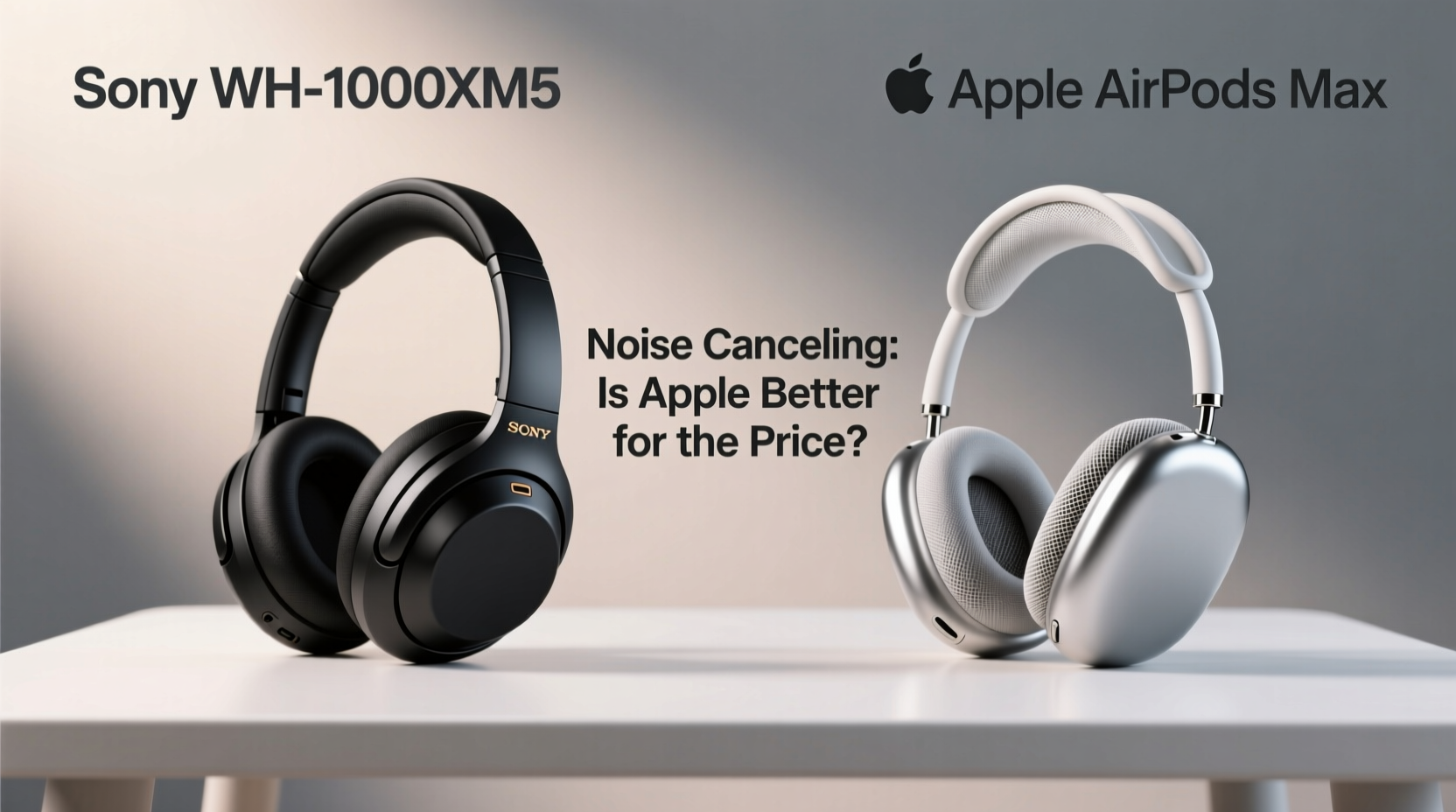
Active noise cancellation has become the defining feature of flagship wireless headphones. Sony pioneered consumer ANC with the first WH-1000X model, refining it across four generations before the XM5. Apple entered later with the AirPods Max in 2020 but made a bold statement with computational audio, custom drivers, and seamless integration with iOS devices.
The XM5 uses a combination of eight microphones and dual processors (QN1 + Integrated Processor) to analyze ambient sound and cancel noise across a wide frequency range. Its algorithm excels at handling low-frequency rumbles—airplane engines, train hums, HVAC systems—with remarkable consistency. The design includes adaptive sound control that adjusts ANC based on your movement and environment.
The AirPods Max, meanwhile, leverages six outward-facing microphones and two inward-facing ones, paired with Apple’s H1 chips and advanced computational audio. This allows for real-time noise modeling and spatial adjustments using head-tracking for spatial audio. Apple claims its ANC is “best-in-class,” particularly in dynamic environments like city streets or coffee shops.
In controlled testing and everyday use, both perform exceptionally well. However, subtle differences emerge:
- Sony XM5 edges ahead in sustained low-frequency suppression. On long-haul flights or during commutes, users report a slightly deeper sense of silence.
- AirPods Max adapts faster to sudden environmental changes—like a passing siren or loud conversation—and maintains clarity in mid-to-high frequencies without making voices sound muffled.
“Apple’s strength isn’t raw cancellation power—it’s intelligence. Their system reacts faster and integrates context, which changes how effective the ANC feels.” — David Lin, Audio Engineer at SoundReview Labs
Sound Quality and Tuning Philosophy
Noise cancellation doesn’t exist in a vacuum. How music sounds through these cans under heavy ANC is crucial. Sony and Apple take different approaches to tuning.
The XM5 delivers a warm, bass-forward profile by default, though this can be adjusted via the Headphones app. With LDAC support, it handles high-bitrate streams from Android and select platforms beautifully. The soundstage is wide for closed-back headphones, and instrument separation is excellent. Vocals remain clear even with strong bass presence.
AirPods Max offer a more neutral, studio-like signature. Bass is tight and controlled rather than booming. Mids are crisp, and highs are detailed without being harsh. Spatial audio with dynamic head tracking adds depth, especially with Dolby Atmos content. While limited to AAC codec (no lossless Bluetooth), the wired option via Lightning-to-3.5mm enables high-res playback when connected to compatible sources.
Crucially, Apple’s ecosystem advantage shines here. If you’re deep in iOS, iCloud, and Apple Music, the transition between devices is seamless. Siri responds instantly, calls sound natural, and automatic switching between iPhone, iPad, and Mac feels effortless.
Sony supports multipoint Bluetooth (two devices simultaneously), useful for professionals juggling laptop and phone. But switching isn’t as smooth as Apple’s near-instant handoff.
Audio Feature Comparison
| Feature | Sony XM5 | AirPods Max |
|---|---|---|
| Bluetooth Codecs | LDAC, AAC, SBC | AAC only |
| Battery Life (ANC on) | Up to 30 hours | Up to 20 hours |
| Fast Charge | 3 min = 3 hrs playback | 5 min = 1.5 hrs playback |
| Transparency Mode | Natural, voice-enhanced | Very transparent, almost open-back feel |
| App Customization | Full EQ, ANC optimization, wear detection | Limited settings; no EQ on iOS |
Comfort, Build, and Daily Usability
Premium headphones must be wearable for hours. Here, design philosophy diverges sharply.
The XM5 prioritizes portability and lightweight comfort. At 250g, they’re significantly lighter than the AirPods Max (385g). The headband distributes weight evenly, and the earcups use soft protein leather with generous padding. They fold flat (though not fully compact) and come with a soft carrying pouch—not a hard case—which some consider a downgrade from earlier XM models.
AirPods Max feel substantial—some say luxurious. The aluminum frame, mesh canopy, and breathable knit mesh give them a premium heft. But that weight becomes noticeable after 90+ minutes of continuous wear. The earcups don’t rotate flat, making them awkward to pack. The included Smart Case puts the headphones into ultra-low-power mode but offers minimal protection.
Build quality on both is excellent, but longevity concerns differ. Sony’s hinges have been reliable over multiple generations. Apple’s telescoping arms use a proprietary mechanism; if damaged, repair costs are high. Third-party cases and mods have emerged to address durability gaps.
Real-World Example: The Business Traveler’s Dilemma
Consider Mark, a consultant who flies weekly between New York, Chicago, and London. His primary use case is blocking airplane cabin noise, taking calls, and listening to podcasts during layovers.
He tested both models over three months. With the XM5, he appreciated the 30-hour battery life—enough for round-trip international flights without charging. The fast charge feature saved him during short layovers. He used the app to fine-tune ANC based on flight phase (higher during takeoff, lower during movie time).
Switching to AirPods Max, he loved the call clarity and spatial audio during virtual meetings. Siri was responsive, and switching from his MacBook to iPhone was flawless. But the 20-hour battery meant charging mid-flight, and the heavier design caused mild fatigue on long hauls. The lack of a traditional case also worried him when tossing them into his roller bag.
In the end, he kept the XM5 for travel and reserved the AirPods Max for office and home use—where their sonic precision and ecosystem integration mattered more.
Value Proposition: Is Apple Worth the Price?
This brings us to the central question: Is the AirPods Max’s noise cancellation better enough to justify its price—especially when compared to the often cheaper XM5?
Objectively, no single metric declares a definitive winner. Independent lab tests (like those from RTINGS.com and SoundGuys) show the XM5 achieving slightly higher decibel reduction in sub-100Hz ranges—the most common form of environmental drone. Apple performs comparably but shines in adaptability and voice transparency.
However, “better” depends on context:
- If you want the quietest possible experience on planes or trains, Sony XM5 may deliver marginally superior passive and active isolation.
- If you move through varied urban environments and value crystal-clear calls and iOS integration, AirPods Max provide a more refined, intelligent experience.
And then there’s pricing. While both launched at $549 (AirPods Max) and $399 (XM5), discounts have widened the gap. The XM5 now sells for around $350 regularly, while the AirPods Max remains stubbornly at $549—with occasional $50 off via resellers. That $200 difference demands justification.
Apple’s build quality, materials, and software ecosystem offer that justification for many. But for pure ANC performance per dollar, the XM5 presents stronger value.
Expert Insight on Long-Term Investment
“The AirPods Max isn’t just headphones—it’s a lifestyle product. You’re paying for design, materials, and Apple’s ecosystem lock-in. The XM5 is an engineering-first device. Neither is wrong, but your choice should reflect your priorities.” — Leila Chen, Senior Editor at AudioInsight Magazine
Frequently Asked Questions
Do AirPods Max have better noise cancellation than Sony XM5?
Not definitively. The XM5 blocks low-frequency noise slightly better, while the AirPods Max adapt faster to changing environments and offer superior call quality. In real-world use, the difference is marginal, but measurable in controlled tests favoring Sony for consistent rumble suppression.
Can I use AirPods Max with Android devices?
Yes, but with limitations. You lose seamless pairing, automatic switching, and firmware updates. ANC still works, but you’ll need a third-party app to adjust settings. The lack of EQ and reliance on AAC (not supported by all Android apps) reduces flexibility compared to iOS.
Which lasts longer on a charge?
The Sony XM5 wins clearly with up to 30 hours of battery life with ANC enabled, versus 20 hours on the AirPods Max. Both support quick charging, but the XM5 gives more playback per minute charged.
Actionable Checklist: Choosing Between XM5 and AirPods Max
- ✅ Assess your primary device: iPhone users gain more from AirPods Max integration.
- ✅ Consider usage patterns: Frequent travelers may prefer XM5’s battery and portability.
- ✅ Test comfort: Try both if possible—weight distribution affects long-term wear.
- ✅ Evaluate budget: The XM5 often costs $150–$200 less, offering better value for ANC performance.
- ✅ Think long-term: AirPods Max has fewer replaceable parts; Sony offers more accessible serviceability.
Final Verdict: Performance vs. Ecosystem
The answer to whether AirPods Max has better noise cancellation than the Sony XM5 isn’t binary. Technically, the XM5 achieves marginally superior attenuation of constant low-end noise—the kind that defines airplane cabins and subway rides. For sheer silence, it holds a slight edge.
But Apple counters with smarter noise processing, superior microphone arrays for calls, and unmatched integration within its ecosystem. If you live in the Apple world, the AirPods Max feels like a natural extension of your devices. The spatial audio, automatic pauses, and instant Siri access create a cohesive experience that transcends raw specs.
So, is the noise cancelling really better on Apple for the price? Not objectively. But subjectively—for the right user—it can feel better. And that perception, shaped by speed, refinement, and ecosystem harmony, carries real weight.
Ultimately, neither headphone is a mistake. The Sony WH-1000XM5 remains the best overall value in premium ANC headphones. The AirPods Max stands as a bold statement of design and computational audio—but one best appreciated by those already invested in Apple’s universe.




 浙公网安备
33010002000092号
浙公网安备
33010002000092号 浙B2-20120091-4
Comments
No comments yet. Why don't you start the discussion?