
For many city dwellers, living in a compact apartment means making smart trade-offs—especially when it comes to entertainment setups. One of the most common dilemmas is whether to invest in a full home theater system or opt for a sleek soundbar. While surround sound promises cinematic immersion, does it truly make sense in a 500-square-foot studio? The answer depends on your listening habits, room layout, budget, and tolerance for clutter.
With streaming quality improving rapidly and more people consuming content at home, audio quality has never mattered more. But better sound doesn’t always mean more speakers. In fact, in small spaces, too much audio equipment can backfire—causing echo, imbalance, and unnecessary complexity. Let’s explore the real-world differences between soundbars and home theater systems, and determine if surround sound is worth it where space is tight.
The Space Challenge: Why Room Size Matters
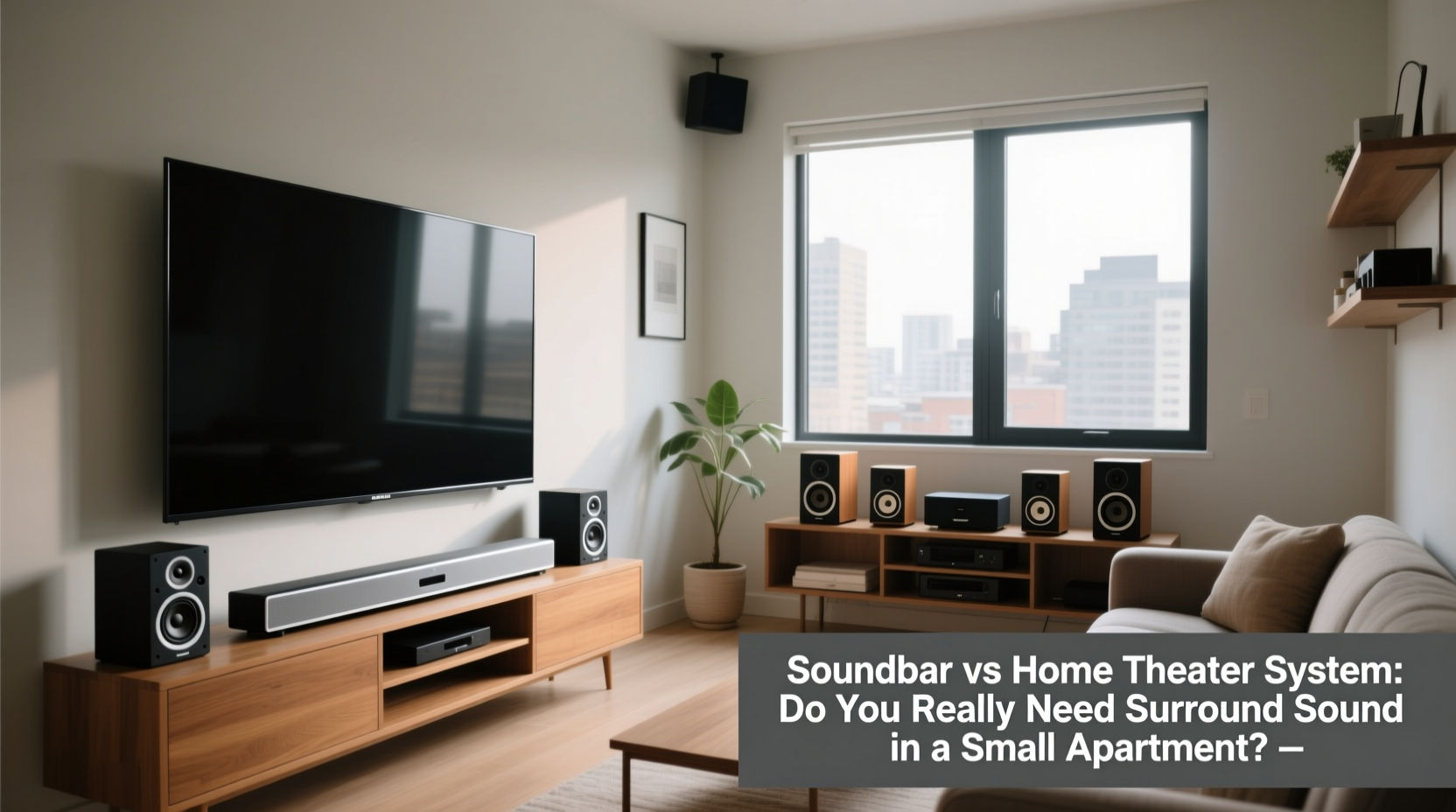
In acoustics, room size directly affects how sound behaves. A large living room allows sound waves to travel, reflect, and blend before reaching your ears—creating a spacious, enveloping effect. In contrast, small apartments compress these dynamics. Sound bounces quickly off close walls, often leading to muddiness or harshness, especially with multiple speakers firing from different directions.
A typical 5.1 surround system includes a center channel, front left and right speakers, rear surrounds, a subwoofer, and an AV receiver. Setting this up in under 400 square feet means placing rear speakers just 3–5 feet behind the listener—closer than ideal. This proximity disrupts the intended spatial separation, making effects feel abrupt rather than immersive.
“Surround sound relies on precise speaker placement and sufficient distance between the listener and each driver. In very small rooms, that physics breaks down.” — Dr. Lena Park, Acoustic Engineer, Audio Dynamics Lab
Moreover, wall mounting or shelf placement becomes a logistical puzzle. Bookshelf speakers take up valuable surface area. Running wires across hardwood floors or under rugs creates tripping hazards and aesthetic clutter. Renters may not even be allowed to drill holes. These constraints make multi-speaker systems impractical for many urban dwellers.
Soundbar Advantages in Compact Living
Soundbars were designed with modern living in mind. Most models are under 40 inches wide—perfect for mounting below a TV or sitting on a media console. They integrate multiple drivers (sometimes 6–10) into a single enclosure, using digital signal processing (DSP) to simulate surround effects like height, depth, and directionality.
High-end soundbars now support Dolby Atmos, using upward-firing drivers and ceiling reflections to create a three-dimensional soundscape—even without rear speakers. When calibrated correctly, they can deliver surprisingly convincing immersion in confined spaces.
Many soundbars also include wireless subwoofers—compact enough to tuck under a sofa—and optional rear add-ons for those who want expandability. This modular approach lets you start simple and upgrade later if needed.
Setup is typically plug-and-play. Most connect via HDMI ARC or optical cable, requiring no complex calibration. Some auto-detect room acoustics using built-in microphones. For renters or minimalist households, this simplicity is a major advantage.
Home Theater Systems: Where They Shine (and Fall Short)
There’s no denying that a well-tuned 5.1 or 7.1 system delivers superior audio fidelity when space and layout allow. Discrete speakers provide true directional sound—explosions move smoothly from front to back, rain feels like it’s falling all around, and orchestral music gains depth and layering.
But in a small apartment, these benefits come with caveats:
- Speaker placement limitations: Rear channels may fire directly into your back or side, creating an unnatural “in-your-head” sensation instead of ambient immersion.
- Bass buildup: Subwoofers in small rooms often produce boomy, uneven low frequencies due to standing waves.
- Complexity: AV receivers require learning curves—input management, speaker leveling, firmware updates—all before you play your first movie.
- Noise complaints: Powerful bass travels through walls. If you live in a condo or shared building, loud sessions might disturb neighbors.
That said, some compact home theater kits are designed specifically for small spaces. Brands like Sony, Denon, and Yamaha offer slim satellite systems with smaller cabinets and lower output, tuned to avoid overwhelming tight rooms. These can work well—if installed carefully and calibrated with room correction software.
Comparison: Soundbar vs Home Theater System
| Feature | Soundbar | Home Theater System |
|---|---|---|
| Footprint | Single unit; minimal space | Multiple units; requires floor/shelf space |
| Installation | Simple; often wireless sub | Complex; wiring, calibration, receiver setup |
| Surround Effect | Simulated via DSP; effective in small rooms | True discrete channels; best in larger rooms |
| Bass Performance | Good with wireless sub; can be tuned | Deeper, more powerful; risk of boominess |
| Expandability | Some support rear modules | Fully customizable; add zones, speakers |
| Cost (Entry-Level) | $150–$300 | $400–$600+ |
| Best For | Apartments, minimalists, casual viewers | Dedicated media rooms, audiophiles, gamers |
Real-World Example: Two Apartment Dwellers, Two Choices
Consider two New Yorkers with similar 600-square-foot studios:
Maria, 32, freelance designer: She watches Netflix and YouTube daily but values clean lines and quiet neighbors. After testing a mid-range soundbar with virtual surround, she found the audio crisp and room-filling—dialogue was clear, music had punch, and action scenes felt dynamic. She added a small subwoofer under her couch and called it complete. Total setup time: 20 minutes.
Jamal, 28, film enthusiast: He wanted the full experience. He invested in a 5.1 kit, mounted satellites, ran cables along baseboards, and spent hours calibrating with his receiver’s Audyssey software. Initially thrilled, he soon noticed the rear speakers were too close—gunshots from behind felt jarring, not immersive. His downstairs neighbor complained about bass vibrations during movies. He eventually disconnected the rears and used only the front trio—effectively turning it into a high-end soundbar setup.
Their stories highlight a key insight: in small spaces, less can be more. What looks impressive on paper doesn’t always translate to better listening.
When You Might Still Want Surround Sound
Surround isn’t automatically off the table. There are scenarios where a compact home theater system makes sense—even in an apartment:
- You have an open-concept layout with a dedicated viewing zone and at least 10 feet of depth.
- You’re an avid gamer who values positional audio cues in competitive titles.
- You frequently host movie nights and want guests to feel “inside” the action.
- You can mount speakers flush to walls or ceilings, minimizing footprint.
- You’re willing to use acoustic treatments (rugs, curtains, panels) to tame reflections.
If you go this route, consider starting with a 3.1 system (front left/center/right + sub) instead of full 5.1. Many find this offers the sweet spot between immersion and practicality. Later, you can add rear modules if desired.
Step-by-Step: Choosing the Right Setup for Your Space
- Measure your room: Note the distance from TV to seating, and side-to-side width. If your primary seat is less than 8 feet from the screen, a soundbar is likely sufficient.
- Assess your usage: Do you watch mostly TV shows and stream music, or dive into 4K Blu-rays and gaming marathons?
- Check your TV’s audio output: Ensure it supports HDMI ARC or eARC for best soundbar integration.
- Demo both options: Visit an electronics store and listen to a soundbar and a small surround system with the same content.
- Read reviews focused on small rooms: Look for terms like “tight bass,” “clear dialogue,” and “no rear bleed” in user feedback.
- Start simple: Buy a soundbar with expandable features. You can always add rear speakers later if needed.
Frequently Asked Questions
Can a soundbar really mimic surround sound effectively?
Yes—modern soundbars use beamforming, phase shifting, and psychoacoustic processing to trick your ears into perceiving sound coming from beyond the physical speaker. In small rooms, this simulated surround often feels more natural than cramped rear speakers.
Is a wireless subwoofer enough for movies?
For most apartment dwellers, yes. Today’s compact subs deliver strong, controlled bass down to 40Hz. Just place it in a corner or against a wall to enhance output, and use the volume knob to avoid disturbing neighbors.
Can I upgrade a soundbar to full surround later?
Some models allow this. Brands like Sonos, Samsung, and Bose offer compatible rear speakers and hubs. Check compatibility before buying—proprietary systems may limit future expansion.
Final Verdict: Simplicity Wins in Small Spaces
For the vast majority of small apartment residents, a quality soundbar outperforms a full home theater system in both practicality and listening experience. It delivers excellent clarity, rich bass (with a sub), and convincing spatial effects—without sacrificing floor space or peace of mind.
Surround sound isn’t obsolete, but its value shifts in confined environments. True immersion comes not from the number of speakers, but from how well the audio fits the room and enhances the content. In a studio or one-bedroom, a well-chosen soundbar often achieves that balance better than a sprawling setup ever could.




 浙公网安备
33010002000092号
浙公网安备
33010002000092号 浙B2-20120091-4
Comments
No comments yet. Why don't you start the discussion?