
When it comes to low-and-slow cooking, two appliances dominate the conversation: the sous vide immersion circulator and the slow cooker. Both promise tender, flavorful meals with minimal hands-on time, but they operate on fundamentally different principles. The sous vide method relies on precise temperature control in a water bath, while the slow cooker uses ambient heat over many hours. The central question for home cooks deciding between them is whether that precision justifies the additional setup, monitoring, and equipment required by sous vide.
The answer depends on what you value most—consistency and control, or simplicity and convenience. Understanding how each appliance works, their strengths, limitations, and real-world applications can help clarify which tool better fits your kitchen style and culinary goals.
How Sous Vide Works: Precision Through Science
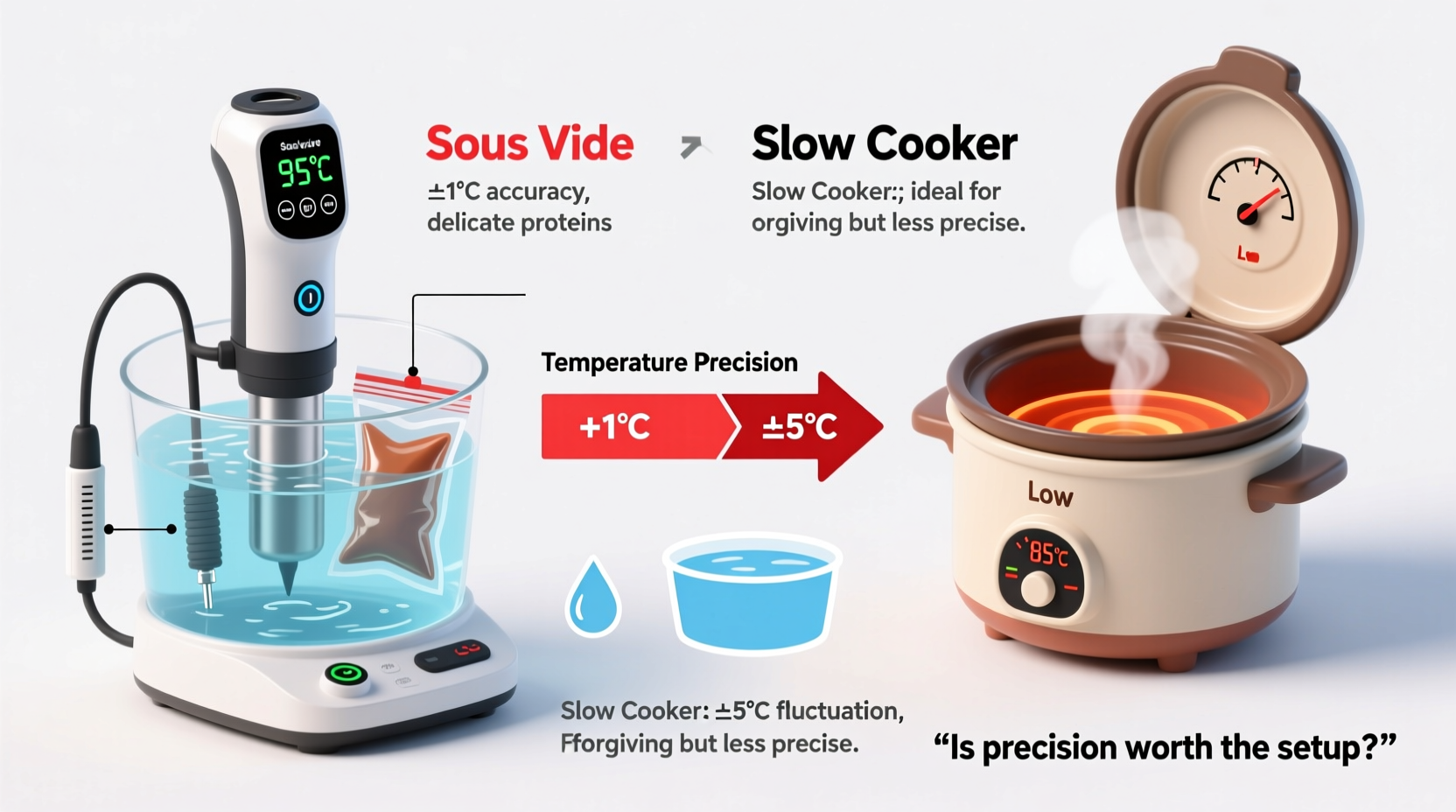
Sous vide, French for “under vacuum,” involves sealing food in airtight plastic bags and submerging them in a water bath maintained at an exact, consistent temperature. An immersion circulator heats and continuously stirs the water to eliminate hot spots and ensure even cooking throughout. Because the water never exceeds the set temperature, food cannot overcook in the traditional sense—it reaches doneness and simply stays there.
This level of control allows for unparalleled consistency, especially with proteins. A steak cooked at 130°F (54°C) for 2–4 hours will emerge medium-rare from edge to center, without gradients or guesswork. Similarly, chicken breast cooked at 140°F (60°C) remains juicy and tender, avoiding the dryness common in oven or stovetop methods.
The process requires more planning than traditional cooking. You must preheat the water bath, often wait several hours for optimal texture, and finish with a quick sear to develop flavor through the Maillard reaction. But for those who prioritize perfection in texture and don’t mind a longer timeline, sous vide delivers repeatable, restaurant-quality results.
How Slow Cookers Work: Simplicity and Set-and-Forget Convenience
Slow cookers, also known as crock-pots, use a ceramic or metal insert surrounded by a heating element. They operate at low (around 200°F / 93°C) or high (around 300°F / 149°C) settings over 4 to 10 hours. Unlike sous vide, they rely on convection and radiant heat in a moist environment, making them ideal for braising tough cuts of meat, stews, soups, and beans.
The beauty of the slow cooker lies in its accessibility. It requires no special bags, no water management, and minimal supervision. You add ingredients in the morning, turn it on, and return to a fully cooked meal. Cleanup is usually limited to one pot. For busy households or those new to cooking, this simplicity is a major advantage.
However, precision is not the slow cooker’s strength. Temperature fluctuations are common, and cooking times can vary based on fill level, room temperature, and lid lifting. Overcooking is a real risk—especially with lean meats like chicken breast or fish, which can become dry and stringy. While great for hearty dishes, the slow cooker lacks the finesse needed for delicate proteins or custards.
“Sous vide gives you control down to the degree. With a slow cooker, you’re trading precision for convenience.” — Chef Marcus Lee, Culinary Instructor at Pacific Heights Cooking School
Direct Comparison: Sous Vide vs Slow Cooker
| Feature | Sous Vide | Slow Cooker |
|---|---|---|
| Temperature Control | Precise (±0.5°F) | Approximate (wide fluctuations) |
| Cooking Time | 1–72 hours (depends on thickness) | 4–10 hours |
| Setup Complexity | Moderate (water bath, sealing, monitoring) | Low (dump and go) |
| Best For | Steaks, fish, eggs, custards, vegetables | Stews, chili, pulled pork, soups |
| Energy Use | Moderate (continuous heating) | Low to moderate |
| Hands-On Time | Low after setup | Very low |
| Texture Consistency | Uniform edge-to-edge | Gradient (outer layers softer) |
| Counter Space | Compact device, needs container | Bulky, fixed footprint |
The table highlights a key trade-off: sous vide offers superior control and consistency but demands more attention during setup and cleanup. The slow cooker wins on ease of use and integration into daily life, especially for families or those cooking large batches.
Is Precise Temperature Control Worth the Extra Water Setup?
The core advantage of sous vide is precision. When cooking a thick ribeye or a delicate piece of salmon, even a few degrees can mean the difference between perfection and disappointment. In contrast, slow cookers operate within broad temperature ranges, making them less suitable for tasks requiring thermal accuracy.
Consider this scenario: you're preparing chicken breasts for a weeknight dinner. In a slow cooker, even on low, the internal temperature can exceed 180°F (82°C), causing proteins to tighten and expel moisture. The result? Dry, rubbery chicken. With sous vide, you cook at exactly 140°F (60°C) for 2 hours, yielding tender, juicy meat every time.
But precision comes with logistical overhead. You need a container large enough to hold water and circulate freely. You must manage water levels to prevent evaporation, especially during long cooks. Some users place ping pong balls on the surface to reduce evaporation, while others invest in lids or reusable covers. There’s also the issue of storage—keeping the immersion circulator, vacuum sealer, and bags organized takes space.
For occasional cooks, this may seem excessive. But for those who regularly prepare proteins, meal prep, or entertain guests, the investment pays off in reliability and quality. As one home chef put it: “I used to ruin expensive steaks trying to get them medium-rare. Now I cook them sous vide, sear them fast, and impress everyone.”
Mini Case Study: Weeknight Family Dinner Redefined
Julia, a working mother of two in Austin, used to rely on her slow cooker for Sunday meal prep. She’d make a big pot of shredded chicken for tacos, soups, and salads. While convenient, she noticed the chicken was often uneven—some pieces dry, others underseasoned. After receiving a sous vide machine as a gift, she experimented with batch-cooking chicken breasts at 140°F for 3 hours.
The change was immediate. Every piece came out uniformly tender, retaining its natural juices. She could season each bag individually—one with taco spices, another with Italian herbs—without flavors bleeding. Though it took longer to seal the bags and monitor the water bath, she saved time later because the chicken required no additional cooking. Her family preferred the taste and texture, and Julia found herself using the sous vide for eggs, vegetables, and even custards.
She still uses her slow cooker for chili and bone broth, but now views it as a separate tool rather than a replacement. “The slow cooker is my ‘dump and forget’ buddy,” she says. “Sous vide is my ‘get it perfect’ secret weapon.”
Step-by-Step Guide: Choosing the Right Tool for Your Meal
Follow this decision framework to determine whether sous vide or a slow cooker is better suited for your next dish:
- Assess the ingredient type: Is it a delicate protein (fish, egg, chicken breast)? → Lean toward sous vide. Is it a tough cut (brisket, short ribs, beans)? → Slow cooker is ideal.
- Evaluate desired texture: Do you want edge-to-edge doneness or fall-apart tenderness? The former favors sous vide; the latter, slow cooking.
- Check your timeline: Can you plan ahead by 2+ hours? If yes, sous vide works. If you need a meal ready in 6 hours without prep, the slow cooker wins.
- Consider portion size: Cooking for one or two? Sous vide excels with individual portions. Feeding a crowd? Slow cooker handles volume more efficiently.
- Determine finishing method: Will you sear, grill, or broil afterward? Sous vide pairs well with high-heat finishes. Slow cooker meals are typically served as-is.
Frequently Asked Questions
Can I use a slow cooker for sous vide-like results?
No. Slow cookers lack the precise temperature regulation needed for true sous vide cooking. Even with a thermometer and manual adjustments, they cannot maintain water within ±1°F, which is essential for accurate doneness. Some hacks exist (like using a temperature controller), but they are unreliable and not recommended for consistent results.
Do I need a vacuum sealer for sous vide?
Not necessarily. While vacuum sealers provide the best air removal and shelf life, you can use the water displacement method with heavy-duty resealable bags. Simply lower the sealed bag into water, letting pressure push air out before sealing the final corner. This method works well for most home applications.
Is sous vide safe given the long cooking times?
Yes, when done correctly. Food safety in sous vide depends on both temperature and time. The USDA guidelines apply: cooking above 130°F (54°C) for sufficient duration kills harmful bacteria. For example, cooking chicken at 140°F for 2+ hours is safer than a brief sear at high heat that leaves cold spots. Always follow tested time/temperature charts and avoid leaving food in the danger zone (40°F–140°F) for more than 2 hours.
Final Verdict: Complementary Tools, Not Competitors
Rather than framing sous vide and slow cookers as rivals, the most practical approach is to see them as complementary tools serving different purposes. The slow cooker remains unmatched for hearty, one-pot meals with minimal effort. It’s ideal for busy days, large batches, and dishes where slight variations in texture are acceptable.
Sous vide, meanwhile, shines when precision matters—when you’re cooking expensive cuts, entertaining guests, or pursuing culinary excellence. Its ability to deliver consistent, repeatable results makes it a favorite among professionals and serious home cooks alike. The water setup and extra steps are not drawbacks but part of a deliberate, controlled process.
So, is precise temperature control worth the extra water setup? For everyday comfort food, perhaps not. But for moments when perfection counts—perfectly cooked salmon, custardy eggs, or melt-in-your-mouth short ribs—the answer is a resounding yes.
“The best kitchen isn’t full of single-purpose gadgets. It has tools that solve specific problems. Sous vide solves the problem of inconsistency.” — Dr. Lena Torres, Food Scientist and Author of *The Science of Home Cooking*




 浙公网安备
33010002000092号
浙公网安备
33010002000092号 浙B2-20120091-4
Comments
No comments yet. Why don't you start the discussion?