
The idea of a superhero clashing with horror icons has long fascinated fans across genres. One particularly wild matchup pits Peter Parker—aka Spider-Man—against two of the most relentless killers in cinematic history: Michael Myers and Jason Voorhees. Could the web-slinger really take on these unstoppable slashers? On paper, it seems like a mismatch. But when you dig into their abilities, weaknesses, and mythos, the answer isn’t as simple as it first appears.
Spider-Man operates within the rules of physics (albeit enhanced ones), while Michael Myers and Jason Voorhees exist in a realm where logic often takes a backseat to supernatural endurance. This clash of universes—one grounded in comic book science, the other steeped in horror folklore—creates a fascinating battlefield for speculation.
Understanding the Combatants
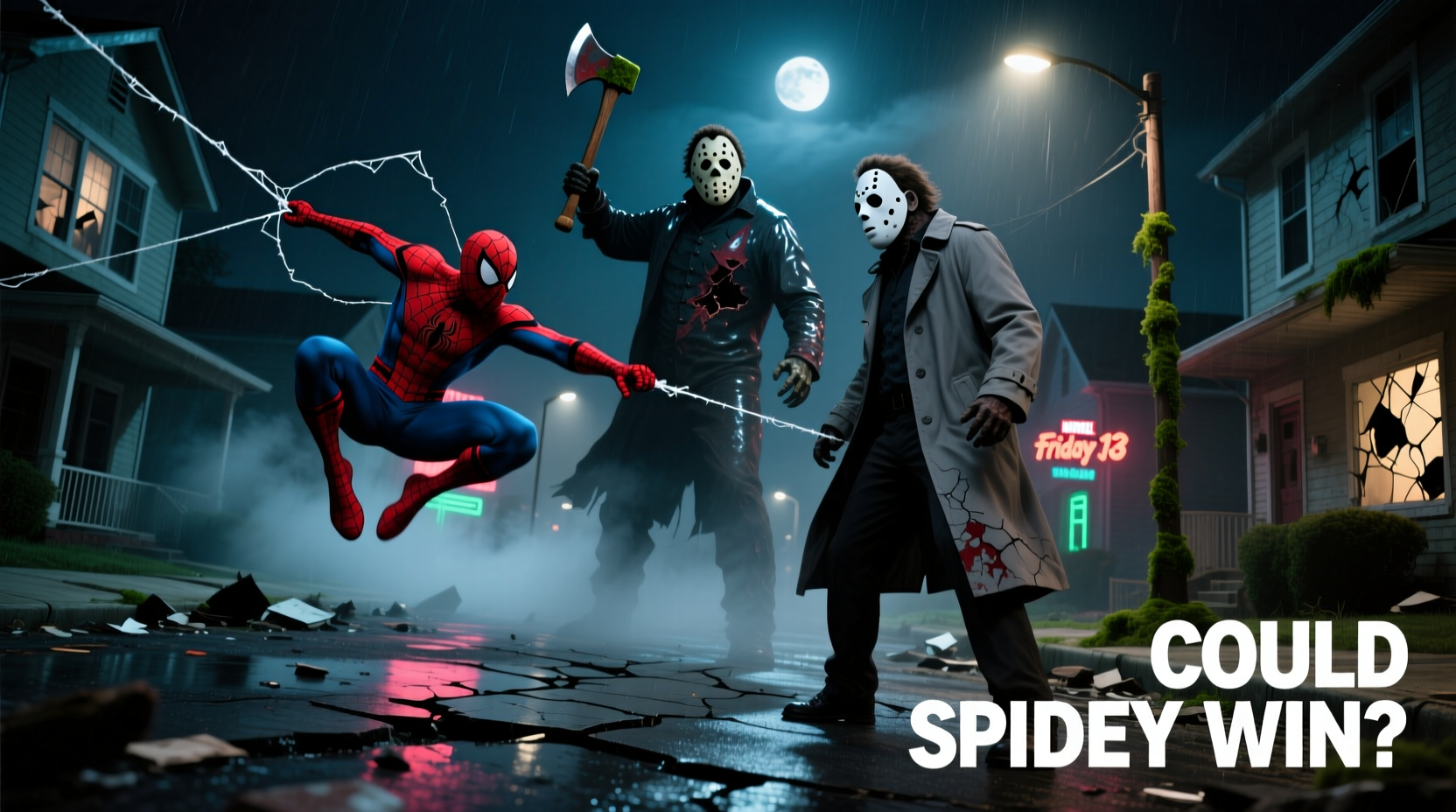
To assess who would win in a fight, we need to break down each character’s capabilities, limitations, and narrative roles.
Spider-Man: The Agile Hero
- Strength: Superhuman strength allowing him to lift up to 10 tons.
- Speed & Reflexes: Enhanced far beyond human limits; capable of dodging bullets at close range.
- Wall-Crawling: Can scale any surface, giving him superior mobility and tactical positioning.
- Web-Shooters: Provide restraint, distance attacks, and rapid repositioning.
- Spidey-Sense: A precognitive warning system that alerts him to danger before it happens.
- Intellect: Genius-level mind with expertise in chemistry, engineering, and strategy.
Spider-Man is not just a brawler—he’s a tactician. He uses his environment, improvises weapons, and avoids unnecessary confrontation when possible.
Michael Myers: The Shape
- Endurance: Nearly impervious to pain and injury; survives gunshots, stabbings, explosions.
- Stamina: Capable of prolonged stalking and silent movement over hours or days.
- Stealth: Moves silently, often appearing without warning.
- Supernatural Aura: In several film iterations, especially post-1978, he’s implied to be cursed or immortal.
- Weakness: No super-speed or ranged attack capability; relies on proximity and surprise.
“Michael Myers isn’t evil, he simply is.” — Dr. Sam Loomis, Halloween II
This quote captures the essence of Michael: an almost elemental force of nature rather than a conventional villain.
Jason Voorhees: The Undead Avenger
- Resurrection: Dies repeatedly but returns, often due to supernatural forces tied to Camp Crystal Lake.
- Strength: Possesses immense brute force—can rip doors off hinges and hurl grown men.
- Durability: Survives decapitation, drowning, and being blown apart.
- Weapon Mastery: Prefers machetes, spears, and improvised tools.
- Weakness: Slower than Spider-Man; lacks agility or intelligence-based tactics.
Like Michael, Jason functions more as a myth than a man—a vengeful spirit bound to punish wrongdoing.
Battle Dynamics: How Would These Fights Play Out?
Let’s simulate two separate encounters: one-on-one with Michael Myers, then with Jason Voorhees. We’ll assume Spider-Man knows who they are and what they’re capable of.
Fight 1: Spider-Man vs Michael Myers
In a direct physical confrontation, Spider-Man holds every advantage. Michael cannot match Spidey’s speed, reflexes, or aerial mobility. A single well-placed web blast could pin Michael long enough for Spidey to escape or incapacitate him temporarily.
However, Michael’s true threat lies in ambush and persistence. If Spider-Man lets his guard down—even for a moment—Michael might strike. The key factor here is Spider-Man’s “spidey-sense,” which should detect imminent threats. But if Michael’s presence is so unnatural that it bypasses precognition (as suggested in some lore interpretations), that edge diminishes.
Fight 2: Spider-Man vs Jason Voorhees
This fight plays out similarly, though Jason is physically stronger and more aggressive. He wouldn’t stalk quietly—he’d charge. That makes him easier to anticipate. Spider-Man could use webs to disarm Jason, trap him mid-swing, or suspend him from a building.
The real challenge comes after the initial takedown. Both slashers have shown the ability to return after apparent defeat. Even if Spider-Man webs Jason to a rooftop and leaves him there, there’s no guarantee Jason won’t eventually break free—or come back later.
Power Comparison Table
| Attribute | Spider-Man | Michael Myers | Jason Voorhees |
|---|---|---|---|
| Strength | 10+ tons lifting capacity | Average to slightly above human | Superhuman (tears through steel) |
| Speed/Agility | Superhuman reflexes, wall-crawling | Slow, deliberate movements | Moderate; lumbering but sudden bursts |
| Durability | Enhanced healing, resistant to impact | Extremely high (survives fatal injuries) | Near-immortal (resurrects repeatedly) |
| Combat Intelligence | Tactical genius, improvisational fighter | Relies on stealth and repetition | Limited reasoning, brute-force approach |
| Ranged Capability | Webs, gadgets | Knife throws (rarely) | Spears, throwing weapons occasionally |
| Weakness | Vulnerable to sonic attacks, distraction | Unknown; possibly fire or ritual destruction | Water (origin tie), complete disintegration |
Can Spider-Man Actually Win?
The answer depends on how strictly we interpret the rules of each universe.
In a standard Marvel continuity, where supernatural elements are acknowledged but not dominant, Spider-Man could neutralize both threats—temporarily. He could web them into containment units, deliver them to S.H.I.E.L.D., or even destroy their bodies using extreme heat or deep-sea disposal.
But neither Michael nor Jason stays dead. Their persistence is part of their mythos. As long as fear and trauma persist, so do they. This introduces a philosophical layer: can a hero truly “win” against a symbol of eternal evil?
Expert Insight: The Nature of Immortal Antagonists
“In horror fiction, monsters like Michael and Jason aren’t meant to be defeated permanently. They represent unresolved guilt, societal neglect, or primal fears. A superhero might stop them today, but the story demands they return tomorrow.” — Dr. Lena Torres, Pop Culture Analyst & Horror Scholar
This insight reframes the question. Instead of asking “who would win,” we might ask: “what kind of victory is possible?” For Spider-Man, defeating evil isn’t just about physical combat—it’s about protecting the innocent and restoring hope.
Checklist: How Spider-Man Could Neutralize the Threat
- Use Spidey-Sense to detect ambush attempts – Prevent surprise attacks from either slasher.
- Establish perimeter control – Web up entry points and set early-warning traps.
- Disable mobility – Restrain legs or anchor them to structures using reinforced webbing.
- Call for backup – Alert heroes with experience in supernatural threats (e.g., Doctor Strange).
- Dispose of bodies strategically – Submerge in ocean trenches or incinerate remains to delay resurrection.
- Protect civilians first – Prioritize evacuation over confrontation.
Mini Case Study: The Warehouse Showdown
Imagine Spider-Man tracks Jason to an abandoned warehouse near Queens. The air is damp, machinery looms in shadows, and the floor creaks underfoot. Spidey arrives cautiously, spidey-sense tingling.
Jason lunges from behind a stack of crates, machete raised. Spidey flips backward, firing a web-line that yanks the weapon from Jason’s grip. Another shot pins Jason’s arm to a steel beam. Within seconds, Spidey has wrapped him head-to-toe in webbing and suspended him from the ceiling.
He radios in for help—maybe Iron Man can analyze the body for weaknesses. But as Spidey swings away, a low groan echoes below. The webbing strains. Something ancient stirs. The fight may be over… but the nightmare isn’t finished.
FAQ
Could Michael Myers sneak up on Spider-Man?
Unlikely. Spider-Man’s spidey-sense reacts to imminent danger, regardless of visibility. Unless Michael’s presence somehow exists outside normal perception (as implied in *Halloween Ends*), Spidey would sense the threat before contact.
Has Spider-Man ever fought supernatural beings?
Yes. He’s battled demons, ghosts, and mystical entities—often alongside Doctor Strange or the Midnight Sons. While not his specialty, he adapts quickly to paranormal threats.
Would silver or fire work against Jason or Michael?
In their respective canons, fire and complete bodily destruction have delayed both. Jason was incinerated in *Friday the 13th Part VIII*, only to return. Michael has been burned, shot, and stabbed—yet always comes back. True “defeat” may require ritualistic or metaphysical solutions beyond physical force.
Conclusion: The Real Winner Is Strategy
Could Spider-Man beat Michael Myers and Jason Voorhees? In a straight-up fight—yes, decisively. His speed, intellect, and versatility give him overwhelming advantages. But permanent victory? That’s another matter entirely.
These horror icons endure because they represent something deeper than flesh and bone. They are manifestations of fear, trauma, and inevitability. Spider-Man, on the other hand, embodies resilience, responsibility, and hope. In that sense, the battle transcends fists and webs—it becomes symbolic.
If you enjoyed this deep dive into genre-crossing showdowns, consider sharing your own matchups. Who should Spider-Man face next? A xenomorph? Freddy Krueger? Let the debate begin.




 浙公网安备
33010002000092号
浙公网安备
33010002000092号 浙B2-20120091-4
Comments
No comments yet. Why don't you start the discussion?