
When it comes to choosing a music streaming service, sound quality and library size matter—but for many users, the real test lies in how well the platform understands their taste. Spotify Premium and YouTube Music are two of the most popular paid services globally, each offering personalized playlists, curated recommendations, and seamless mobile experiences. But beneath the surface, their recommendation engines operate on fundamentally different philosophies. One leans heavily on behavioral data and collaborative filtering; the other leverages Google’s vast video ecosystem and search behavior. So, is one algorithm actually better—or just different?
How Recommendation Algorithms Work: The Core Principles
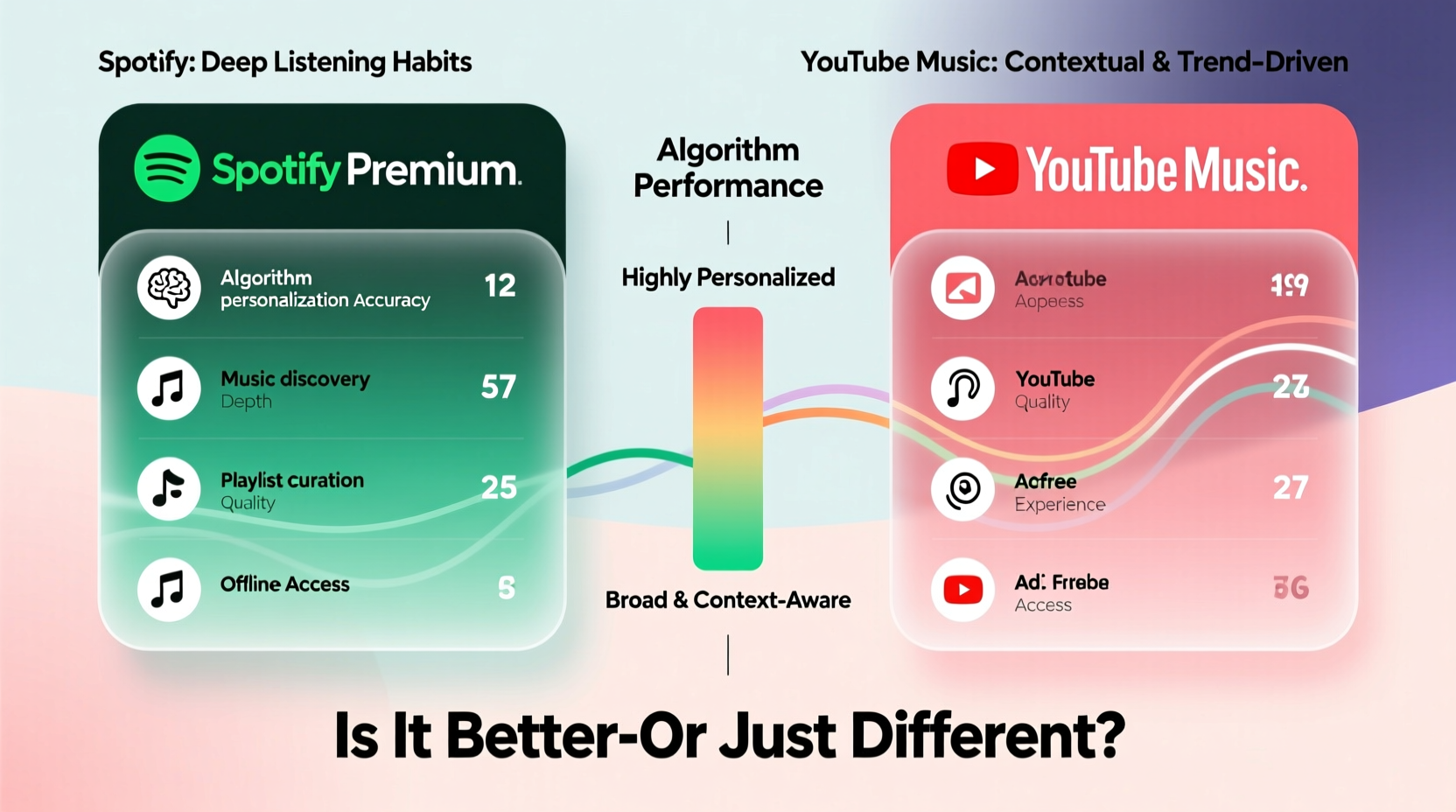
At their core, both Spotify and YouTube Music rely on machine learning models trained on massive datasets. However, the nature of those datasets—and how they’re interpreted—shapes the listening experience in distinct ways.
Spotify's algorithm primarily uses what’s known as collaborative filtering, which analyzes patterns across millions of users with similar tastes. If people who enjoy Billie Eilish also tend to listen to Clairo and Phoebe Bridgers, the system infers that you might too if you’ve shown interest in any of them. It also incorporates audio analysis—examining tempo, key, energy, and danceability—to recommend tracks with similar sonic characteristics.
YouTube Music, by contrast, benefits from Google’s broader data footprint. Its algorithm considers not only your music history but also your YouTube watch behavior, search queries, location, time of day, and even device type. This allows for context-aware suggestions—like recommending upbeat workout tracks when you open the app at 6 a.m. on a weekday.
“Algorithms aren’t neutral—they reflect design priorities. Spotify optimizes for musical discovery within a closed ecosystem; YouTube Music thrives on intent and context.” — Dr. Lena Patel, AI Researcher at MIT Media Lab
A Side-by-Side Comparison: Key Differences in Approach
| Feature | Spotify Premium | YouTube Music |
|---|---|---|
| Data Sources | User listening history, playlist interactions, audio features | Music streams, YouTube video views, Google search history, location |
| Discovery Focus | Musical similarity and community trends (e.g., Discover Weekly) | Intent-based suggestions (e.g., “songs like this live version”) |
| Personalization Depth | High within music; limited external context | Broad, incorporating non-music behaviors |
| Live/Alternate Versions | Rarely included unless officially released | Frequently recommended due to YouTube content |
| New Artist Discovery | Strong via editorial + algorithmic curation | Dependent on upload visibility and search volume |
| Offline Listening | Full access to entire catalog when downloaded | Some videos may have download restrictions |
The table highlights a fundamental divergence: Spotify treats music as an isolated cultural artifact, while YouTube Music sees it as part of a larger digital footprint. Neither approach is inherently superior—it depends on what kind of listener you are.
Real-World User Experience: Who Gets It Right More Often?
To understand how these algorithms perform outside lab conditions, consider a realistic scenario:
Mini Case Study: The Indie Rock Listener
Sophia, a 29-year-old graphic designer, listens to indie rock, lo-fi beats, and occasional jazz. She uses Spotify during her commute and YouTube Music while working. Over three months, she noticed key differences:
- Spotify consistently delivered high-quality indie discoveries through Discover Weekly and Daily Mixes, introducing her to emerging artists like Wet Leg and Arlo Parks before they went mainstream.
- YouTube Music, however, picked up on her habit of watching full concert films late at night and began suggesting extended live versions of songs she liked—something Spotify rarely surfaces.
- When she searched for “chill guitar riffs,” YouTube Music returned ambient YouTube uploads and session recordings, while Spotify offered polished studio tracks from similar genres.
In Sophia’s case, both platforms excelled in different areas. Spotify was better at expanding her musical horizons within established release channels. YouTube Music responded more intuitively to her exploratory behavior, especially around unofficial or rare content.
This duality reflects a broader trend: Spotify leads in curated discovery, while YouTube Music shines in contextual relevance.
Optimizing Your Experience: A Step-by-Step Guide
You don’t have to choose sides. With intentional use, you can leverage the strengths of both platforms. Here’s how:
- Train Spotify with intentional feedback: Like, save, and share tracks actively. Skip disliked songs promptly—this signals preference more strongly than passive listening.
- Use YouTube Music for deep dives: Search for specific moods (“rainy day piano”), live sessions, or covers. Let your browsing history inform richer suggestions over time.
- Cross-pollinate playlists: Export favorite Spotify discoveries and import them into YouTube Music (via third-party tools like Soundiiz) to enrich its understanding of your taste.
- Clear misleading data: On YouTube Music, periodically review and remove watched videos or searches that skew recommendations (e.g., kids’ songs played for a nephew).
- Reset algorithms when needed: Start fresh playlists, unfollow old ones, and avoid autoplaying generic mixes that dilute personalization.
Actionable Checklist: Maximize Algorithm Performance
Follow this checklist monthly to keep your recommendations sharp and aligned with your evolving taste:
- ✅ Rate at least 5 new songs per week (like/save)
- ✅ Delete or hide irrelevant recommendations
- ✅ Update your \"Liked Songs\" playlist regularly
- ✅ Explore one new genre or artist intentionally
- ✅ Review and refine your top playlists (remove outdated tracks)
- ✅ Use private/incognito mode for outlier listening (e.g., wedding music)
- ✅ Sync your listening habits across devices for consistent profiling
Expert Insights: What Industry Leaders Say About Music AI
The debate over algorithmic superiority isn’t just user-driven—engineers and researchers have strong opinions about where each platform stands.
“Spotify has invested heavily in ‘taste profiles’—mapping not just what you listen to, but *how* you listen. That granularity gives it an edge in consistency.” — Amir Chen, Former Data Scientist at Spotify
“YouTube Music doesn’t just recommend songs—it predicts intent. If you’re searching for ‘guitar practice backing tracks,’ it knows you’re not just relaxing; you’re engaging. That’s powerful.” — Nia Johnson, Machine Learning Engineer at Google
These insights underscore a crucial point: effectiveness depends on goals. For casual listeners seeking comfort and familiarity, Spotify’s stable, mood-aligned playlists may feel more satisfying. For curious explorers or fans of live/unreleased material, YouTube Music’s flexibility offers unique value.
Frequently Asked Questions
Is Spotify’s Discover Weekly better than YouTube Music’s recommendations?
It depends. Discover Weekly is widely praised for its accuracy and freshness, often surfacing obscure tracks from rising artists. However, YouTube Music’s \"New Releases Mix\" and \"Your Mix\" can be equally compelling—if you’ve engaged deeply with specific genres or artists. Spotify generally wins on consistency; YouTube Music on surprise and variety.
Can I improve YouTube Music’s algorithm if I mostly use regular YouTube?
Yes. Since both platforms share data, your music preferences will gradually emerge from your viewing habits. To accelerate this, actively like music videos, create playlists, and use voice search (“play mellow synthwave”). Over time, the app learns to distinguish between background noise and intentional listening.
Do both services use the same audio analysis technology?
No. Spotify uses its proprietary Echo Nest technology to analyze hundreds of acoustic attributes per track. YouTube Music relies more on metadata, user engagement, and contextual signals than deep audio fingerprinting. As a result, Spotify tends to make more musically coherent recommendations based on sound, while YouTube prioritizes popularity and relevance.
Conclusion: Better or Different? The Verdict
The question isn’t whether Spotify Premium’s algorithm is objectively better than YouTube Music’s—it’s whether it aligns with your listening identity. Spotify operates like a seasoned music critic, drawing connections between artists, eras, and styles based on structured data and expert curation. YouTube Music behaves more like a attentive friend who notices not just what you play, but when, where, and why.
If you value precision, consistency, and being introduced to vetted new music, Spotify likely feels smarter. If you appreciate serendipity, live performances, and having your real-world habits reflected in your feed, YouTube Music may seem more intuitive.
Rather than declaring a winner, the smartest move is to recognize that these algorithms serve different purposes. They are not competitors in a zero-sum game—they are complementary tools. By understanding their logic, training them deliberately, and using each for its strengths, you gain a richer, more dynamic relationship with music.




 浙公网安备
33010002000092号
浙公网安备
33010002000092号 浙B2-20120091-4
Comments
No comments yet. Why don't you start the discussion?