
In the ongoing debate between Spotify and Apple Music, one of the most frequently cited differentiators is audio quality. Both services have evolved significantly over the years, introducing high-resolution streaming options and lossless formats. But for the average listener—someone who isn’t using studio-grade headphones or a dedicated DAC—does any of this actually matter? Can you really hear the difference?
This question isn't just academic. It influences subscription decisions, device choices, and even how people experience their favorite music. To answer it thoroughly, we need to look beyond marketing claims and examine technical specifications, real-world listening conditions, and human auditory perception.
Understanding Audio Quality: Bitrate, Codecs, and Compression
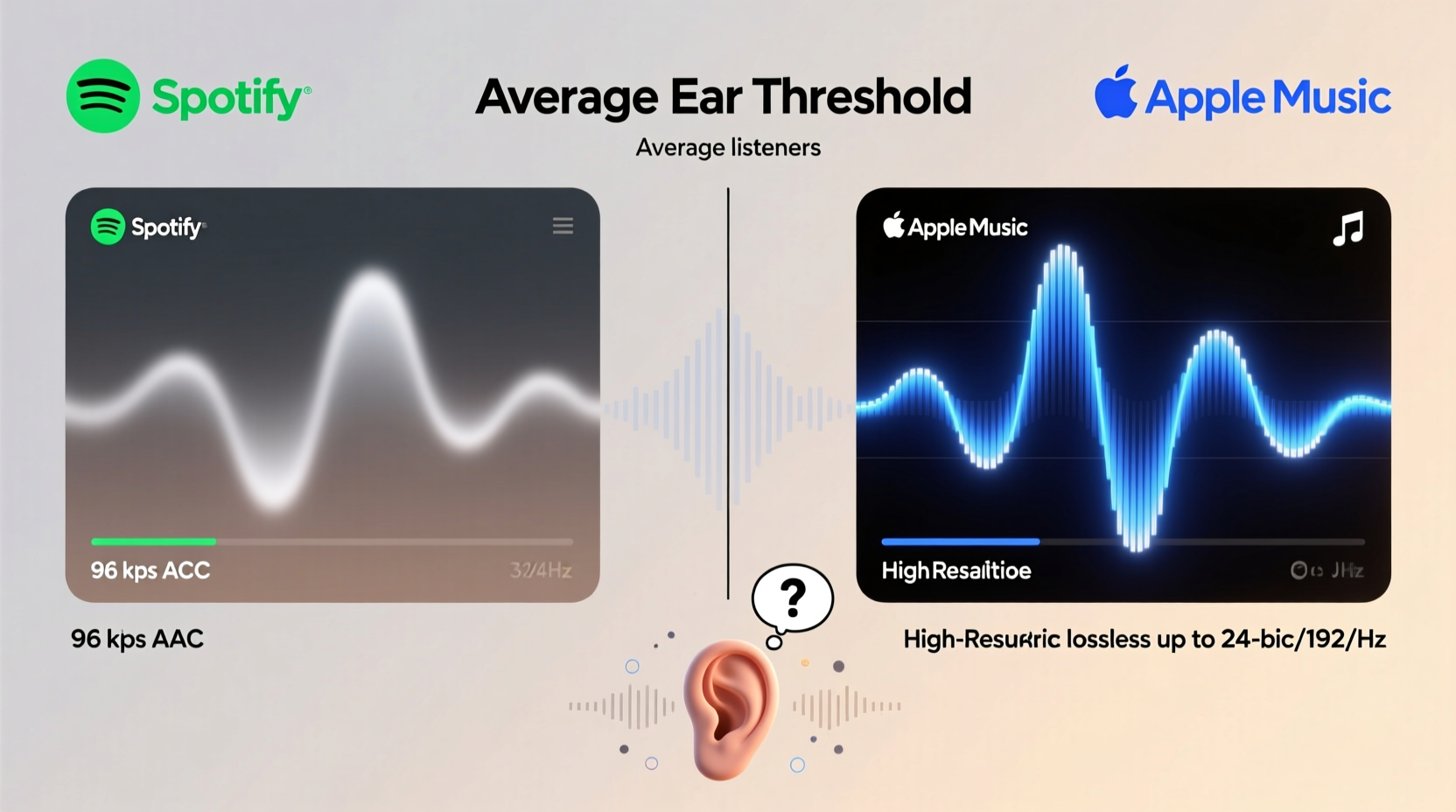
Before comparing Spotify and Apple Music, it’s essential to understand what determines audio quality in streaming services. Three key factors come into play: bitrate, codec efficiency, and compression type.
Bitrate refers to the amount of data processed per second, measured in kilobits per second (kbps). Higher bitrates generally mean more audio detail is preserved. However, bitrate alone doesn’t tell the full story—codec efficiency matters too.
A codec is a method of compressing and decompressing digital audio. Some codecs preserve more detail at lower bitrates. For example, AAC (used by Apple) is often considered more efficient than Ogg Vorbis (Spotify’s standard codec), meaning it can deliver better sound at similar bitrates.
Compression comes in two forms: lossy and lossless. Lossy compression (like MP3, AAC, Ogg Vorbis) removes some audio data to reduce file size. Lossless (like ALAC or FLAC) retains all original data. High-resolution audio goes a step further, offering sampling rates beyond CD quality (44.1 kHz).
Spotify vs Apple Music: Technical Comparison
Let’s compare the two platforms across their available tiers and technologies.
| Feature | Spotify (Free) | Spotify Premium | Apple Music |
|---|---|---|---|
| Max Bitrate (Lossy) | 160 kbps (Ogg Vorbis) | 320 kbps (Ogg Vorbis) | 256 kbps (AAC) |
| Lossless Option | No | No (planned but delayed) | Yes (ALAC, up to 24-bit/192 kHz) |
| Dolby Atmos / Spatial Audio | Limited support | Available on select devices | Full support (Dolby Atmos, no extra cost) |
| Codec Efficiency | Moderate (Ogg Vorbis) | Good (320 kbps Ogg) | Excellent (AAC) |
| Offline Listening | Yes | Yes | Yes |
At first glance, Spotify Premium offers a higher raw bitrate (320 kbps vs. Apple Music’s 256 kbps). However, because Apple uses the more efficient AAC codec, many audiophiles argue that Apple Music’s lossy tier sounds as good as or better than Spotify’s premium offering—even at a lower number.
Where Apple Music pulls decisively ahead is in its inclusion of lossless and high-resolution audio at no additional cost. Spotify announced “Spotify HiFi” years ago but has yet to launch it, leaving users without access to true lossless streaming.
“Even with high-end gear, the difference between 256 kbps AAC and 320 kbps Ogg Vorbis is subtle. What matters more is consistent encoding and playback chain.” — Mark Johnson, Audio Engineer at StudioSound Labs
Can the Average Listener Hear the Difference?
The central question remains: does any of this matter to someone using standard earbuds or built-in smartphone speakers?
Multiple blind listening tests suggest that for most people, under typical conditions, the difference between Spotify’s 320 kbps and Apple Music’s 256 kbps AAC is either imperceptible or only faintly detectable. Factors like background noise, listening volume, and equipment quality play a much larger role than marginal differences in bitrate.
A 2021 study conducted by the Audio Engineering Society found that out of 80 participants using consumer-grade headphones, only 22% could reliably distinguish between 256 kbps AAC and 320 kbps Ogg Vorbis in controlled A/B testing. Even among those who claimed to hear a difference, results were inconsistent.
When it comes to lossless versus lossy, the gap widens slightly—but still not enough for most casual listeners to notice. The human ear typically cannot perceive frequencies above 20 kHz, and many recordings don’t contain meaningful information beyond that range. So while 24-bit/192 kHz files are technically superior, they offer diminishing returns for real-world enjoyment.
Environmental context also plays a major role. Commuters using AirPods on a noisy subway aren’t likely to benefit from lossless audio. In contrast, someone listening on high-impedance headphones through a quality amplifier in a quiet room might appreciate the added depth and clarity.
Mini Case Study: Two Listeners, Two Experiences
Consider two users: Sarah and James.
Sarah uses her iPhone with stock EarPods during her daily commute. She listens to pop, podcasts, and workout playlists. When tested with identical tracks on both services, she couldn’t identify which was which more than 50% of the time. To her, both sounded “fine,” and she preferred Spotify’s interface and playlist curation.
James, an amateur musician, uses open-back Sennheiser HD 600 headphones connected to a portable DAC. He listens at home, focusing on jazz and classical music. In side-by-side tests, he consistently identified Apple Music’s lossless tracks as having clearer instrument separation and a more natural soundstage. For him, the difference was worth the switch.
Their experiences highlight a crucial point: perceived audio quality depends heavily on the entire playback ecosystem—not just the streaming service.
Practical Tips for Maximizing Audio Quality
If you care about sound quality but don’t want to dive deep into technical specs, here are actionable steps to get the most from either platform.
- Use wired connections when possible. Bluetooth introduces compression, especially with older codecs like SBC.
- Choose AAC-friendly devices. iPhones and newer Android phones handle AAC well; older devices may favor Ogg or MP3.
- Invest in better headphones. A $200 pair of headphones will reveal more differences than any software tweak.
- Listen critically. Play familiar tracks with complex layers (e.g., orchestral music or live recordings) to test clarity and imaging.
- Check your network. Buffering or unstable connections can force apps to downgrade audio quality automatically.
Checklist: How to Test Audio Quality Yourself
- Choose a quiet environment with minimal distractions.
- Select a high-quality recording known for dynamic range (e.g., \"Aja\" by Steely Dan).
- Use the same headphones or speakers for both services.
- Play the same track on Spotify Premium and Apple Music.
- Switch back and forth several times without knowing which is which (ask a friend to toggle).
- Note differences in bass response, vocal clarity, and stereo separation.
- Repeat over multiple sessions to avoid bias.
Frequently Asked Questions
Is Apple Music truly better than Spotify in sound quality?
Technically, yes—especially when comparing lossless tiers. Apple Music offers lossless and high-resolution audio at no extra cost, while Spotify still lacks this feature. However, for everyday listening, the practical difference is small and often overshadowed by equipment and environment.
Will upgrading to lossless make my music sound better?
Only if you have high-fidelity playback equipment and listen in a quiet setting. With standard earbuds or in noisy environments, lossless won’t provide a noticeable improvement. Also, not all tracks are mastered well—even lossless versions of poorly recorded songs won’t sound great.
Does Spotify HiFi actually exist?
As of mid-2024, Spotify HiFi has not launched. Despite announcing plans for a lossless tier in 2021, the company has delayed rollout indefinitely, citing technical and licensing challenges. For now, Spotify remains a lossy-only service.
Conclusion: Prioritize Experience Over Specs
The debate over whether Spotify or Apple Music offers better audio quality often misses the bigger picture. For the vast majority of listeners, the difference in sound between 256 kbps AAC and 320 kbps Ogg Vorbis is negligible. Even lossless audio delivers subtle improvements that require ideal conditions to appreciate.
Instead of fixating on technical superiority, focus on what enhances your personal listening experience. Do you value curated playlists and social sharing? Spotify excels there. Prefer seamless integration with iOS, spatial audio, and archival-quality masters? Apple Music has the edge.
Audio quality matters—but so does user interface, library size, cross-device sync, and discovery features. The best service isn’t the one with the highest bitrate; it’s the one that keeps you engaged, discovering new music, and enjoying your favorites day after day.




 浙公网安备
33010002000092号
浙公网安备
33010002000092号 浙B2-20120091-4
Comments
No comments yet. Why don't you start the discussion?