
Rivet earrings have long been a staple in minimalist and modern jewelry design. Known for their sleek, industrial-inspired aesthetic, they’re popular among those who appreciate clean lines and subtle statement pieces. But as more variations emerge—particularly in the form of square and round silhouettes—a question arises: does the shape of a rivet earring genuinely impact its wearability, longevity, or style significance? Or is the distinction purely a marketing-driven trend with no real-world difference?
This article dives into the functional, aesthetic, and cultural dimensions of square versus round rivet earrings to help you make informed choices based on substance—not just style.
The Anatomy of a Rivet Earring
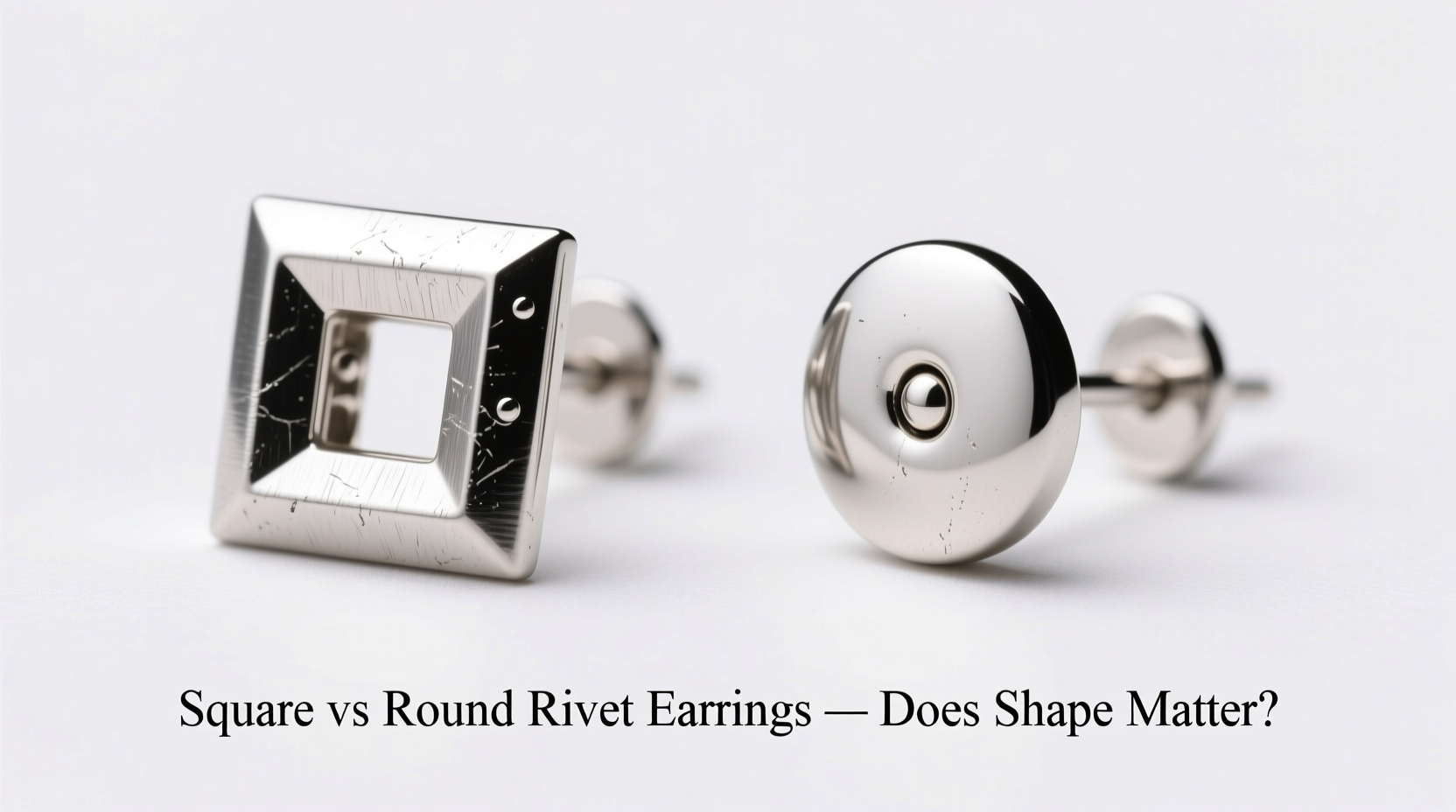
To understand how shape influences performance, it’s essential to first grasp what defines a rivet earring. Unlike traditional stud or hoop designs, rivet earrings mimic the look of mechanical fasteners. They typically consist of a flat backplate secured through the earlobe, with a visible front cap that resembles a bolt head. The \"rivet\" effect comes from the flush fit and metallic finish, often in stainless steel, titanium, or gold-plated alloys.
The two most common shapes—square and round—are not merely decorative choices. Each impacts how light reflects off the surface, how the earring feels during extended wear, and how it interacts with other accessories like glasses or hair.
Aesthetic Impact: Style Language of Shape
Shape carries meaning in design. Round forms are universally associated with softness, continuity, and approachability. In jewelry, circles suggest timelessness and fluidity. A round rivet earring tends to feel more organic, blending seamlessly with both casual and formal attire. It's less likely to draw attention to itself, making it ideal for understated elegance.
Square rivets, by contrast, project structure, precision, and modernity. Their sharp edges communicate intentionality and bold minimalism. Worn singly or in pairs, square rivets stand out subtly—perfect for those who want their accessories to reflect a deliberate sense of identity.
Fashion designers like Jil Sander and Helmut Lang have historically favored geometric rigor, often incorporating angular hardware into their collections. This legacy has influenced contemporary jewelry trends, where square rivets signal an affinity for architectural fashion.
“Shape isn’t just visual—it’s semantic. A square rivet says control and clarity; a round one whispers harmony and flow.” — Lena Torres, Jewelry Design Historian
Functional Differences: Comfort, Durability, and Practicality
Beyond aesthetics, practical considerations come into play. Let’s examine three key areas: comfort, durability, and compatibility.
Comfort During Wear
Round rivets generally offer smoother edges, reducing friction against clothing or skin. For sensitive ears or active lifestyles, this can mean fewer irritations. Square rivets, especially those with 90-degree corners, may catch on fabrics or press unevenly against the earlobe over time.
However, many premium brands now bevel or polish the edges of square rivets, mitigating discomfort. The quality of craftsmanship matters more than the inherent shape.
Durability and Structural Integrity
In engineering terms, round shapes distribute stress more evenly than angular ones. While this principle applies more dramatically to large-scale construction, microscopically, round rivets may resist cracking at stress points better than squares—especially under repeated pressure (e.g., sleeping on one side).
That said, most rivet earrings are small enough that material thickness and alloy composition outweigh shape-related weaknesses. Stainless steel or titanium models, regardless of geometry, tend to outlast thinner, plated versions.
Compatibility with Other Accessories
Glasses wearers may find square rivets interfere more with temple arms due to protruding corners. Similarly, people who frequently use helmets, headphones, or VR gear might prefer round profiles for seamless integration.
| Factor | Round Rivets | Square Rivets |
|---|---|---|
| Edge Comfort | Smooth, low friction | Potential snagging (unless polished) |
| Style Flexibility | High – works with all aesthetics | Moderate – leans avant-garde |
| Durability | Slightly better stress distribution | Depends on edge finishing |
| Fashion Statement | Subtle, timeless | Bold, intentional |
| Accessory Compatibility | Excellent with glasses/headphones | May cause interference |
Market Trends vs. Timeless Design
There’s no denying that square rivets have gained momentum in recent years, particularly within gender-neutral and techwear fashion circles. Social media platforms like Instagram and TikTok have amplified niche styles, turning once-avant-garde details into mainstream staples.
But popularity doesn’t equate to permanence. Round rivets remain dominant in classic minimalist lines from brands like Mejuri, Monica Vinader, and Alighieri. These companies prioritize versatility and emotional resonance—qualities often linked to circular motifs.
The rise of square rivets aligns with broader cultural shifts toward individuality and deconstructed norms. Yet, as trends cycle, many consumers return to foundational pieces. The risk with overly trendy shapes is obsolescence: wear them too long after the moment passes, and they may read as dated rather than daring.
Mini Case Study: Emma’s Capsule Jewelry Edit
Emma, a 34-year-old brand strategist in Berlin, decided to streamline her jewelry collection to ten core pieces. She owned both square and round rivet earrings—one from a limited-edition designer line, the other a simple round pair from a sustainable brand.
After tracking usage over three months, she found she reached for the round pair 80% of the time. “The square ones felt ‘costume-y’ after a while,” she admitted. “They were perfect for events, but I wanted something effortless for daily wear.”
She kept the square set for creative meetings and nights out but donated duplicates. Her takeaway? Shape affects frequency of use more than she expected. Functionality won over novelty.
How to Choose Based on Your Lifestyle
Selecting between square and round shouldn’t hinge solely on what’s trending. Instead, follow these steps to align your choice with personal needs.
- Assess your wardrobe palette: Do you lean toward structured tailoring (favoring square) or flowing, organic shapes (suited to round)?
- Evaluate daily activities: If you wear glasses, work out regularly, or drive often, prioritize comfort and non-interference.
- Consider long-term wear: Ask yourself: will I still love this shape in two years? Round tends to age more gracefully.
- Test before committing: Try both styles in person if possible. Pay attention to how they feel after several hours.
- Check material quality: High-polish finishes and hypoallergenic metals matter more than shape when it comes to longevity.
FAQ
Are square rivet earrings harder to clean than round ones?
Not significantly. Both require gentle wiping with a microfiber cloth. However, square designs with sharp grooves may trap debris slightly more, so occasional brushing with a soft toothbrush is advisable.
Can I wear square and round rivets together?
Absolutely. Mixing shapes can create intentional asymmetry, a hallmark of contemporary styling. Just ensure the metal tone and size are consistent for cohesion.
Do square rivets damage earlobes over time?
No evidence suggests shape alone causes damage. Poor fit, low-quality materials, or improper insertion are greater risks. Always ensure posts are securely anchored and edges are smooth.
Conclusion: Shape Matters—But Not How You Might Think
The debate between square and round rivet earrings isn't about which is objectively better—it's about alignment. Alignment with your lifestyle, aesthetic values, and long-term habits. While trends may elevate one shape over the other seasonally, true style endurance lies in thoughtful selection.
Round rivets offer timeless adaptability and ergonomic ease. Square rivets provide a platform for self-expression and modern flair. Neither is inherently superior; each serves a purpose.




 浙公网安备
33010002000092号
浙公网安备
33010002000092号 浙B2-20120091-4
Comments
No comments yet. Why don't you start the discussion?