
As remote work and hybrid office models become the norm, professionals are rethinking how they stay active during the workday. Sedentary behavior has long been linked to health risks, including cardiovascular disease, weight gain, and metabolic slowdown. Enter two popular solutions: the standing desk treadmill and the under-desk elliptical. Both promise to help you burn calories without sacrificing productivity—but which one actually delivers more effective calorie burn while you work?
This article breaks down the science, mechanics, and real-world usage of both devices to determine which is better for energy expenditure. We’ll also explore how intensity, posture, and individual physiology influence results—so you can make an informed decision based on your goals.
How Calorie Burn Works During Light Activity
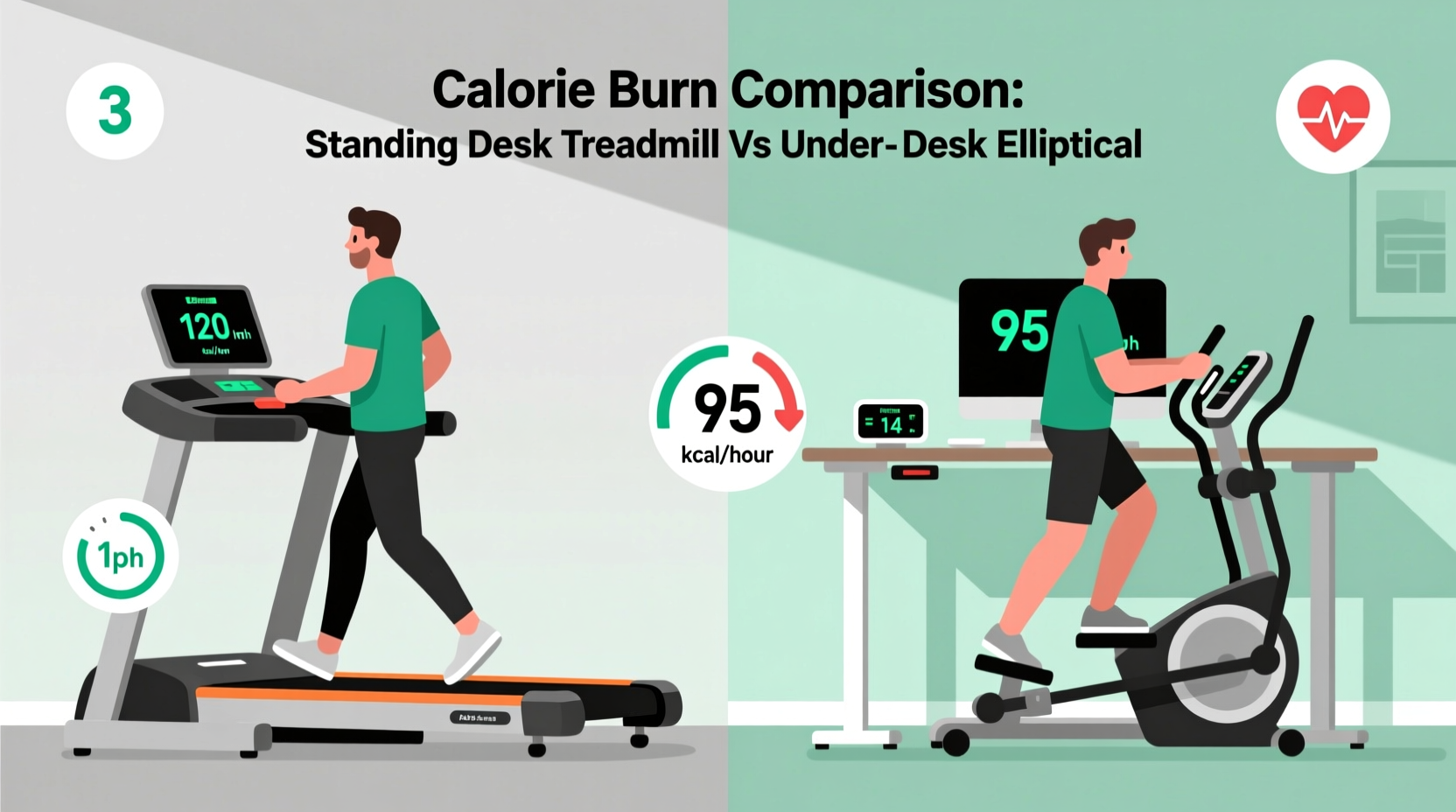
Before comparing equipment, it’s essential to understand how the body burns calories during low-intensity movement. Unlike vigorous exercise, walking or pedaling slowly doesn’t spike heart rate dramatically, but it does increase energy expenditure above resting levels. The key metric here is MET (Metabolic Equivalent of Task), which measures the energy cost of physical activities.
Sitting at a desk typically registers around 1.0–1.3 METs. Standing increases that to about 1.5 METs. Light walking ranges from 2.0 to 3.0 METs, while slow pedaling may fall between 1.8 and 2.5 METs, depending on resistance and effort.
Calories burned per hour can be estimated using this formula:
Calories/hour = MET × body weight in kg × 0.0175
For example, a 70 kg (154 lb) person walking at 2.0 METs would burn approximately 2.0 × 70 × 0.0175 = 24.5 kcal/hour above baseline. While this may seem modest, over an 8-hour workday, that adds up to nearly 200 extra calories—equivalent to a small meal or a short gym session.
Standing Desk Treadmill: How It Works and Calorie Impact
A standing desk treadmill combines a motorized walking platform with a height-adjustable desk. Users walk at very slow speeds—typically between 0.5 and 2.0 mph—while typing, reading, or attending meetings. The goal isn't cardio training but sustained light movement to offset sitting.
At 1.0 mph, walking burns roughly 2.0 METs. At 2.0 mph, that rises to about 2.8–3.0 METs. For most users, staying productive limits speed to the lower end of that range. Faster paces introduce balance challenges and reduce typing accuracy.
Studies support moderate calorie gains. A 2018 study published in Occupational Medicine found that employees using treadmill desks increased their daily energy expenditure by 60–120 kcal, depending on duration and pace.
Pros and Cons of Treadmill Desks
- Pros: Higher potential calorie burn, full-body engagement, improved circulation, easier transition from sitting to moving.
- Cons: Expensive ($400–$1,500+), noisy, requires significant floor space, may disrupt concentration at higher speeds.
Under-Desk Elliptical: Functionality and Energy Expenditure
An under-desk elliptical is a compact machine that fits beneath a standing or seated desk. It uses smooth, gliding motions to simulate cross-training movement. Resistance levels can often be adjusted manually or digitally, allowing users to increase intensity without changing position.
The motion primarily engages leg muscles—quadriceps, hamstrings, and calves—but involves minimal upper-body activation unless paired with arm levers (available on select models). Because the movement is seated or semi-standing, core engagement is lower than with a treadmill.
In terms of MET values, most under-desk ellipticals operate between 1.8 and 2.5 METs at moderate resistance. A 2020 study from the Journal of Sports Science & Medicine showed participants burned an average of 100–140 extra calories over four hours using an under-desk elliptical at medium resistance—about 25–35 kcal/hour above rest.
While not as intense as brisk walking, the elliptical allows consistent use throughout the day due to its quiet operation and non-disruptive design.
Advantages and Limitations
- Advantages: Affordable ($100–$300), portable, silent, compatible with standard desks, easy to start/stop.
- Disadvantages: Lower calorie burn ceiling, limited muscle recruitment, less impact on posture or spinal decompression compared to standing.
Direct Comparison: Which Burns More Calories?
To determine which device offers superior calorie burn, we must compare typical usage scenarios—not just maximum capabilities.
| Feature | Treadmill Desk | Under-Desk Elliptical |
|---|---|---|
| Average Speed / Resistance | 1.0–2.0 mph | Medium resistance |
| MET Range | 2.0–3.0 | 1.8–2.5 |
| Calories/Hour (70kg person) | 35–60 kcal | 25–45 kcal |
| Typical Daily Use Duration | 2–4 hours | 4–6 hours |
| Total Daily Burn (Est.) | 70–240 kcal | 100–270 kcal |
| Noise Level | Moderate to high | Low |
| Floor Space Required | Large | Minimal |
At first glance, the treadmill appears superior in hourly burn rate. However, the under-desk elliptical often wins in total daily contribution because it’s easier to use continuously. Most people cannot walk for 6–8 hours straight without discomfort or distraction. In contrast, pedaling gently under the desk feels natural and sustainable for longer durations.
“While treadmill desks offer higher peak calorie burn, user adherence tends to be lower. The elliptical’s comfort and discretion lead to greater cumulative activity.” — Dr. Lena Patel, Occupational Health Researcher, University of Michigan
Real-World Usage: A Mini Case Study
Consider Sarah, a 34-year-old software developer who spends eight hours daily at her computer. She tried both devices over a six-month period.
With the treadmill desk, she started strong—walking 30 minutes each morning and afternoon at 1.5 mph. However, after three weeks, she noticed increased lower back stiffness and difficulty focusing during coding sessions. Her average walking time dropped to just 1.5 hours per day.
She then switched to an under-desk elliptical. Though the motion felt less “active,” she could pedal almost all day—at first lightly, then increasing resistance during breaks. Over time, she averaged five hours of use daily. Despite the lower intensity, her weekly calorie deficit was 20% higher than with the treadmill.
Sarah’s experience reflects a broader trend: sustainability often trumps peak performance when integrating fitness into work life.
Maximizing Calorie Burn: Practical Strategies
Regardless of which device you choose, several techniques can enhance calorie expenditure without compromising work quality.
Step-by-Step Guide to Optimize Active Workstation Use
- Start Gradually: Begin with 15–20 minute sessions twice a day to build stamina and adapt neuromuscular coordination.
- Monitor Intensity: Use a fitness tracker to ensure your heart rate stays 20–40 bpm above resting. This indicates light aerobic activity without overexertion.
- Incorporate Resistance: On ellipticals, increase resistance every few days. On treadmills, slightly raise incline if available.
- Alternate Postures: Combine sitting, standing, and moving phases. Example: 30 min seated, 30 min elliptical, 30 min standing (no movement), 30 min walking.
- Stay Hydrated: Drinking water encourages brief movement breaks and supports metabolism.
- Track Progress: Log daily usage and perceived exertion to identify patterns and improvements.
Checklist: Choosing the Right Option for You
- ✅ Do you have enough space for a treadmill desk? (Requires ~4' x 2' clear area)
- ✅ Is noise a concern? (Treadmills can disrupt calls; ellipticals are quieter)
- ✅ Can you maintain focus while walking slowly?
- ✅ Are you aiming for higher intensity or longer duration?
- ✅ What’s your budget? (Ellipticals are generally more affordable)
- ✅ Do you prefer standing or sitting while working?
- ✅ Will you actually use it consistently?
Your choice should align not only with calorie goals but also with lifestyle compatibility. A device that collects dust burns zero calories.
Frequently Asked Questions
Can I lose weight using a treadmill or elliptical desk?
Yes, but gradually. Burning an extra 100–200 calories daily can lead to 1–2 pounds of fat loss per month, assuming no compensatory eating. Combined with diet control and occasional structured exercise, these tools support sustainable weight management.
Which is safer for joints—treadmill or elliptical?
The under-desk elliptical is generally gentler on joints. It provides a smooth, low-impact glide with no foot strike force. Treadmill walking is still low-impact compared to running, but repetitive heel striking over hours may aggravate knee or plantar fascia issues in susceptible individuals.
Do these devices improve focus or energy levels?
Many users report enhanced alertness and reduced afternoon fatigue. Light movement boosts cerebral blood flow and dopamine production. However, complex cognitive tasks may suffer slightly during treadmill use due to divided attention. Simpler, rhythmic motion like elliptical pedaling tends to be less disruptive.
Final Verdict: Which Burns More Calories Overall?
If comparing peak hourly calorie burn, the standing desk treadmill wins. Walking at even 1.5 mph engages more muscle mass and requires greater metabolic effort than seated pedaling.
However, when considering realistic, long-term usage, the under-desk elliptical often leads in total daily calorie expenditure. Its unobtrusive design allows for extended use—up to 6 or more hours a day—without fatigue or distraction. Over time, those extra hours compound into meaningful energy burn.
The best choice depends on your priorities:
- Choose a treadmill desk if you want higher-intensity movement, stand frequently anyway, and have space/budget.
- Opt for an under-desk elliptical if you prefer seated work, value quiet operation, and prioritize consistency over intensity.
Some users even combine both—using the treadmill in the morning and switching to the elliptical in the afternoon—to balance benefits.
Take Action Today: Move More, Sit Less
The real winner isn’t one device over another—it’s the decision to move while you work. Whether you walk slowly or pedal gently, the cumulative effect of replacing sedentary time with light activity reshapes your metabolic health, supports weight control, and enhances mental clarity.
Don’t wait for the “perfect” setup. Start where you are. Even 30 minutes a day on any active workstation makes a difference. Try a trial period with one device, track how you feel, and adjust accordingly.




 浙公网安备
33010002000092号
浙公网安备
33010002000092号 浙B2-20120091-4
Comments
No comments yet. Why don't you start the discussion?