
In an era where knowledge work dominates, the average office worker spends nearly 6.5 hours a day seated at a desk. As remote and hybrid work become standard, more people are reevaluating their workspace setups—not just for comfort, but for long-term physical health and mental performance. The debate between standing desks and sitting desks has moved beyond trendiness into serious ergonomic and cognitive science territory. While both have advantages, understanding how each affects posture and concentration over time is crucial for sustainable productivity.
The human body wasn't designed for prolonged stillness. Sitting for extended periods has been linked to poor spinal alignment, reduced circulation, and even decreased cognitive function. Standing all day isn’t a perfect solution either—without proper technique and balance, it can lead to fatigue, varicose veins, and lower back strain. The real question isn’t whether one is universally better than the other, but how each impacts your ability to maintain good posture and stay mentally sharp throughout the workday—and over months or years of use.
The Postural Impact of Sitting Desks
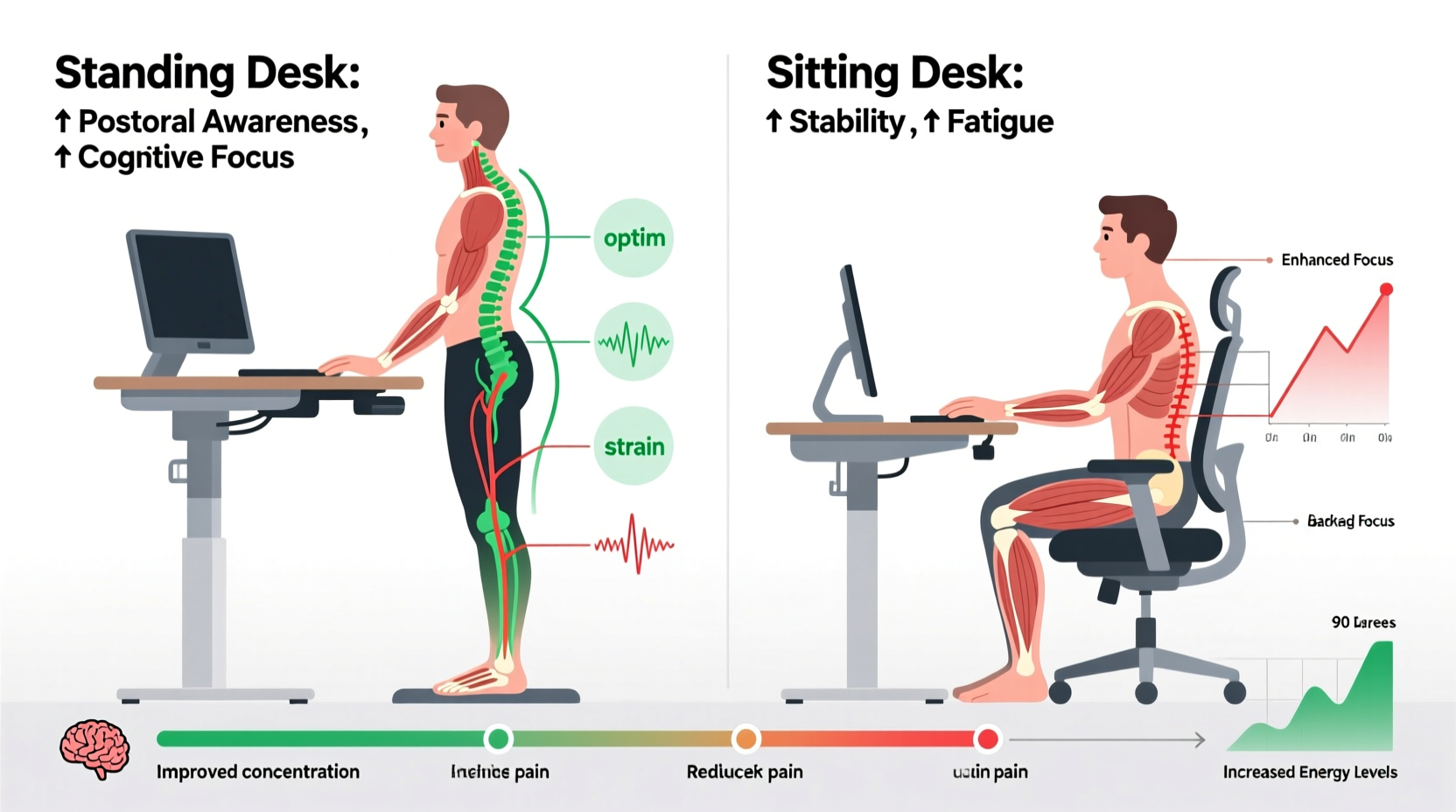
Sitting desks have dominated workplaces for decades, largely due to convenience and tradition. However, research increasingly shows that prolonged sitting disrupts natural spinal mechanics. When seated, especially in non-ergonomic chairs, the pelvis tilts backward, flattening the lumbar curve and placing pressure on intervertebral discs. Over time, this contributes to kyphosis (rounded upper back), forward head posture, and weakened core muscles.
A 2018 study published in Applied Ergonomics found that office workers using traditional sitting desks showed measurable increases in thoracic spine flexion and neck protraction after just four weeks of continuous use without movement breaks. These postural deviations not only cause discomfort but also reduce lung capacity and diaphragmatic breathing—factors indirectly tied to alertness and oxygen flow to the brain.
“Prolonged static sitting creates a cascade of biomechanical inefficiencies. The spine loses its natural curves, muscles deactivate, and neural signaling slows.” — Dr. Lena Torres, Biomechanist and Ergonomics Consultant
Additionally, sitting compresses the hip flexors and weakens gluteal muscles, creating muscular imbalances that affect gait and stability. While adjustable chairs and lumbar supports help, they don’t fully counteract the metabolic and structural downsides of remaining sedentary for hours.
How Standing Desks Influence Posture and Spinal Alignment
Standing desks promote a more upright, neutral posture when used correctly. By aligning the ears, shoulders, and hips vertically, users naturally engage their core and maintain a balanced stance. This reduces disc compression in the lower back and encourages activation of postural stabilizers like the transverse abdominis and erector spinae.
However, benefits depend heavily on setup and behavior. A poorly adjusted standing desk—one too high or too low—can cause shoulder hunching, wrist extension, or forward head tilt, negating any advantage. Moreover, standing statically for hours leads to fatigue and compensatory postures such as locking the knees or shifting weight unevenly, which may result in plantar fasciitis or pelvic misalignment.
The key lies in dynamic standing: shifting weight, using anti-fatigue mats, and incorporating micro-movements like gentle calf raises or pelvic tilts. Studies from the Journal of Physical Activity and Health indicate that workers who alternate between sitting and standing report significantly better posture scores after eight weeks compared to those who remain seated full-time.
Cognitive Performance: Does Standing Boost Focus?
Attention and mental clarity are influenced by blood flow, oxygen delivery, and neurotransmitter activity—all of which are affected by posture and movement. Research suggests that light physical activity, including standing, increases cerebral blood flow by up to 15%, enhancing executive function and working memory.
A 2020 randomized trial conducted at Texas A&M University observed knowledge workers using sit-stand desks over a 12-week period. Participants reported improved concentration, fewer attention lapses, and higher self-rated task engagement. Objective metrics, including keystroke analysis and error rates in data entry tasks, supported these findings: users made 17% fewer mistakes during standing intervals.
The mechanism appears to be twofold: first, standing activates the sympathetic nervous system mildly, increasing alertness without inducing stress. Second, frequent transitions between sitting and standing break monotony, reducing mental fatigue associated with sustained cognitive load.
That said, deep-focus tasks—such as coding, writing, or complex problem-solving—may benefit from a seated position, where stability allows for prolonged immersion. The ideal approach isn’t choosing one mode permanently, but cycling through both based on task type and energy levels.
Comparative Analysis: Standing Desk vs Sitting Desk
| Factor | Sitting Desk | Standing Desk |
|---|---|---|
| Posture Support | Moderate (with ergonomic chair); risk of slouching | High (when properly adjusted); promotes spinal neutrality |
| Muscle Engagement | Low; passive support leads to deactivation | Moderate to high; engages core, legs, glutes |
| Blood Circulation | Poor; reduced leg circulation after 30+ minutes | Improved; enhances venous return and oxygen flow |
| Cognitive Alertness | Declines over time due to sedentary state | Increases short-term focus and vigilance |
| Fatigue Onset | Late (after several hours), but often unnoticed | Earlier (1–2 hours), but more perceptible |
| Long-Term Injury Risk | Higher risk of disc degeneration, hip tightness | Lower back strain, foot pain if overused |
This comparison underscores that neither option is inherently superior. Instead, effectiveness depends on usage patterns, individual physiology, and environmental design.
Real-World Example: Transformation in a Tech Startup
At NovaFlow, a mid-sized software development firm, leadership noticed rising complaints about back pain and afternoon energy crashes. In response, they replaced all fixed-height desks with adjustable sit-stand models and launched a wellness initiative. Employees received training on proper ergonomics and were encouraged to stand for at least two hours daily, split into 30-minute intervals.
After six months, internal surveys revealed a 42% reduction in reported musculoskeletal discomfort. Productivity metrics—measured via completed sprint tasks and bug resolution times—improved by 13%. One developer, Maria Chen, shared: “I used to slump by noon and need coffee just to stay awake. Now I start standing at 10 a.m., switch every hour, and actually feel more in control of my energy.”
The company also introduced walking meetings and stretch breaks, reinforcing a culture of movement. While not every employee adopted full-time standing, the flexibility led to personalized routines that improved both comfort and output.
Best Practices for Long-Term Posture and Focus
Maximizing the benefits of either desk type requires intentional habits. Here’s a step-by-step guide to integrating healthy posture and sustained focus into your daily routine:
- Assess Your Workspace Setup: Ensure your desk height (sitting or standing) allows wrists to remain neutral, elbows bent at 90°, and eyes aligned with the top third of the monitor.
- Use a Timer-Based Transition System: Follow a 30-30-30 rule: 30 minutes sitting, 30 minutes standing, 30 minutes moving (walking, stretching).
- Invest in Supportive Accessories: Use an anti-fatigue mat when standing and a lumbar roll when sitting to maintain spinal curves.
- Practice Micro-Movements: Shift weight, perform seated marches, or do shoulder rolls hourly to prevent stiffness.
- Listen to Your Body: If you experience numbness, pain, or dizziness, adjust immediately. Pain is a signal, not a challenge to overcome.
Checklist: Daily Habits for Optimal Desk Use
- ☑ Adjust desk height before starting work
- ☑ Take a posture check every 60 minutes
- ☑ Stand during calls or brainstorming sessions
- ☑ Walk for 5 minutes every 2 hours
- ☑ Perform three stretches before logging off (neck rolls, chest opener, hamstring reach)
Frequently Asked Questions
Can standing desks reduce back pain over time?
Yes, but only when combined with proper form and regular movement. Standing redistributes spinal load and strengthens postural muscles, which can alleviate chronic lower back pain caused by prolonged sitting. However, standing incorrectly—or for too long—can worsen symptoms. Gradual adaptation and ergonomic alignment are essential.
Is it better to stand or sit when focusing on complex tasks?
It depends on the individual and task phase. Standing enhances alertness and is ideal for active tasks like editing, reviewing, or collaborating. Sitting provides greater stability and is often preferred for deep, uninterrupted concentration. Many high-performing professionals use a hybrid model: standing during ideation and switching to seated for execution.
How much standing is too much?
Most experts recommend no more than 2–4 hours of cumulative standing per day for desk workers. Exceeding this without adequate footwear, flooring support, or movement variation can lead to foot, knee, or lower back issues. Signs of overuse include persistent leg fatigue, swelling, or sharp joint pain. Balance is key.
Conclusion: Movement Is the Real Solution
The question of whether standing desks or sitting desks improve focus and posture over time doesn’t have a one-size-fits-all answer. What matters most is variability. The human body thrives on movement, not static positions—whether upright or seated. Over years, consistent postural variety reduces wear on joints, sustains cognitive sharpness, and prevents the slow erosion of physical resilience.
Instead of choosing sides in the standing vs sitting debate, embrace integration. Equip your workspace to support both modes. Train yourself to move intentionally throughout the day. Recognize that posture isn’t a single position, but a dynamic process of alignment and adjustment. Over time, this approach does more than protect your spine—it enhances your ability to think clearly, work efficiently, and stay energized.




 浙公网安备
33010002000092号
浙公网安备
33010002000092号 浙B2-20120091-4
Comments
No comments yet. Why don't you start the discussion?