
If you've opened your latest credit card or bank statement only to find a balance significantly higher than anticipated, you're not alone. Many consumers experience this moment of confusion—and sometimes alarm—when their financial records don’t align with memory or expectations. A higher-than-expected balance doesn't always mean overspending. It can stem from pending transactions, billing errors, interest accruals, or even fraud. Understanding the root causes empowers you to take control, dispute inaccuracies, and prevent future surprises.
Why Your Statement Balance Might Be Higher Than Expected
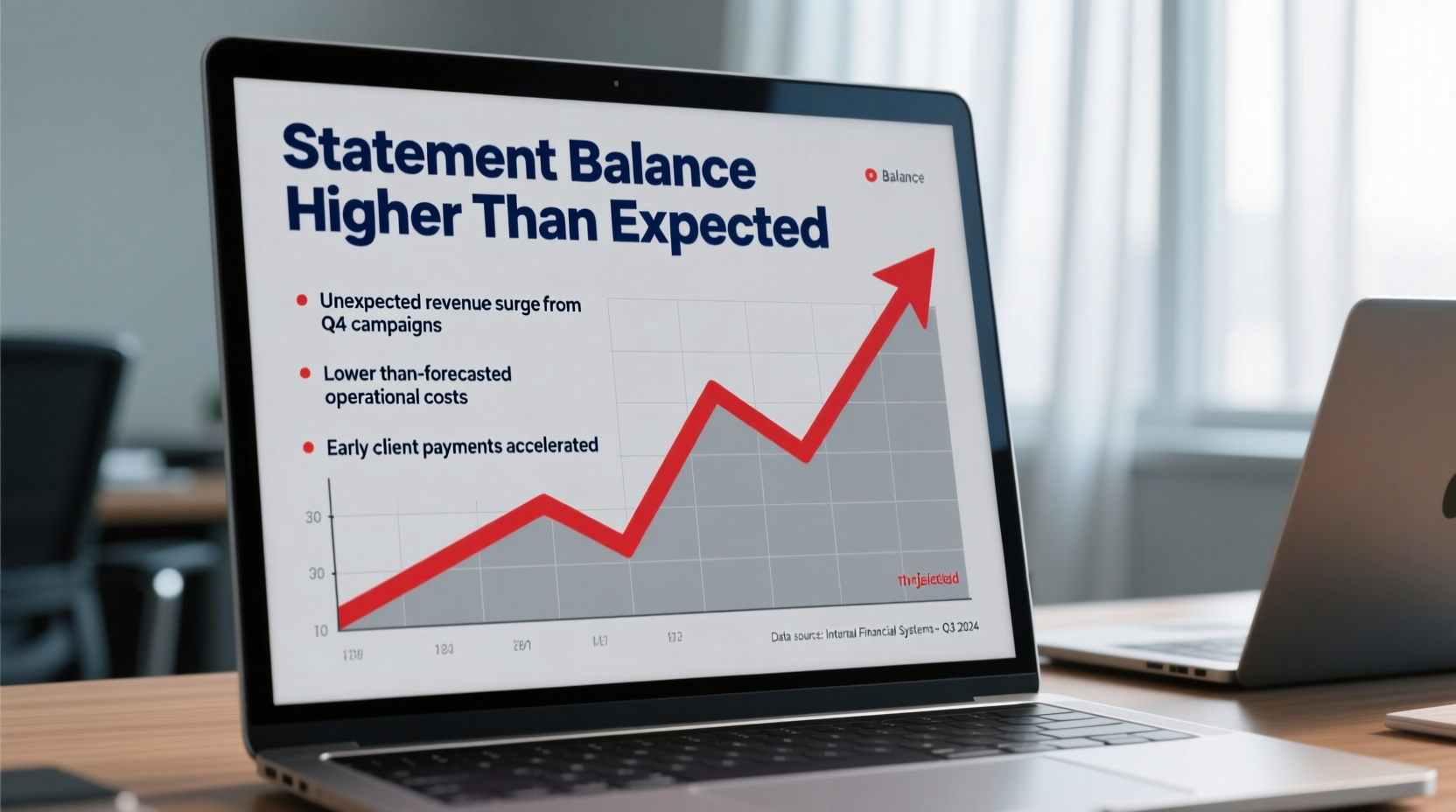
The most immediate explanation for a sudden spike in your statement balance often lies in what’s happening behind the scenes of your account activity. Financial institutions report balances based on posted transactions, but your personal tracking may include only what you’ve spent recently—or what you remember authorizing. Here are the most frequent culprits:
- Pending transactions finally posting: Charges that were authorized days earlier (like gas station holds or hotel deposits) may only appear as “pending” until they settle.
- Interest charges applied: If you carry a revolving balance, interest may have been calculated and added at the end of the billing cycle.
- Late fees or penalty APRs: Missing a payment deadline—even by one day—can trigger fees and higher interest rates.
- Recurring subscriptions renewed: Auto-renewals for streaming services, software, or memberships often go unnoticed until billed.
- Foreign transaction fees: International purchases may incur additional charges not reflected in the original price.
- Duplicate charges or processing errors: Rare but possible, technical glitches can result in double billing.
- Fraudulent activity: Unauthorized transactions, even small \"test\" charges, can inflate your balance unexpectedly.
How Interest and Fees Inflate Your Balance
One of the least visible yet most impactful factors in rising balances is compound interest—especially when you’re carrying debt across billing cycles. Credit cards typically calculate interest daily using your average daily balance and apply it at the end of the cycle.
For example, if you had a $2,000 balance with a 19.99% APR, you could accrue over $30 in interest in a single month—even if you didn’t make any new purchases. Add a late fee of $40, and suddenly your balance jumps by nearly $75 without any new spending.
Penalty APRs can be even more damaging. Some issuers raise your interest rate to 29.99% or higher after a missed payment, dramatically increasing future interest costs.
“Many people don’t realize that paying the minimum keeps them in debt for years while interest compounds silently.” — Laura Simmons, Certified Financial Counselor
Step-by-Step: Investigating and Resolving a High Balance
When your balance seems off, follow this structured approach to identify and correct the issue:
- Download your full statement: Access the official PDF from your bank or issuer—don’t rely solely on app summaries.
- Compare dates and amounts: Line up each transaction with your own records (receipts, calendar notes, budgeting app).
- Flag unfamiliar charges: Look for merchants you don’t recognize, repeated entries, or incorrect amounts.
- Check for pending vs. posted transactions: Determine if large pending charges from the prior cycle have now posted.
- Contact customer service: Call your issuer directly to ask about specific line items. Request clarification on fees or interest calculations.
- Dispute errors in writing: If you find inaccuracies, file a formal dispute under the Fair Credit Billing Act (FCBA), which gives you 60 days to challenge charges.
- Update automatic payments: If the high balance was due to a missed payment, set up autopay to avoid recurrence.
Common Pitfalls and How to Avoid Them
Even financially savvy individuals fall into traps that lead to unexpected balances. Awareness is the first step toward prevention.
| Pitfall | What Happens | How to Prevent It |
|---|---|---|
| Ignoring small recurring charges | $5/month adds up to $60/year—plus potential renewal spikes | Review statements monthly; cancel unused subscriptions |
| Assuming grace periods apply to all balances | Carrying any balance negates the grace period on new purchases | Pay in full each month to maintain grace benefits |
| Overlooking foreign transaction fees | 3% extra on international purchases goes unnoticed | Use no-fee travel cards when abroad |
| Misunderstanding credit limit vs. utilization | High utilization impacts credit score, even if paid monthly | Keep usage below 30% of limit for optimal scoring |
Real-Life Example: Sarah’s Surprise Hotel Charge
Sarah reviewed her credit card statement and found a $278 charge from a hotel she didn’t recall booking. She initially thought it was fraud. After calling the issuer, she learned the charge was legitimate: she had stayed there two weeks prior, but the hotel had placed a $100 pre-authorization hold during check-in. The final bill, including room tax and incidentals, wasn’t processed until the statement closing date.
The lesson? Pre-authorizations and delayed settlements create timing gaps between your perception of spending and actual posted charges. Sarah now checks her app weekly to monitor pending transactions and avoids relying only on her mental tally.
Essential Checklist: Responding to an Unexpectedly High Balance
- ✅ Download and print the full statement
- ✅ Highlight all unfamiliar or questionable charges
- ✅ Verify whether pending transactions have posted
- ✅ Calculate interest and fees manually to confirm accuracy
- ✅ Contact customer service within 60 days of the statement date
- ✅ File a written dispute if errors are confirmed
- ✅ Adjust budget or payment plan to cover the corrected balance
- ✅ Schedule a monthly statement review habit
Frequently Asked Questions
Why is my balance higher even though I paid my last statement in full?
This can happen if you made new purchases after the last statement closed but before your payment was due. Those charges appear on the next statement. Also, some issuers apply interest during transitional periods if there was a carried balance previously.
Can I get late fees or interest removed if it’s my first time missing a payment?
Yes, many banks offer “courtesy adjustments” for first-time offenders. Call customer service and politely request a waiver. They often comply to retain good customers.
How long do I have to dispute a charge on my statement?
Under the Fair Credit Billing Act, you have 60 days from the statement date to file a dispute. After that window closes, your ability to contest unauthorized or incorrect charges is severely limited.
Take Control of Your Financial Picture
An unexpectedly high statement balance doesn’t have to spiral into stress or debt. With careful review, timely action, and better monitoring habits, you can uncover the cause—whether it's a simple timing issue or a serious error—and protect your financial health. Knowledge is power: understanding how balances are calculated, how fees accumulate, and how to advocate for yourself turns confusion into confidence.




 浙公网安备
33010002000092号
浙公网安备
33010002000092号 浙B2-20120091-4
Comments
No comments yet. Why don't you start the discussion?