
The rise of handheld gaming PCs has transformed how we play. Devices like Valve’s Steam Deck OLED and ASUS’s ROG Ally deliver console-quality experiences in portable form. But when choosing between them, one question looms large: does running Windows instead of Linux-based SteamOS make the ROG Ally less suitable for gaming on the go? The answer isn’t as simple as “Windows bad” or “Linux better.” It depends on your priorities—game library access, customization, performance tuning, and long-term usability.
At first glance, the ROG Ally appears more powerful on paper, with higher specs and full Windows 11 support. Meanwhile, the Steam Deck OLED runs SteamOS, a Linux-based system optimized specifically for handheld gaming. Yet this distinction raises concerns: Can Windows really compete in a space designed for streamlined, battery-efficient gameplay? Or does its versatility outweigh potential drawbacks?
Hardware Comparison: Power vs Efficiency
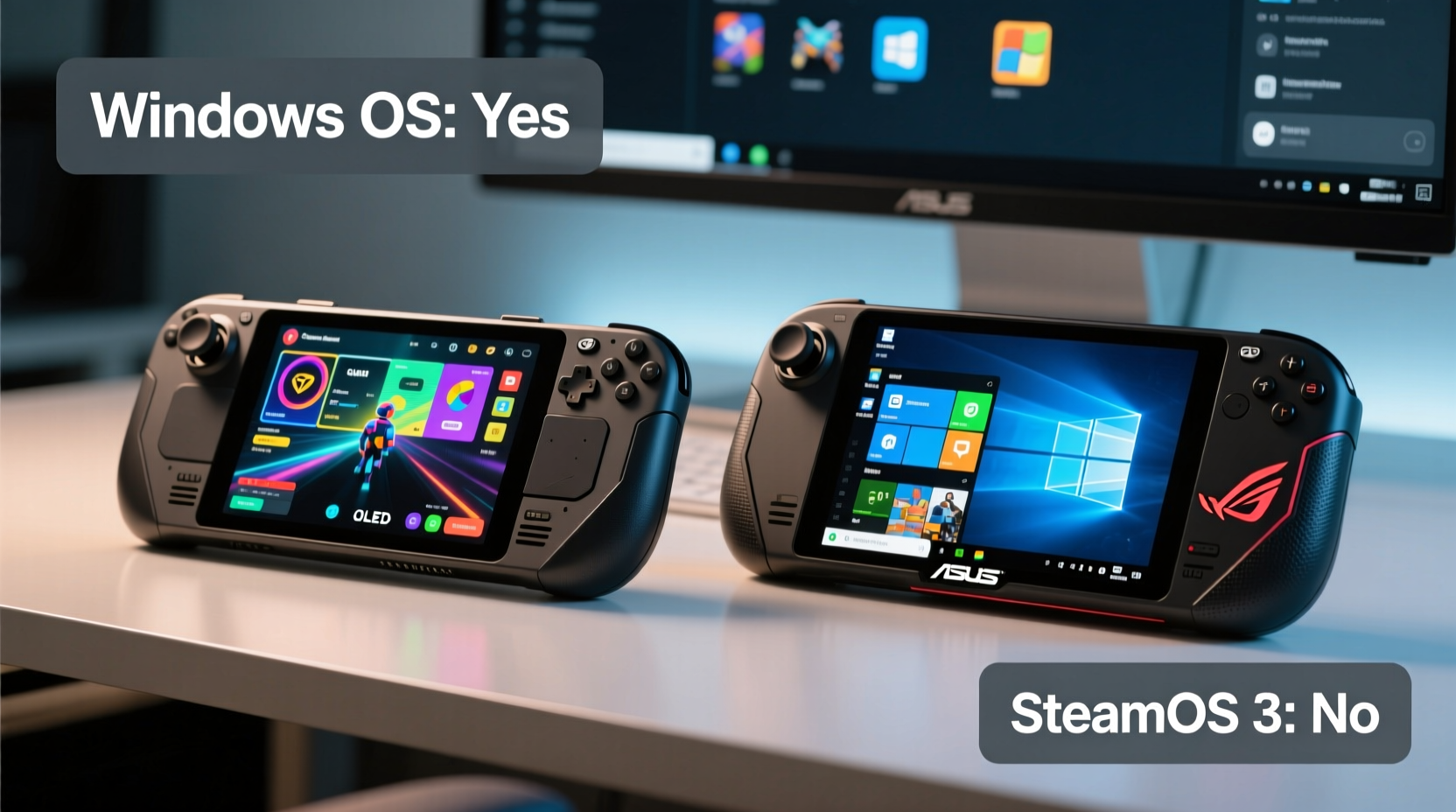
Both devices are engineered for high-performance mobile gaming, but they take different architectural paths. The Steam Deck OLED uses a custom AMD APU based on Zen 2 and RDNA 2 architectures, paired with 512GB or 1TB storage and a vibrant 7.4-inch OLED display with improved brightness and reduced latency. Battery life ranges from 3 to 10 hours depending on settings, with excellent thermal management due to passive vents and intelligent fan control.
The ASUS ROG Ally, particularly the Z1 Extreme model, leverages AMD’s more advanced Z1 Extreme chip (Zen 4 CPU, RDNA 3 GPU), offering superior raw compute power. It features a 7-inch FHD 120Hz LCD screen, upgradable RAM via SO-DIMM slot (on later models), and faster internal storage options. However, this increased performance comes at a cost—higher power draw and shorter battery life under load, typically ranging from 1.5 to 4 hours when playing AAA titles.
| Feature | Steam Deck OLED | ASUS ROG Ally (Z1 Extreme) |
|---|---|---|
| Processor | Custom AMD APU (Zen 2 / RDNA 2) | AMD Ryzen Z1 Extreme (Zen 4 / RDNA 3) |
| Display | 7.4\" OLED, 120Hz, 1080p | 7\" LCD, 120Hz, 1080p |
| Storage | 512GB / 1TB NVMe SSD | 512GB / 1TB PCIe Gen 4 SSD |
| RAM | 16GB LPDDR5 (soldered) | 16GB LPDDR5 (upgradable in Z1 Extreme model) |
| OS | SteamOS 3.0 (Linux-based) | Windows 11 + optional Legion Go UI |
| Battery Life | 3–10 hours | 1.5–5 hours |
| Weight | 640g | 608g |
Operating Systems: Purpose-Built vs Full Flexibility
The core difference lies in their operating systems. SteamOS is purpose-built for gaming. It boots directly into a console-like interface powered by Proton—a compatibility layer that translates DirectX calls into Vulkan, enabling most Windows games to run natively on Linux. This tight integration reduces background processes, improves boot times, and enhances battery efficiency.
In contrast, the ROG Ally ships with full Windows 11 Home, giving users complete desktop functionality. You can install any software, browse the web freely, use Discord, OBS, or even run productivity apps like Excel. For many, this freedom is invaluable. But it also introduces complexity: background updates, antivirus scans, driver conflicts, and higher idle power consumption—all factors that can disrupt the seamless handheld experience.
“Running Windows on a handheld gives unparalleled flexibility, but it demands more maintenance to keep it optimized for gaming.” — Mark Chen, Senior Hardware Analyst at TechPulse Weekly
Valve has invested heavily in making SteamOS reliable. Game caching, suspend/resume stability, and automatic controller mapping work out of the box. On the ROG Ally, while Windows supports these features, achieving the same polish requires manual tweaking—disabling unnecessary services, managing startup programs, and fine-tuning power profiles.
Game Compatibility and Performance Realities
On paper, Windows should offer perfect game compatibility. In practice, the gap between Windows and Proton on Steam Deck has narrowed dramatically. As of 2024, over 90% of top 100 Steam games are playable on SteamOS through ProtonDB ratings, with many achieving native-like performance.
Some titles still struggle—especially anti-cheat-heavy multiplayer games like *Valorant* or *Deep Rock Galactic* (though recent improvements in Proton Experimental have resolved many issues). Others, such as those relying on .NET frameworks or specific DRM schemes, may require workarounds.
The ROG Ally avoids these hurdles entirely. Any PC game that runs on Windows runs here—no translation layer needed. Emulation is also stronger; tools like Dolphin, RPCS3, and Citra often perform better under native Windows drivers. Plus, cloud gaming apps (GeForce Now, Xbox Cloud) integrate seamlessly.
However, performance doesn’t always favor the Ally. Despite its superior hardware, some games run hotter and drain the battery faster unless manually throttled. The Steam Deck OLED, meanwhile, benefits from aggressive frame rate limiting, auto-brightness adjustment, and efficient video decoding—all tuned for longevity over brute force.
Real-World Example: Playing Elden Ring on Both Devices
A user attempting to play *Elden Ring* on both devices will notice distinct differences. On the Steam Deck OLED, the game runs at ~30 FPS on medium settings using Proton-GE, with stable performance after a few shader pre-caches. Battery lasts around 3.5 hours, and the OLED panel enhances atmospheric visuals.
On the ROG Ally, the same game achieves 45–60 FPS at high settings, leveraging the RDNA 3 architecture. But without proper fan curve adjustments, temperatures climb quickly. With default Windows power plans, battery drops to just over two hours. To match the Deck’s endurance, the user must cap frame rates, lower resolution via FSR, and disable RGB lighting—steps not required out of the box.
Customization and Long-Term Usability
For tinkerers, the ROG Ally is a dream. Full administrator access means you can dual-boot Linux, install alternative UIs like Chime or Handheldizer, overclock the GPU, or even connect external GPUs via USB-C (with limitations). Upgrading RAM on supported models extends future-proofing beyond what the soldered Steam Deck allows.
Yet for casual players, this level of access introduces risk. Misconfigured drivers or poorly optimized launchers can degrade performance. Windows Update might restart during gameplay. Bloatware from ASUS (pre-installed utilities, trials) needs removal for optimal responsiveness.
The Steam Deck takes the opposite approach: constrained choice for consistent results. While you *can* install Windows or other OSes (and many do), the default environment prioritizes reliability. Valve regularly pushes OS updates focused solely on gaming enhancements—not general computing tasks.
Checklist: Choosing the Right Device for Your Needs
- Choose the Steam Deck OLED if:
- You want a dedicated gaming device with minimal setup
- Battery life is a top priority
- You mainly play Steam games and don’t need non-gaming apps
- You prefer automatic optimizations and firmware updates
- Choose the ASUS ROG Ally if:
- You already own a large Windows game library (Battle.net, Epic, Xbox)
- You plan to use the device for productivity or media outside gaming
- You’re comfortable troubleshooting driver or update issues
- You want upgradeable components and maximum graphical fidelity
Is Windows a Dealbreaker? The Verdict
No—Windows is not inherently a dealbreaker for handheld gaming. But it shifts the responsibility onto the user. Where the Steam Deck aims to be a console alternative, the ROG Ally functions more like a mini gaming laptop. Its strengths lie in versatility, not simplicity.
For mainstream gamers seeking a Netflix-and-chill-style experience—pick up and play, no configuration needed—the Steam Deck OLED delivers a smoother, more refined journey. Its OLED screen, improved speakers, and matured software ecosystem make it ideal for couch or commute gaming.
For enthusiasts who want full access to their entire digital library, run emulators at full speed, stream while gaming, or customize every aspect of their UI, the ROG Ally’s Windows foundation unlocks possibilities SteamOS cannot match—at the cost of extra effort.
“The best handheld isn’t the one with the best specs—it’s the one you actually use. Sometimes, convenience beats capability.” — Lena Patel, Editor-in-Chief, Portable Gamers Digest
Frequently Asked Questions
Can I install SteamOS on the ASUS ROG Ally?
Not officially. SteamOS is proprietary to Valve and tied to specific hardware. However, you can install Linux distributions like Arch or Ubuntu and set up Steam with Proton manually. This requires technical knowledge and may lack some features like suspend/resume reliability.
Does the Steam Deck OLED support non-Steam games?
Yes. Through desktop mode, you can install launchers like Epic Games Store, GOG Galaxy, or Ubisoft Connect. Many function well under Proton, though some may require tweaks. Adding games to your Steam library as non-Steam shortcuts enables controller-friendly launching.
Which device has better controls?
Both feature responsive joysticks, triggers, and rear buttons. The Steam Deck includes capacitive grip sensors and a touchscreen, enhancing immersion in certain titles. The ROG Ally offers slightly larger analog sticks and programmable shoulder buttons. Preference varies by hand size and grip style—try both if possible.
Final Thoughts: Match the Machine to Your Lifestyle
The debate between Steam Deck OLED and ASUS ROG Ally ultimately centers on philosophy. Valve designed a closed, optimized system focused on accessibility and endurance. ASUS built an open, powerful machine aimed at tech-savvy users who demand flexibility.
Windows isn’t a flaw—it’s a feature. But it’s one that demands engagement. If you’re unwilling to manage updates, optimize power settings, or troubleshoot occasional glitches, then yes, Windows becomes a burden. But if you relish customization and want one device for everything—from gaming to browsing to creative work—the ROG Ally justifies its complexity.
Meanwhile, the Steam Deck OLED shines as a true “handheld console.” It proves that Linux, when properly engineered, can rival Windows in practicality. Its OLED screen, improved audio, and tighter software integration offer a premium feel that appeals to purists.
Neither device is objectively superior. They serve different audiences. The real question isn’t whether Windows is a dealbreaker—it’s whether you want a tool or a toy. One empowers creation and control. The other offers escape and enjoyment. Choose based on how you play, not just what you play.




 浙公网安备
33010002000092号
浙公网安备
33010002000092号 浙B2-20120091-4
Comments
No comments yet. Why don't you start the discussion?