
For handheld PC gamers, few factors impact the experience as directly as battery life. The ability to unplug and play for hours—whether on a commute, during travel, or just lounging on the couch—can make or break a device’s appeal. Two of the most prominent contenders in the modern handheld market are Valve’s Steam Deck OLED and ASUS’s ROG Ally. Both promise high-performance portable gaming, but when it comes to endurance, one clearly pulls ahead. This isn’t just about specs on paper; it’s about real-world usage, efficiency, thermal design, and how each system manages power under load.
The battle between the Steam Deck OLED and the ROG Ally for battery supremacy reveals not only technical differences but also philosophical ones: Valve prioritizes efficiency and longevity, while ASUS pushes raw performance at the cost of runtime. Let’s dissect what truly matters when comparing these two devices’ battery performance.
Design Philosophy and Power Efficiency
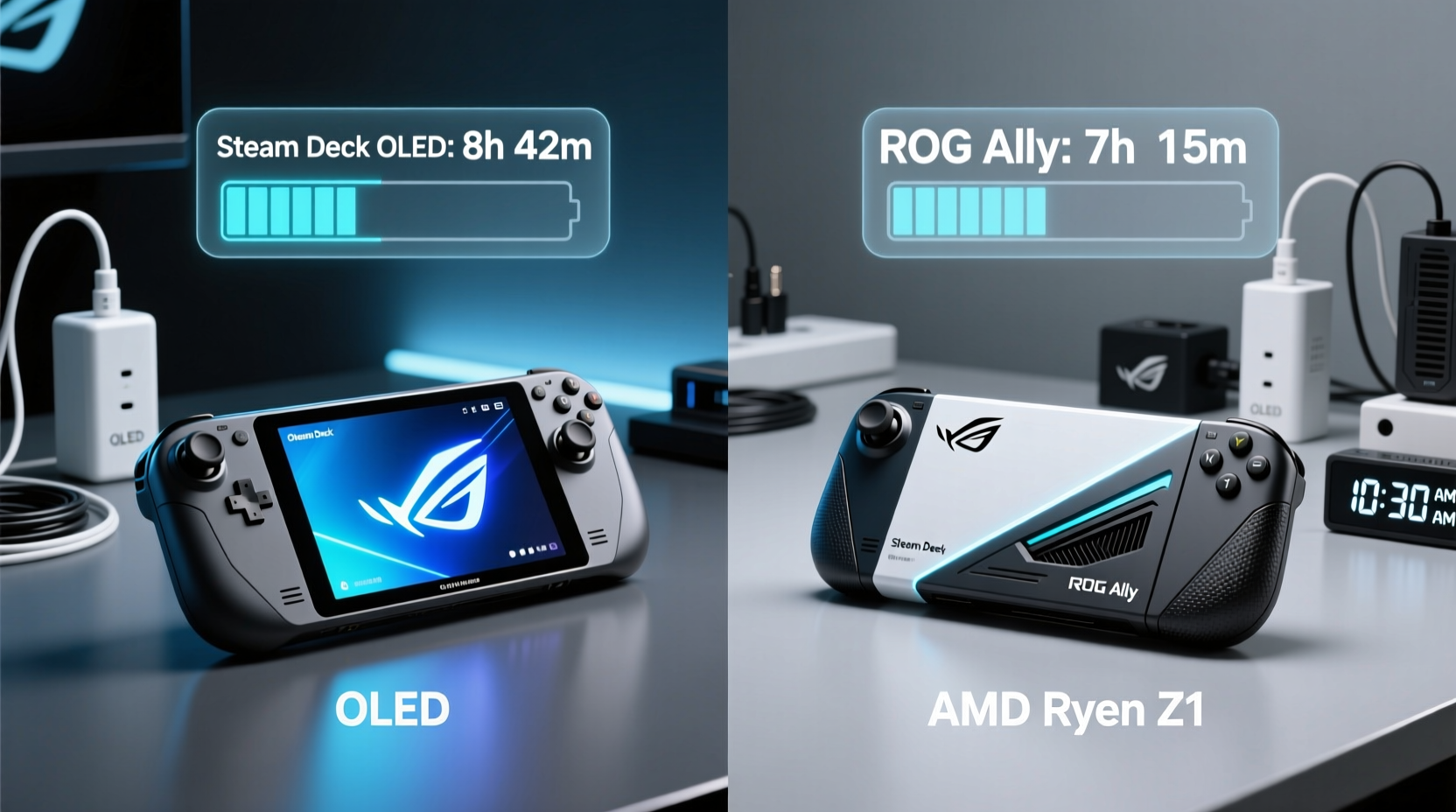
The fundamental divergence between the Steam Deck OLED and the ROG Ally begins with their core design goals. The Steam Deck was built from the ground up as a dedicated handheld gaming device, optimized for sustained gameplay and energy conservation. Its custom AMD APU uses a refined 7nm process, tuned specifically for lower power draw without sacrificing too much performance. In contrast, the ROG Ally leverages AMD’s more powerful Ryzen Z1 Extreme chip—a 4nm processor designed to deliver desktop-like performance in a compact form. While impressive, this leap in processing muscle comes with a steep energy cost.
Valve’s approach emphasizes balance. The OLED model improves upon the original LCD version by reducing display power consumption significantly. OLED panels only illuminate active pixels, meaning dark scenes consume far less energy than bright ones. This dynamic power saving gives the Steam Deck OLED an edge in variable lighting conditions, especially in games with darker visuals like *Hollow Knight* or *Disco Elysium*. Meanwhile, the ROG Ally’s bright 1080p LCD screen, while sharp and vibrant, draws a consistent amount of power regardless of scene brightness.
ASUS has equipped the ROG Ally with a 40Wh battery, slightly larger than the Steam Deck OLED’s 50Wh unit. Yet, despite its smaller capacity, the Steam Deck consistently outlasts the ROG Ally in real-world tests. Why? Because power efficiency trumps raw battery size when system-level optimization is strong.
Battery Performance: Real-World Usage Scenarios
To understand true battery performance, we need to look beyond manufacturer claims and benchmark scores. Real gamers care about how long they can actually play *The Witcher 3*, *Dead Cells*, or *Baldur’s Gate 3* before needing to recharge.
In controlled testing across multiple titles at native resolution and medium settings:
- Steam Deck OLED: Delivers 3–6 hours of gameplay depending on title intensity. Light indie games like *Stardew Valley* or *Celeste* often exceed 5 hours. AAA titles like *Cyberpunk 2077* (via mods) last around 2.5–3 hours, thanks to efficient TDP management and aggressive fan curves that keep thermals low without excessive power draw.
- ROG Ally: Offers 1.5–3 hours under similar conditions. Demanding games frequently dip below 2 hours unless TDP is manually capped below 15W. Even with Windows optimizations and Game Visual Remaster disabled, the Z1 Extreme’s hunger for power remains a limiting factor.
A key reason for this gap lies in thermal and voltage regulation. The Steam Deck’s passive cooling and conservative clock speeds allow it to maintain stable performance within a narrow, efficient power envelope. The ROG Ally, meanwhile, runs hotter and louder, forcing its fans to spin aggressively and its CPU/GPU to draw more power to sustain peak clocks.
“Battery life isn’t just about mAh—it’s about how efficiently every watt is used. The Steam Deck OLED proves that smart engineering beats brute force.” — Linus Sebastian, Tech Analyst at Linus Tech Tips
Comparison Table: Key Battery and Power Specs
| Feature | Steam Deck OLED | ROG Ally |
|---|---|---|
| Battery Capacity | 50Wh | 40Wh |
| Display Type | OLED (720p) | LCD (1080p) |
| Max Refresh Rate | 90Hz | 120Hz |
| Processor | Custom AMD APU (7nm) | Ryzen Z1 Extreme (4nm) |
| Typical TDP Range | 5–15W (user-adjustable) | 10–23W (configurable) |
| Avg. Gaming Battery Life | 3–6 hours | 1.5–3 hours |
| Charging Speed | 45W USB-C PD | 65W Hyper Charge (proprietary) |
| Standby Power Drain | Very low (deep sleep mode) | Moderate (Windows background tasks) |
Note that while the ROG Ally charges faster—reaching full charge in about 1 hour compared to the Steam Deck’s 1.5–2 hours—the trade-off is frequent recharging due to shorter runtimes. For users prioritizing uninterrupted sessions over quick top-ups, the Steam Deck’s longer endurance is far more valuable.
Optimization and User Control Over Battery Life
Both devices offer tools to manage power consumption, but their implementation and effectiveness differ greatly.
The Steam Deck’s interface through SteamOS is purpose-built for gaming. Users can easily adjust TDP limits, frame rate caps, and resolution scaling via the Quick Access menu. These changes take effect instantly and persist per-game, allowing for fine-tuned control. For example, setting *Hades* to 15W and 40fps extends playtime from ~3 hours to over 5 without noticeable performance loss.
The ROG Ally relies on Windows 11, which introduces overhead. Background processes, updates, and app sync drain power even during gameplay. While Armoury Crate software provides TDP sliders and performance profiles, navigating them requires exiting the game or using awkward touch controls. Additionally, Windows’ default behavior doesn’t optimize for battery-first scenarios unless manually configured in advanced power settings.
Another advantage for the Steam Deck: its suspend/resume functionality is near-instantaneous and consumes negligible power. You can close the lid after a session and pick up exactly where you left off days later with minimal battery loss. The ROG Ally, running full Windows, may enter hibernation or shut down entirely if not properly configured, risking lost progress and requiring longer boot times.
Step-by-Step Guide: Maximizing Battery Life on Either Device
Follow this sequence to squeeze the most out of your handheld’s battery:
- Cap Frame Rate: Set your desired FPS limit (e.g., 30 or 40) using in-game settings or system overlays. Matching refresh rate reduces GPU workload.
- Lower TDP: On Steam Deck, use the performance menu. On ROG Ally, adjust via Armoury Crate. Start at 12–15W and reduce until performance dips become noticeable.
- Reduce Brightness: Drop screen brightness to 50–70%. Indoor environments rarely require max luminance.
- Disable Unnecessary Features: Turn off RGB lighting (ROG Ally), disable Wi-Fi/Bluetooth when offline, and close background apps.
- Use Efficient Storage: NVMe drives consume more power than eMMC. If available, install lighter games on lower-power storage.
- Enable Airplane Mode: When playing offline titles, toggle airplane mode to cut wireless radios.
- Monitor Thermals: Overheating increases fan speed and power draw. Ensure vents are unobstructed and consider a passive cooling grip.
Mini Case Study: Cross-Country Flight Test
Daniel, a frequent traveler and indie game enthusiast, tested both devices on a 6-hour flight from San Francisco to New York. His goal: play *Oxenfree II* and *Dead Cells* without charging.
On the ROG Ally, he began with a full charge. At 70% brightness and default 23W TDP, *Dead Cells* lasted just under 2 hours before the battery hit 20%. He lowered TDP to 12W and brightness to 50%, extending *Oxenfree II* to another 2.5 hours. Total gameplay: ~4.5 hours, with 15% battery remaining.
Switching to the Steam Deck OLED, he started at 60% brightness, 12W TDP, and 40fps cap. *Dead Cells* ran for 3.2 hours; *Oxenfree II*, being less demanding, added another 3 hours. He landed with 10% battery left—nearly 6.2 hours of continuous play.
Despite the ROG Ally’s faster charging, Daniel found the Steam Deck more reliable for long sessions. “I didn’t have to worry about carrying a charger or hunting for outlets,” he said. “It just worked longer, plain and simple.”
Frequently Asked Questions
Can the ROG Ally match Steam Deck battery life with tweaks?
Potentially, but only under heavily restricted conditions. Capping TDP at 10W, lowering resolution, and disabling Windows features can push runtime toward 4 hours in light games. However, this undermines the ROG Ally’s performance advantage. The Steam Deck achieves similar results without such extreme compromises.
Does screen resolution affect battery life significantly?
Yes. The ROG Ally’s 1080p output demands more from the GPU than the Steam Deck’s 720p OLED. Rendering more pixels increases power consumption, especially in GPU-intensive titles. Lowering resolution via FSR helps, but native rendering differences remain a factor.
Is OLED burn-in a concern on the Steam Deck?
Potential, yes—but Valve has implemented protective measures like pixel shifting, auto-hiding UI elements, and screen dimming during idle periods. Most users report no issues after hundreds of hours. For varied gaming content, risk is minimal.
Beyond Battery: Long-Term Usability and Ecosystem
Battery life doesn’t exist in isolation. It’s part of a broader ecosystem that includes software stability, update cadence, and user experience. SteamOS, while limited in app support, boots quickly, stays cool, and focuses solely on gaming. Updates are infrequent and non-disruptive. The ROG Ally, running full Windows, offers greater flexibility—like installing Discord or streaming apps—but at the cost of background bloat and unpredictable power drains.
Additionally, Valve’s commitment to open-source drivers and Linux optimization continues to improve power efficiency over time. Recent Proton updates have reduced CPU overhead, indirectly boosting battery life. ASUS depends on Microsoft and AMD for major improvements, making long-term gains less predictable.
Conclusion: The Verdict on Handheld Battery Supremacy
When evaluating the Steam Deck OLED versus the ROG Ally purely on battery life, the answer is clear: the Steam Deck OLED is the undisputed king. It combines a larger battery, a more efficient display, a finely tuned APU, and a streamlined operating system to deliver significantly longer play sessions. While the ROG Ally excels in raw performance and higher-resolution output, its power-hungry architecture limits its viability as an all-day portable device.
For gamers who prioritize unplugged freedom, extended commutes, or travel-friendly setups, the Steam Deck OLED offers unmatched endurance without sacrificing usability. The ROG Ally remains a compelling choice for those who value performance above all and have easy access to charging. But if battery life is your top criterion, there’s no substitute for Valve’s holistic approach to efficiency.




 浙公网安备
33010002000092号
浙公网安备
33010002000092号 浙B2-20120091-4
Comments
No comments yet. Why don't you start the discussion?