
Selecting the right ring size is more than a matter of comfort—it’s essential for both style and function. A ring that slips off during daily tasks or digs into your knuckle can quickly become more nuisance than adornment. This is especially true for the index finger, which often experiences greater movement and pressure than other fingers. Whether you're shopping online, surprising a partner, or ordering a custom piece, accurate measurement ensures your ring stays secure, feels natural, and reflects your taste without requiring costly adjustments later.
Many people rely on guesswork or outdated sizing methods, leading to frustration and returns. But with the right tools and approach, you can achieve professional-level accuracy from home. This guide walks through scientifically sound techniques, common pitfalls, and real-world insights to help you determine your exact index finger size—every time.
Why Index Finger Sizing Is Different
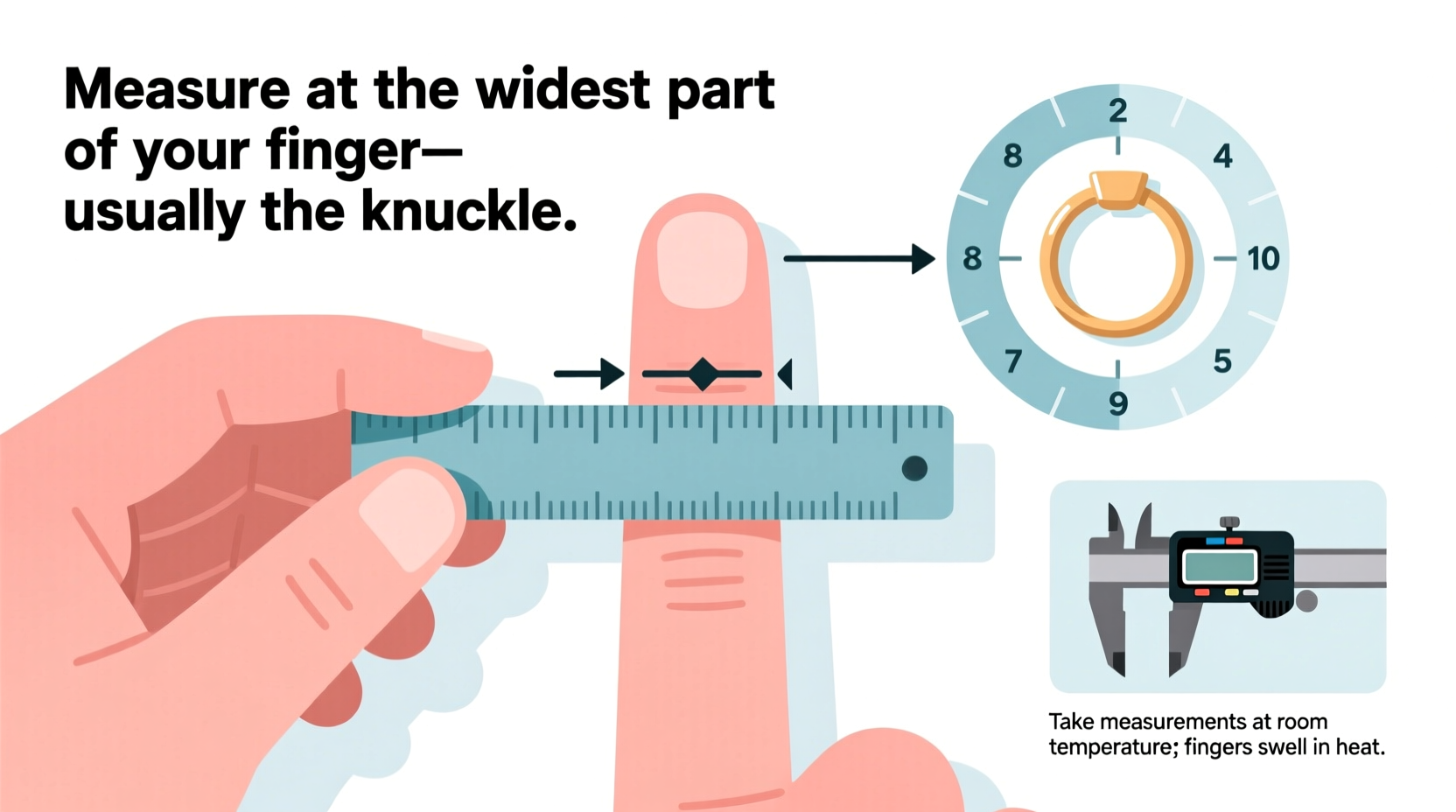
The index finger presents unique challenges compared to the ring or middle finger. It typically has a larger knuckle relative to the base of the finger, meaning a ring must be snug enough to stay on but loose enough to slide over the joint comfortably. Temperature, activity level, and even hydration affect finger swelling, further complicating consistency.
Jewelers often note that index finger rings are among the most frequently returned due to poor fit. “A quarter-size difference might be tolerable on the pinky, but on the index, it’s either too tight or gone by lunch,” says Lydia Chen, master jeweler at Urban Band Co. “The margin for error is razor-thin.”
“A well-fitted index ring should require slight resistance when sliding on but never pinch or restrict circulation.” — Lydia Chen, Master Jeweler
Best Time of Day to Measure
Finger size fluctuates throughout the day. Blood flow increases with activity and heat, causing temporary swelling. For the most accurate reading, measure in the late afternoon or early evening—when fingers are naturally at their largest due to normal daily use and temperature exposure.
Avoid measuring first thing in the morning or after being in cold environments, as fingers tend to shrink under cooler conditions. One study published in the *Journal of Hand Surgery* found average finger circumference varies up to 7% between morning and evening cycles.
Step-by-Step Guide to Measuring Your Index Finger
- Gather Supplies: You’ll need a flexible measuring tape (preferably in millimeters), a ruler, a strip of paper or string (about 1/4 inch wide), a pen, and a calculator.
- Cut a Strip: If using paper or string, cut a 6-inch length. Ensure edges are straight to avoid measurement distortion.
- Wrap Around the Knuckle: Place the strip around the widest part of your index finger—the knuckle—not the base. This ensures the ring will clear the joint.
- Mark the Overlap: Hold the strip taut (but not tight) and mark where it overlaps with a pen.
- Measure the Length: Lay the strip flat against a ruler and record the distance in millimeters from start to mark.
- Calculate Diameter: Divide the circumference by pi (3.14). For example, 58 mm ÷ 3.14 = ~18.47 mm diameter.
- Match to Ring Size Chart: Use an international ring size chart to convert the diameter into a standard size (e.g., US 8, UK L, EU 54).
- Repeat Twice: Conduct two additional measurements over different days to confirm consistency.
If you already own a ring that fits your index finger well, skip the wrapping method. Instead, measure the internal diameter of the ring in millimeters using a caliper or ruler, then match it directly to a size chart.
Do’s and Don’ts When Measuring
| Do’s | Don’ts |
|---|---|
| Measure at room temperature after normal activity | Measure when hands are cold or swollen |
| Use millimeter precision for accuracy | Rely solely on imperial units (inches) |
| Check fit over the knuckle, not just the base | Size only at the narrowest part of the finger |
| Test with multiple wraps across different times | Take a single measurement and assume it’s final |
| Account for ring width—wider bands feel tighter | Ignore band thickness when converting sizes |
Real Example: Avoiding a Costly Mistake
Sophie, a graphic designer from Portland, ordered a minimalist titanium band online for her index finger. She used a friend’s ring sizer tool one morning before coffee, assuming convenience outweighed timing. The ring arrived in a size 9—too tight to remove once on, causing discomfort within hours.
After returning it, she followed a three-day measurement routine: wrapping her finger each evening using a paper strip, recording results (57.2 mm, 57.8 mm, 57.5 mm), averaging them, and dividing by pi. Her actual diameter was 18.3 mm—size 8.5. She reordered confidently and now wears the ring daily without issue.
Her experience underscores the importance of repetition and timing. “I saved $40 in resizing fees just by waiting until dinner time,” she said.
Alternative Methods & Their Reliability
- Paper Ruler Printouts: Some websites offer printable ring sizers. These can work if printed at 100% scale and verified with a known object (like a credit card). However, paper stretch and printer calibration errors reduce reliability.
- Mobile Apps: Camera-based apps claim to measure finger size using augmented reality. While improving, they lack consistent accuracy due to lighting, lens distortion, and user positioning.
- Professional Sizing: Visiting a local jeweler remains the gold standard. They use metal mandrels calibrated to industry standards and can assess fit dynamically.
If opting for DIY, combine two methods—e.g., wrap test plus comparison with a well-fitting ring—for cross-verification.
Checklist: How to Confirm Your Final Size
- ✅ Measured in the late afternoon or evening
- ✅ Used millimeters for precision
- ✅ Wrapped around the knuckle, not just the base
- ✅ Took at least three measurements on separate occasions
- ✅ Accounted for ring width (wider = larger size)
- ✅ Compared result to a trusted international size chart
- ✅ Verified with a known-fitting ring if available
FAQ
Can I use a string instead of paper?
Yes, but ensure the string is non-stretch (like cotton or nylon) and mark precisely where it overlaps. Avoid elastic materials, which distort readings.
What if my knuckle is much larger than the base of my finger?
This is common. Consider a ring with a comfort-fit interior (slightly domed inner surface) or discuss a sizing bar with your jeweler—a small insert that reduces diameter without altering appearance.
Do ring sizes vary between countries?
Yes. The U.S. uses a numerical scale, while Europe uses circumference in millimeters, and the UK uses letters. Always verify conversion using a standardized chart. For example, a 19 mm diameter equals US size 10, UK size P, and EU size 59.
Final Thoughts
Getting your index ring size right isn’t about luck—it’s about process. By respecting the biological nuances of finger swelling, applying precise measurement techniques, and validating results across multiple sessions, you eliminate guesswork and protect your investment. Whether it’s a statement piece, engagement band, or everyday accessory, a perfectly fitted ring enhances both confidence and comfort.
Don’t settle for “close enough.” Take the extra 10 minutes to measure correctly. Your fingers—and your jewelry—will thank you.




 浙公网安备
33010002000092号
浙公网安备
33010002000092号 浙B2-20120091-4
Comments
No comments yet. Why don't you start the discussion?