
History is more than a list of dates and names—it’s a narrative of human experience, conflict, innovation, and transformation. A well-crafted historical timeline can transform dry facts into an engaging story that resonates emotionally and intellectually. Whether you're a student, educator, writer, or history enthusiast, creating a timeline that truly brings the past to life requires intention, structure, and insight. This guide walks you through the essential steps to design a timeline that informs, captivates, and endures.
1. Define Your Purpose and Scope
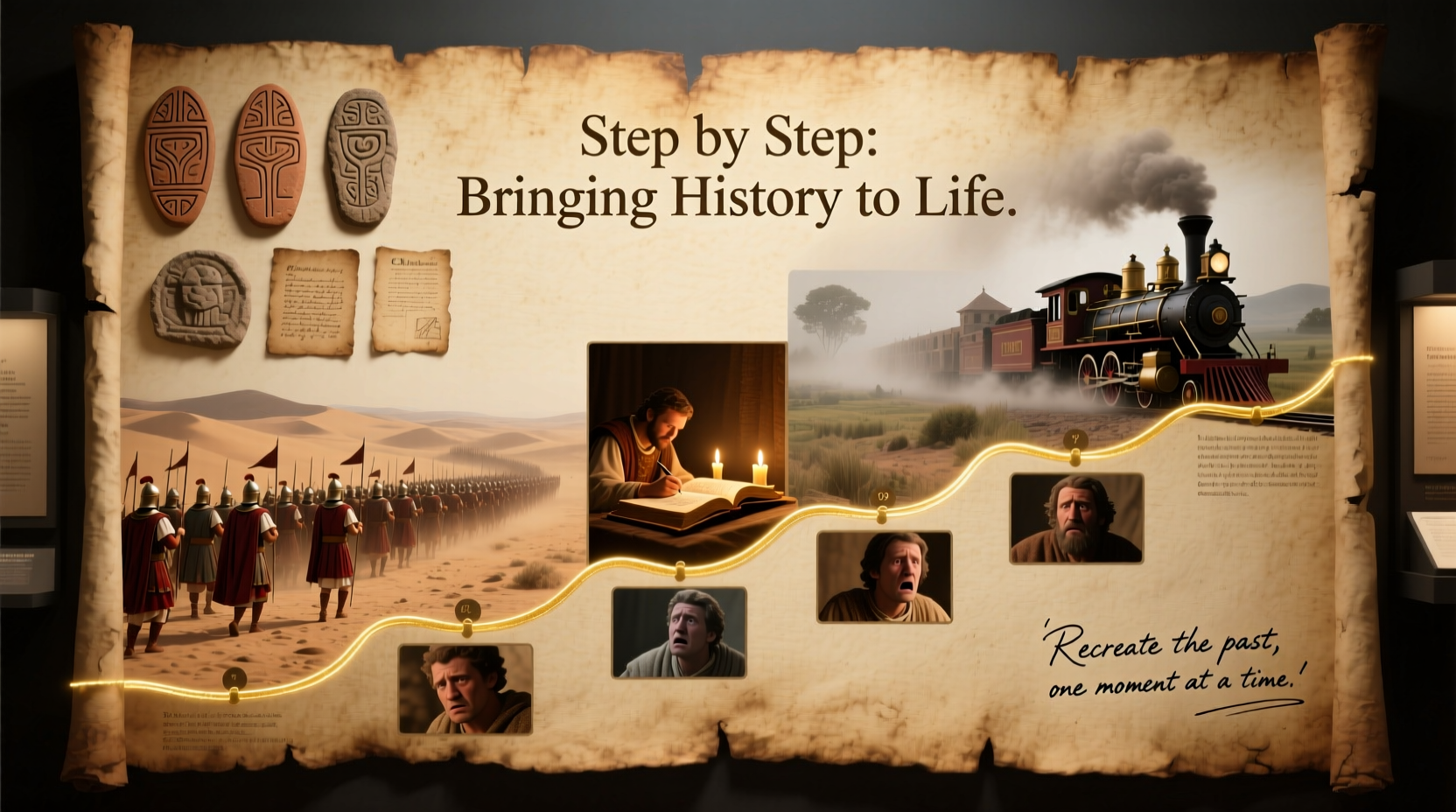
Before selecting any events, determine why you’re building the timeline and who will use it. Are you illustrating the causes of World War I for a classroom? Tracing the evolution of civil rights in America? Or mapping the rise and fall of an ancient empire?
A clear purpose shapes every decision—from the time span covered to the level of detail included. For example, a timeline on “The Space Race” might begin in 1957 with Sputnik and conclude in 1969 with Apollo 11. In contrast, one focused on “Technological Innovation in the 20th Century” could stretch from 1900 to 2000 and include broader developments like radio, computers, and medical breakthroughs.
Ask yourself:
- What story do I want this timeline to tell?
- Who is my audience? (e.g., high school students, researchers, general readers)
- How much depth is appropriate for their understanding?
- Will this be used for education, presentation, or personal reference?
2. Research and Select Key Events
Accuracy is non-negotiable in historical work. Begin by consulting reliable sources such as academic journals, primary documents, museum archives, and authoritative books. Avoid relying solely on crowd-edited websites unless cross-referenced.
Not every event deserves a place on your timeline. Prioritize moments that are:
- Causally significant – Did it directly influence later developments?
- Symptomatic – Does it represent a larger trend (e.g., a protest reflecting widespread dissent)?
- Symbolic – Does it mark a turning point in public perception or policy?
For instance, while thousands of battles occurred during the American Civil War, including Gettysburg (1863) makes sense due to its strategic and symbolic impact. Similarly, Rosa Parks’ arrest in 1955 is not just a single incident but a catalyst that ignited the Montgomery Bus Boycott and national attention on segregation.
“Timelines should reflect not just what happened, but why it mattered.” — Dr. Helen Torres, Professor of Historical Pedagogy, University of Edinburgh
3. Organize Chronologically with Contextual Flow
A common mistake is treating a timeline as a mere sequence of isolated events. To bring the past to life, show how each moment connects to the next. Use annotations or brief descriptions to explain cause-and-effect relationships.
Structure your timeline with:
- Dates (exact or approximate)
- Event titles
- Short explanations (1–3 sentences)
- Connections to prior/following events
Consider using arrows, color coding, or callout boxes if formatting allows—though in plain HTML, descriptive language fills this role.
Example Snippet:
| Date | Event | Significance |
|---|---|---|
| April 12, 1861 | Confederate forces attack Fort Sumter | Marked the official start of the American Civil War; prompted Lincoln to call for troops. |
| July 1–3, 1863 | Battle of Gettysburg | Union victory halted Confederate advance into the North; became a turning point in morale and momentum. |
| November 19, 1863 | Lincoln delivers Gettysburg Address | Reframed the war as a struggle for equality and democracy; linked sacrifice to national rebirth. |
4. Add Narrative Elements to Humanize History
Data becomes meaningful when people are at the center. Integrate individual stories, quotes, or firsthand accounts to ground abstract events in lived experience.
Instead of writing “1929: Stock Market Crash,” consider:
“October 29, 1929 – Black Tuesday: The Dow lost 12%, wiping out billions in wealth. Breadlines formed across cities. ‘I stood there holding my last dollar,’ recalled Mary Ellison, a Chicago teacher, ‘and didn’t know if I’d eat tomorrow.’”
This approach transforms statistics into empathy. Readers don’t just learn about the Great Depression—they feel its weight.
Mini Case Study: Teaching the Industrial Revolution
A high school teacher in Manchester created a timeline titled “Coal, Cotton, and Children: Life During the Industrial Revolution.” Rather than listing inventions and factory laws, she embedded diary entries from child laborers, images of mill conditions (described textually), and quotes from reformers like Lord Shaftesbury. Students reported feeling “shocked” and “connected” in ways textbooks hadn’t achieved. The timeline wasn’t just informative—it was transformative.
5. Design for Clarity and Engagement
Even the most insightful content fails if it’s disorganized or overwhelming. Apply these design principles:
- Use consistent formatting: Same font, spacing, and date style throughout.
- Group related events: Use subheadings like “Early Conflicts,” “Diplomatic Shifts,” or “Social Reforms.”
- Limit entries per section: 5–10 key points per century or era prevent clutter.
- Highlight pivotal moments: Bold or italicize turning points without overusing emphasis.
Do’s and Don’ts of Timeline Design
| Do | Don't |
|---|---|
| Use neutral, readable fonts (e.g., Arial, Georgia) | Use decorative or hard-to-read typefaces |
| Include context for each event | List only dates and titles without explanation |
| Balance breadth and depth | Crowd too many minor events |
| Cite sources at the bottom | Present information without attribution |
Checklist: Building a Living Timeline
- ✅ Define the central theme or question
- ✅ Choose a manageable time span
- ✅ Research using credible, diverse sources
- ✅ Select 8–15 pivotal events based on significance
- ✅ Write concise descriptions linking events causally
- ✅ Add human elements: quotes, personal stories, cultural artifacts
- ✅ Organize chronologically with clear headings
- ✅ Review for accuracy, flow, and readability
- ✅ Cite all sources
- ✅ Test with a sample audience for clarity
Frequently Asked Questions
How detailed should a historical timeline be?
The level of detail depends on your audience and purpose. For classroom use, aim for clarity over comprehensiveness—include enough context so each event makes sense in isolation and in sequence. Avoid deep dives into obscure figures unless they’re critical to the narrative.
Can I include speculative or debated dates?
Yes, but label them clearly. Use phrases like “circa,” “possibly,” or “scholars debate whether…” to maintain credibility. Transparency about uncertainty is a hallmark of responsible historical communication.
Should timelines always move left to right or top to bottom?
While linear progression is standard, creative formats exist—circular timelines for cyclical histories, branching paths for alternate outcomes. Stick to linear unless your medium and message benefit from innovation.
Conclusion: Make History Move Forward by Looking Back
A powerful historical timeline does more than record the past—it resurrects it. By carefully selecting events, weaving narrative threads, and centering human experience, you turn static facts into dynamic understanding. Whether displayed in a classroom, shared online, or used for personal study, a well-built timeline becomes a window into another time, inviting curiosity, reflection, and connection.




 浙公网安备
33010002000092号
浙公网安备
33010002000092号 浙B2-20120091-4
Comments
No comments yet. Why don't you start the discussion?