
Understanding the geometry of circles is fundamental in algebra, trigonometry, and calculus. One of the most practical skills is extracting key information—like the radius—from a circle’s equation. Whether you're solving problems in coordinate geometry or analyzing real-world circular motion, knowing how to isolate the radius from an equation is essential. This guide walks you through the process systematically, starting from standard and general forms of the circle equation and progressing to advanced interpretation and application.
The Standard Form of a Circle's Equation
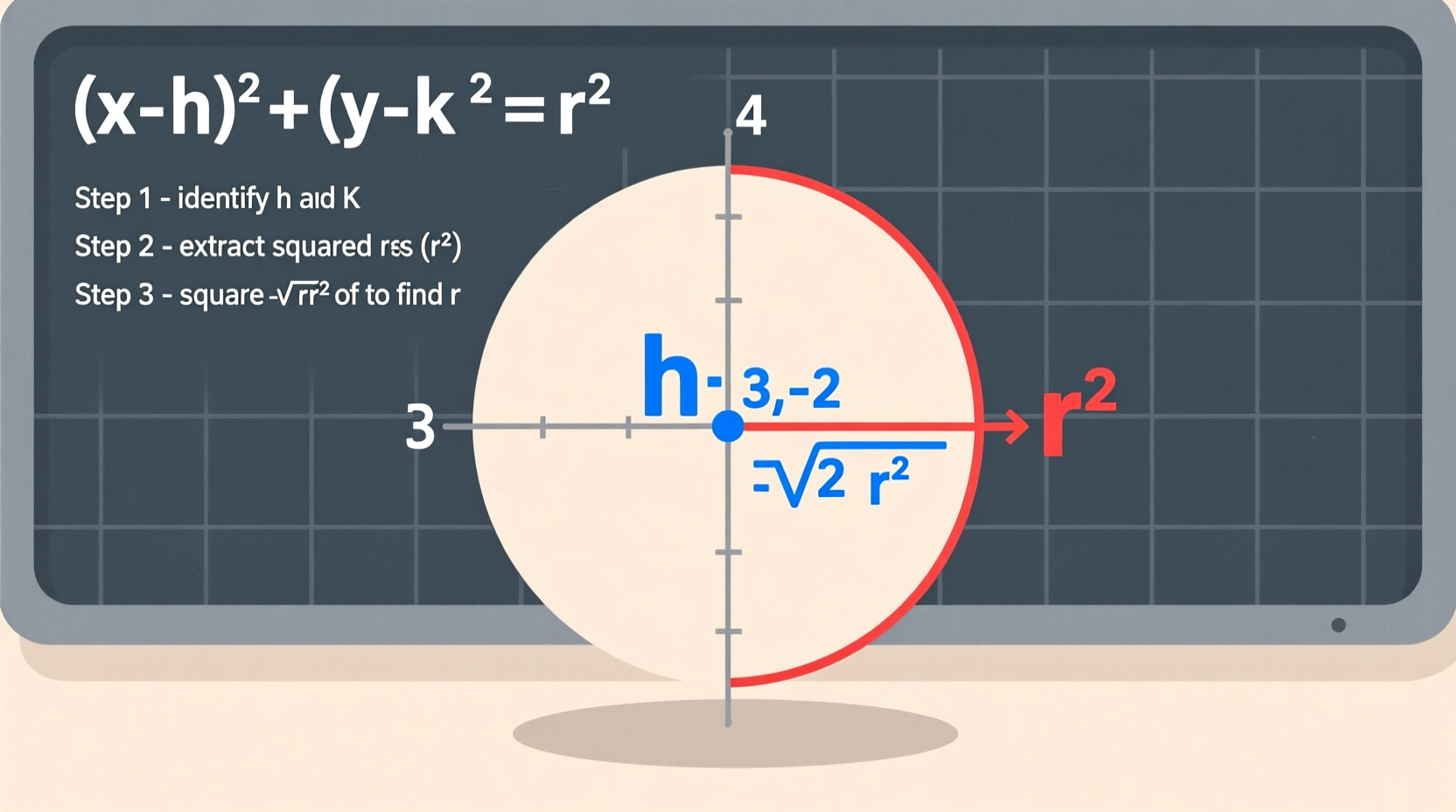
The foundation for deriving the radius lies in the standard form of a circle’s equation:
In this equation:
- (h, k) represents the coordinates of the center of the circle,
- r is the radius,
- x and y are variables representing any point on the circle.
If an equation is already in this form, identifying the radius is straightforward: take the square root of the right-hand side. For example, given:
The radius is √25 = 5. The center is at (3, -4). No further manipulation is needed.
Converting General Form to Standard Form
More often, you’ll encounter the general form of a circle’s equation:
To extract the radius, you must complete the square for both x and y terms to convert this into standard form. Let’s walk through the process.
Step 1: Group x and y terms
Start by rearranging the equation so that x-terms and y-terms are grouped together, and constants move to the other side.
Example: Given
Rearrange as:
Step 2: Complete the square for x and y
Take half of the coefficient of x, square it, and add it to both sides. Repeat for y.
- For x: Coefficient is −6 → (−6/2)² = 9
- For y: Coefficient is 8 → (8/2)² = 16
Add 9 and 16 to both sides:
Step 3: Identify the radius
Now in standard form, the right-hand side is r² = 36. Therefore, the radius is √36 = 6.
“Completing the square transforms abstract coefficients into geometric meaning—it’s the bridge between algebra and geometry.” — Dr. Alan Reyes, Mathematics Educator
Checklist: Deriving Radius from Any Circle Equation
Use this checklist whenever you’re faced with a circle equation and need to find the radius:
- Confirm the equation represents a circle (both x² and y² have equal coefficients and no xy term).
- If in standard form, extract r directly by taking the square root of the constant on the right.
- If in general form, group x and y terms and move the constant to the opposite side.
- Complete the square for both variables.
- Add the same values to both sides to maintain equality.
- Rewrite trinomials as perfect squares.
- Simplify the right-hand side to get r², then compute r = √(r²).
- Ensure r is positive—radius is a length and cannot be negative.
Common Pitfalls and How to Avoid Them
Mistakes often occur during the completing-the-square phase. Below is a comparison of correct practices versus common errors.
| Do’s | Don’ts |
|---|---|
| Always balance the equation by adding the same value to both sides when completing the square. | Don’t forget to add the squared terms to both sides—this is a frequent error. |
| Factor the completed square correctly: x² − 4x + 4 becomes (x − 2)². | Don’t write (x + 2)² when the middle term is negative. |
| Double-check signs when moving constants across the equals sign. | Don’t misread −F as part of the grouping without flipping the sign. |
| Verify that the final r² is positive. A negative result means the equation doesn't represent a real circle. | Don’t proceed with a negative r²—this indicates no real solution or a degenerate case. |
Real-World Example: Designing a Circular Garden
Imagine you're a landscape architect given the following constraint for a garden layout:
Your task is to determine the radius to estimate fencing material. Follow the steps:
- Group terms: (x² + 10x) + (y² − 14y) = −58
- Complete the square:
- For x: (10/2)² = 25
- For y: (−14/2)² = 49
- Add to both sides: (x² + 10x + 25) + (y² − 14y + 49) = −58 + 25 + 49 = 16
- Rewrite: (x + 5)² + (y − 7)² = 16
- Thus, r² = 16 → r = 4 meters.
The garden has a radius of 4 meters. With this, you can calculate the circumference (2πr ≈ 25.1 meters) and order materials accordingly. This demonstrates how abstract math translates into tangible design decisions.
Frequently Asked Questions
Can a circle have a negative radius?
No. The radius is a measure of distance and must be non-negative. While r² appears in equations, the actual radius is defined as the principal (positive) square root. A negative value under the square root (i.e., r² < 0) means the equation does not describe a real circle.
What if the equation has coefficients in front of x² and y²?
If the coefficients of x² and y² are equal but not 1 (e.g., 2x² + 2y²), divide the entire equation by that coefficient first. If they are unequal or one is missing, the graph is not a circle—it could be an ellipse, parabola, or hyperbola.
How do I know if an equation represents a circle at all?
An equation in two variables represents a circle if:
- Both x² and y² terms are present,
- They have the same non-zero coefficient,
- There is no xy cross-term,
- After completing the square, the resulting r² is positive.
Conclusion and Next Steps
Deriving the radius from a circle’s equation is more than a mechanical exercise—it strengthens your understanding of the relationship between algebra and geometry. By mastering the standard and general forms, and practicing completing the square, you gain the ability to interpret mathematical models in physics, engineering, computer graphics, and beyond.
The skill becomes intuitive with repetition. Start with equations in standard form, then challenge yourself with messy general forms. Verify your results by plugging the center back into the original equation or sketching a quick graph.




 浙公网安备
33010002000092号
浙公网安备
33010002000092号 浙B2-20120091-4
Comments
No comments yet. Why don't you start the discussion?