
Casio watches are known for their durability, precision, and user-friendly design. Whether you own a classic F-91W, an advanced G-Shock, or a sleek Edifice model, one of the most common tasks is adjusting the date. While it may seem straightforward, incorrect handling can lead to inaccurate timekeeping, skipped dates, or even damage to internal mechanisms—especially if done during restricted hours. This comprehensive guide walks you through the exact steps to safely and accurately change the date on any Casio watch, regardless of model.
Understanding How Casio Watches Handle Date Changes
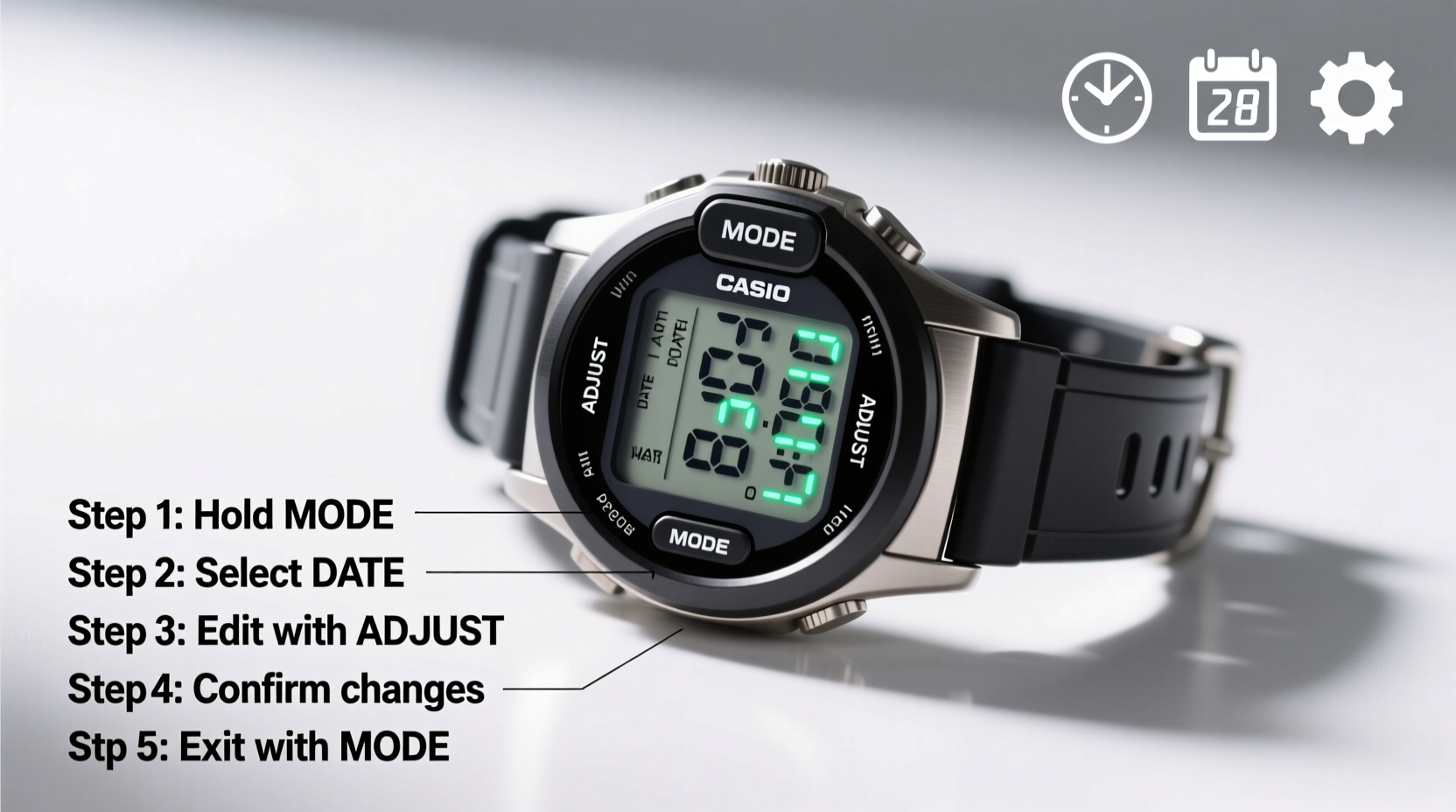
Casio integrates date functionality across hundreds of models, but the underlying principle remains consistent: the date changes automatically once every 24 hours, typically between 12:00 AM and 12:30 AM. What many users don’t realize is that adjusting the date manually during certain times—especially from 8:00 PM to 3:00 AM—can interfere with the internal gear mechanism responsible for advancing the calendar.
During this window, the movement is in the process of transitioning to the next day. Forcing a manual change risks misalignment, which could result in the date failing to advance properly in the future.
“Always avoid adjusting the date or time between 8 PM and 3 AM unless absolutely necessary. It’s the golden rule of analog-digital watch care.” — Hiroshi Tanaka, Senior Watch Technician at Tokyo Time Institute
Step-by-Step Guide to Changing the Date on Your Casio Watch
The method varies slightly depending on whether your Casio has a traditional crown (common in analog or analog-digital models) or digital buttons (as seen in G-Shock or Wave Ceptor series). Below is a universal approach broken into clear phases.
Phase 1: Prepare Your Watch
- Check the current time. Ensure it's not between 8:00 PM and 3:00 AM.
- If it is, advance the time past 3:00 AM first (we’ll explain how).
- Find a clean, well-lit space to work. Use a soft cloth to prevent scratches.
- For digital models, ensure the display is active and readable.
Phase 2: Accessing Date Mode (Analog & Analog-Digital Models)
- Pull the crown out to the first stop (one click out). This usually controls the date.
- Rotate the crown clockwise. Each full turn advances the date by one day.
- To move backward, push the crown back in and pull it out again—if your model supports reverse adjustment.
- Once the correct date appears, push the crown back fully to secure it.
Phase 3: Adjusting Time First (If Needed)
If the time is off, especially near midnight, follow this sequence:
- Pull the crown to the second stop (fully extended).
- Turn the hands forward until the date flips (around 12:00 AM).
- Continue moving forward past 3:00 AM to exit the danger zone.
- Now, go backward to your correct time.
- Finally, use the first crown position to fine-tune the date if needed.
Phase 4: Digital Casio Models (G-Shock, Baby-G, etc.)
- Press the \"Mode\" button until the display shows the date (often labeled \"CAL\" or flashes the date field).
- Press and hold the \"Adjust\" button (usually top-left) for 2–3 seconds until digits start blinking.
- Use \"Search\" or \"Forward/Back\" buttons to change the day, month, and year.
- Press \"Mode\" or \"Adjust\" again to confirm and exit.
Model-Specific Considerations
While the general principles apply, some popular Casio lines have unique behaviors.
| Model Series | Date Adjustment Method | Special Notes |
|---|---|---|
| F-91W / A158W | Crown pulled to first position | No month/year setting; only date |
| G-Shock (DW-5600, GA-2100) | Digital button interface | Hold \"Adjust\" to enter edit mode |
| Edifice (EFV-100D) | Two-position crown | Second pull adjusts time, first pull adjusts date |
| Wave Ceptor (BC-280) | Auto-syncs via radio signal | Manual override possible; disable auto-set temporarily |
| Pro Trek (PRW-3500) | Multi-sensor digital interface | Date tied to altitude/time settings; use \"Mode\" chain |
Common Mistakes and How to Avoid Them
- Changing the date at night: As mentioned, doing so risks gear damage. Always wait until daytime or skip past midnight first.
- Forcing the crown: If resistance is felt, stop immediately. You may be in the wrong position or past mechanical limits.
- Skipping leap year adjustments: Most basic Casios don’t auto-adjust for February 29. Manually update once every four years.
- Ignoring battery warnings: A low battery can cause erratic date jumps or failure to advance. Replace within three months of the EOL (End-of-Life) indicator.
Mini Case Study: Recovering from a Misadjusted Date
Mark, a field engineer using a G-Shock DW-6900, noticed his watch skipped from the 15th to the 17th. He had adjusted the date late one evening after a flight, unaware of the timing restriction. The gears partially engaged but didn’t complete the cycle. Following Casio’s recommended reset procedure—advancing the time past 3:00 AM, resetting the correct hour, then re-adjusting the date—he restored normal function. Since then, he uses a reminder note on his phone to avoid repeating the error.
Essential Checklist Before Adjusting Your Casio Watch
- ✅ Confirm the current time is outside 8:00 PM – 3:00 AM window
- ✅ Identify your model type (analog, digital, hybrid)
- ✅ Locate the correct control (crown or buttons)
- ✅ Clean hands and workspace to avoid smudging
- ✅ Test crown smoothness—no excessive resistance
- ✅ For digital models, ensure sufficient battery charge
- ✅ After adjustment, verify both date and time accuracy over 24 hours
Frequently Asked Questions
Why does my Casio watch skip a date?
Sudden power loss, low battery, or manual adjustment during the 8 PM–3 AM window can interrupt the date mechanism. The gears may fail to engage fully, causing a missed day. To fix, advance the time past midnight and let it reset naturally.
Can I change the date every day without harming the watch?
Yes, but only when done correctly. Frequent changes are safe as long as you avoid the restricted hours and don’t force the crown. Mechanical wear accumulates slowly, so moderate use poses no risk.
My Casio doesn’t have a crown—how do I change the date?
If your model is fully digital (like most G-Shocks), use the button interface. Press \"Mode\" until the date appears, hold \"Adjust\" to edit, then navigate with other buttons. Refer to your manual for exact sequences.
Final Tips for Long-Term Accuracy
Maintaining accurate date tracking isn’t just about convenience—it reflects respect for the craftsmanship behind your Casio timepiece. Over decades, these watches have proven reliable precisely because users follow simple, disciplined habits. Treat the date function with care, and it will serve you flawlessly for years.
Remember: consistency beats correction. Set the date right the first time, avoid high-risk hours, and double-check alignment after travel or daylight saving shifts.




 浙公网安备
33010002000092号
浙公网安备
33010002000092号 浙B2-20120091-4
Comments
No comments yet. Why don't you start the discussion?