
Finding the perimeter of a triangle is one of the most fundamental skills in geometry. Whether you're solving problems in a math class, designing structures, or measuring land, knowing how to calculate the total distance around a triangle is essential. The good news? It's simple once you understand the core principle: the perimeter is just the sum of all three side lengths. This guide walks you through multiple methods, practical examples, and common pitfalls so you can confidently compute the perimeter of any triangle—scalene, isosceles, equilateral, or even right-angled.
Understanding the Basics: What Is Perimeter?
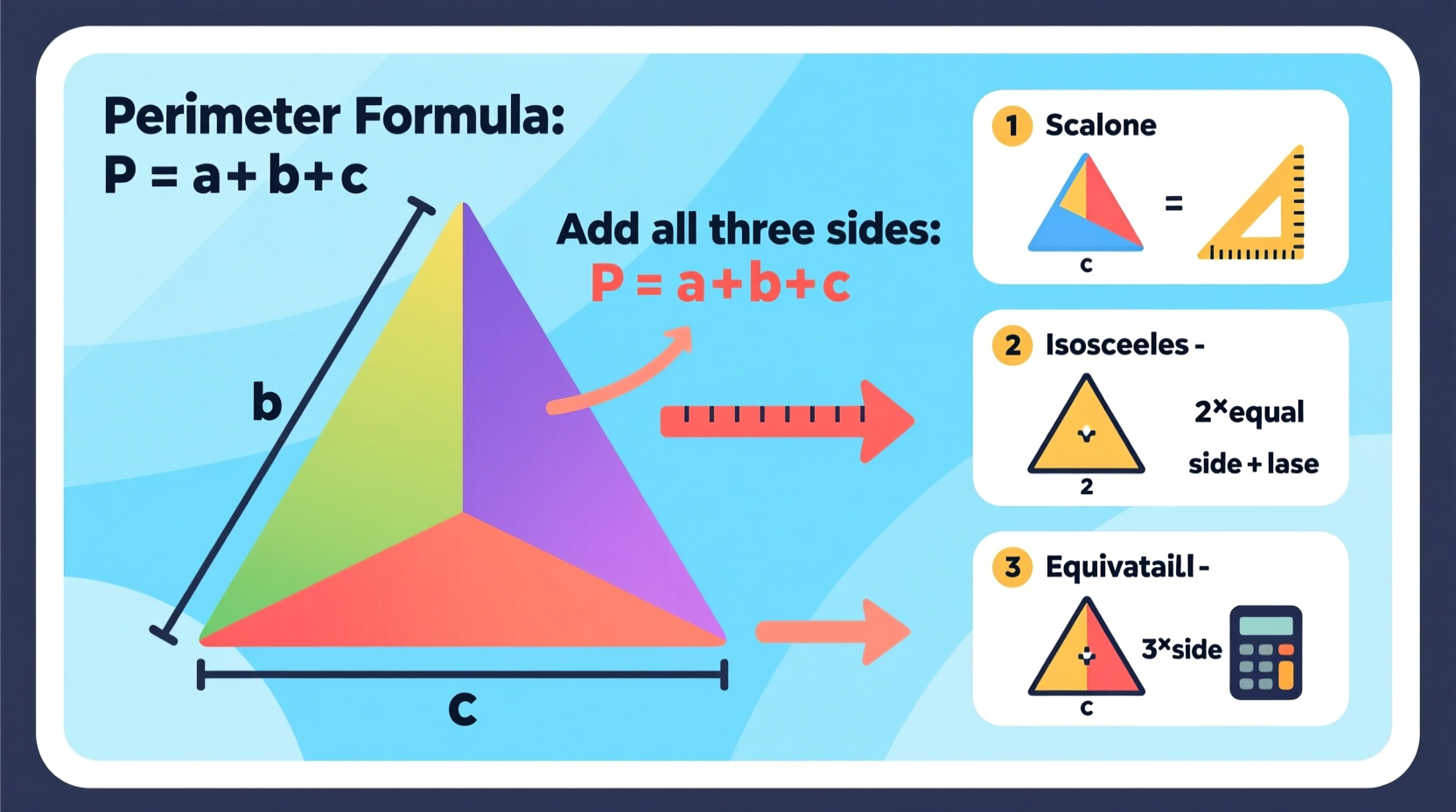
The perimeter of any shape is the total length of its outer boundary. For a triangle, which has three sides, the perimeter is simply the sum of the lengths of those three sides. Unlike area, which measures space inside, perimeter measures the distance around the edge.
If the three sides of a triangle are labeled as a, b, and c, then the formula for the perimeter (P) is:
This formula applies universally—regardless of the triangle’s type. You don’t need angles or height measurements unless you’re first solving for missing side lengths.
Step-by-Step Guide to Finding Triangle Perimeter
- Identify the three side lengths: Check if all three side measurements are given. If not, you may need to use additional geometric principles (like the Pythagorean theorem) to find missing values.
- Ensure consistent units: All side lengths must be in the same unit (e.g., centimeters, inches). Convert if necessary.
- Add the three sides together: Use basic addition to sum the lengths.
- Label your answer with the correct unit: Always include the unit of measurement in your final answer (e.g., \"15 cm\").
Types of Triangles and Their Perimeter Calculations
Different triangles have different properties, but the perimeter formula remains the same. However, some types allow for shortcuts due to symmetry or known relationships between sides.
Equilateral Triangle
All three sides are equal. If each side is length s, then:
P = 3s
Example: Each side is 7 cm → P = 3 × 7 = 21 cm.
Isosceles Triangle
Two sides are equal. If the two equal sides are a and the base is b, then:
P = 2a + b
Example: Two sides are 5 cm, base is 8 cm → P = 2(5) + 8 = 18 cm.
Scalene Triangle
All sides are different. Simply add all three unique lengths.
Example: Sides are 6 cm, 9 cm, and 11 cm → P = 6 + 9 + 11 = 26 cm.
Right Triangle
A right triangle has one 90-degree angle. Often, only two sides are given, and you must find the third using the Pythagorean theorem before calculating perimeter.
| Triangle Type | Side Properties | Perimeter Formula |
|---|---|---|
| Equilateral | All sides equal | P = 3s |
| Isosceles | Two sides equal | P = 2a + b |
| Scalene | All sides different | P = a + b + c |
| Right Triangle | Satisfies a² + b² = c² | P = a + b + c (after finding missing side) |
Calculating Perimeter When a Side Is Missing
In many real-world scenarios, you won’t have all three side lengths. Here’s how to handle common cases:
Using the Pythagorean Theorem (Right Triangles)
If you know two sides of a right triangle, you can find the third using:
a² + b² = c², where c is the hypotenuse.
Example: A right triangle has legs of 3 cm and 4 cm. Find the perimeter.
- Find hypotenuse: c² = 3² + 4² = 9 + 16 = 25 → c = √25 = 5 cm
- Add all sides: P = 3 + 4 + 5 = 12 cm
Using the Law of Cosines (Non-Right Triangles)
If you know two sides and the included angle, use the Law of Cosines:
c² = a² + b² – 2ab·cos(C)
Once you compute the third side, proceed with standard perimeter addition.
Mini Case Study: Fencing a Triangular Garden
Sarah wants to install a fence around her triangular backyard plot. She measures two sides: 10 meters and 14 meters. The angle between them is 60 degrees. She needs to know how much fencing to buy—the perimeter.
Since it’s not a right triangle and one side is missing, she uses the Law of Cosines:
- a = 10 m, b = 14 m, C = 60°
- c² = 10² + 14² – 2(10)(14)·cos(60°)
- c² = 100 + 196 – 280·(0.5) = 296 – 140 = 156
- c ≈ √156 ≈ 12.49 m
Now, perimeter = 10 + 14 + 12.49 = 36.49 meters. Sarah rounds up to 37 meters to account for installation waste.
This example shows how theoretical geometry applies directly to practical decisions like material purchasing.
“Accurate perimeter calculation prevents costly over-ordering or under-ordering in construction and design.” — Dr. Alan Reyes, Civil Engineering Instructor
Checklist: How to Find Any Triangle’s Perimeter
- ✅ Identify the type of triangle (equilateral, isosceles, scalene, right)
- ✅ Confirm all three side lengths are known (or determine how to find missing ones)
- ✅ Ensure all measurements use the same unit
- ✅ Apply the appropriate method (Pythagorean theorem, Law of Cosines, etc.) if a side is missing
- ✅ Add all three sides together
- ✅ Include units in the final answer
- ✅ Double-check arithmetic and labeling
Common Mistakes and How to Avoid Them
- Mixing units: Never add feet and inches without conversion. Convert everything to the same unit first.
- Forgetting the third side: Especially in diagrams, it’s easy to overlook a side. Label each one clearly.
- Assuming all triangles are right-angled: Only use the Pythagorean theorem when you know there’s a 90-degree angle.
- Rounding too early: Keep decimals during intermediate steps. Round only the final perimeter for accuracy.
Frequently Asked Questions
Can I find the perimeter if I only know the angles?
No. Angles alone don’t provide information about side lengths. You need at least some side measurements. Infinite triangles can have the same angles but different sizes (similar triangles), so perimeter cannot be determined from angles alone.
What if the triangle sides are given in different units?
Convert all measurements to the same unit before adding. For example, if one side is in meters and another in centimeters, convert meters to centimeters (1 m = 100 cm) or vice versa.
Does the order of the sides matter when adding?
No. Addition is commutative, so a + b + c gives the same result as b + c + a. Just make sure all three are included.
Final Thoughts and Action Steps
Calculating the perimeter of a triangle doesn’t require advanced tools—just clear thinking and basic arithmetic. From schoolwork to home improvement, this skill proves useful across contexts. The key is understanding the universal formula and knowing when and how to find missing sides using geometric rules.
Start practicing today: take a ruler, sketch a triangle, measure its sides, and compute the perimeter. Try variations—right triangles, isosceles shapes, irregular forms. The more you apply these methods, the more intuitive they become.




 浙公网安备
33010002000092号
浙公网安备
33010002000092号 浙B2-20120091-4
Comments
No comments yet. Why don't you start the discussion?