
Reattaching a watch back can feel intimidating, especially if you don’t have access to professional tools. Whether you’ve just replaced the battery or cleaned the movement, securing the case back properly is essential to protect the internal components from dust, moisture, and impact. While watchmakers use precision presses and gasket compressors, it’s possible to achieve a secure seal at home with careful technique and common household items. This guide walks through a reliable, tool-free method that prioritizes safety and long-term integrity.
Understanding Watch Case Back Types
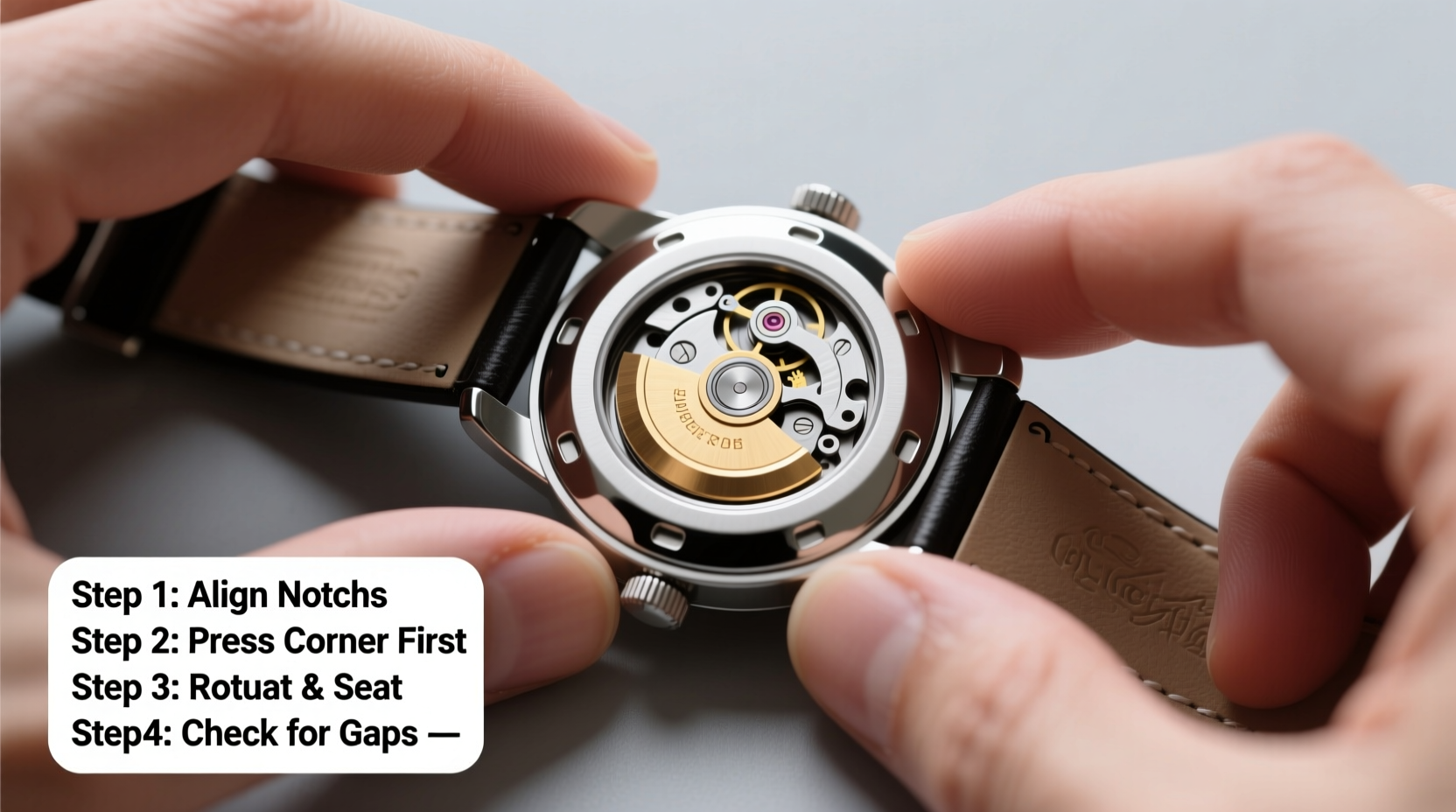
Before attempting to reattach a watch back, identify which type your timepiece uses. The method of closure determines the safest reassembly approach:
- Snap-on backs: These are pressed into place with a tight friction fit. Common in vintage and budget watches.
- Screw-down backs: Feature threaded edges that twist into the case. Found on water-resistant and dive watches.
- Notched (or claw-style) backs: Require a special wrench to tighten but are less common in consumer-grade watches.
This guide focuses on snap-on and screw-down backs, as these are most likely to be handled without tools. For notched backs, professional assistance is strongly recommended.
“Improperly seated case backs are one of the leading causes of moisture damage in otherwise well-maintained watches.” — Daniel Reyes, Master Watchmaker, 25+ years experience
Preparation: Clean and Inspect Before Reassembly
A clean case and intact gasket are critical for a secure seal. Even microscopic debris can prevent proper closure or compromise water resistance.
Step-by-step preparation checklist:
- Remove all lint, dust, or old gasket residue from the case back groove using a soft brush or wooden toothpick.
- Inspect the rubber or silicone gasket for cracks, warping, or dryness. Replace if damaged.
- Clean the inner case edge with isopropyl alcohol on a cotton swab. Let dry completely.
- Apply a tiny amount of watch-specific gasket grease (optional but recommended for screw-down types).
- Ensure the watch crystal and movement are protected—cover with a soft cloth if necessary.
Securely Reattaching a Snap-On Watch Back
Snap-on backs rely on compression to stay in place. The goal is even pressure around the entire rim to avoid bending or misalignment.
Method using household items:
- Align the case back carefully. It should sit flush with no visible gaps on one side.
- Place the watch face-down on a soft surface like a microfiber cloth or folded towel.
- Use a smooth, flat object such as a wide-mouth glass jar or sturdy plastic cup. The opening should be slightly larger than the case back.
- Invert the jar so its base presses against the center of the case back.
- Gently tap the top of the jar with the palm of your hand. Use short, controlled taps—do not strike hard.
- After several taps, check alignment. Rotate the watch 90 degrees and repeat until fully seated.
The key is distributing force evenly. Avoid using metal objects or pliers, which can scratch or deform the case. If resistance increases dramatically, stop—misalignment may be causing binding.
Alternative: Wooden Block Technique
For thicker cases, place a small hardwood block (like a chopstick end) centered on the back. Tap lightly with a rubber mallet or hammer wrapped in cloth. This concentrates force safely while minimizing risk to the crystal.
Reattaching a Screw-Down Case Back Without Tools
Screw-down backs require rotational force rather than compression. While a case wrench is ideal, limited options exist for manual tightening.
Safe DIY Method:
- Align the threads carefully. Turn the back counterclockwise until it drops into place, then reverse direction.
- Use textured rubber gloves or a rubber band wrapped around the back’s edge to improve grip.
- Press firmly and turn clockwise with steady, even pressure. Do not jerk or force it.
- If resistance occurs before full engagement, disengage and realign—cross-threading can ruin the case.
- Once hand-tight, wrap a wide rubber band around the case and use it as a lever for slight additional torque.
Note: Full water resistance cannot be guaranteed without calibrated torque tools. Avoid swimming or showering with a manually sealed screw-down back unless verified by a professional.
| METHOD | BEST FOR | RISK LEVEL | WATER RESISTANCE OUTCOME |
|---|---|---|---|
| Jar Tapping (Snap-on) | Vintage, fashion, quartz watches | Low (if done gently) | Fair – dust/moisture resistant |
| Rubber Grip (Screw-down) | Dive watches with intact threads | Moderate (risk of cross-threading) | Limited – not suitable for deep immersion |
| Pliers / Metal Tools | None – avoid entirely | High | Poor – likely damage |
Real Example: Recovering a Vintage Heirloom Watch
Mark, a collector in Portland, inherited his grandfather’s 1967 Seiko automatic. After replacing the dead battery, he struggled to reseat the snap-back. Using pliers initially, he dented the edge and created a gap. Moisture entered within days, fogging the crystal.
He reset the process: cleaned the groove with alcohol, sourced a replacement gasket online, and used a glass spice jar to apply even pressure. Five minutes of patient tapping resulted in a perfect seal. Six months later, the watch remains fog-free and accurate. His takeaway: “Patience beats force every time.”
Frequently Asked Questions
Can I use tape to hold the back on temporarily?
No. Tape lacks structural integrity and can leave residue. A loose back should be secured properly or left off until correct tools are available.
How do I know if the back is on straight?
Check for uniform gaps around the perimeter. A misaligned back will protrude on one side. Also, run a fingernail around the seam—it should feel smooth and continuous.
Is it safe to wear a watch with a loosely attached back?
No. Internal components are vulnerable to dust, moisture, and shock. A loose back can detach unexpectedly, risking loss of the watch or injury.
Final Tips for Long-Term Success
- Always work on a clean, stable surface to avoid dropping small parts.
- Keep track of screws and gaskets in a small container—magnets help with steel components.
- Label your tools and materials if assisting others—confusion leads to mistakes.
- When in doubt, consult a local jeweler. Many charge minimal fees for simple reseating.
Conclusion
Securing a watch back without specialized tools is achievable with patience, the right technique, and respect for the mechanics involved. By understanding your watch’s case type, preparing thoroughly, and applying even pressure or grip, you can restore protection and function safely at home. While professional tools offer precision, careful improvisation preserves both timepiece and budget. Treat each reassembly as an act of care—not just repair—and your watches will continue ticking reliably for years.




 浙公网安备
33010002000092号
浙公网安备
33010002000092号 浙B2-20120091-4
Comments
No comments yet. Why don't you start the discussion?