
Accurate personal information is critical when completing the Free Application for Federal Student Aid (FAFSA). Among the most important details is your permanent address. If you've moved or are planning to relocate, updating your address ensures that all financial aid communications—from award letters to verification requests—reach you promptly. A mismatched or outdated address can delay processing, create confusion with tax data retrieval, or even affect eligibility determinations. This guide walks you through the exact steps to update your permanent address on the FAFSA, explains why it matters, and provides real-world examples and checklists to help you avoid common pitfalls.
Why Your Permanent Address Matters on FAFSA
The permanent address listed on your FAFSA isn’t just a formality—it plays a key role in how your financial aid is assessed and delivered. The U.S. Department of Education uses this address to determine your state of legal residence, which affects eligibility for state-specific grants and scholarships. For dependent students, the address also influences which state’s tuition rates may apply if attending an in-state public institution.
Additionally, colleges and state agencies use the permanent address to send sensitive documents, such as financial aid offers, loan disclosures, and verification forms. An incorrect or outdated address increases the risk of missed deadlines and lost paperwork. Unlike a mailing address, the permanent address reflects where you legally reside, not where you’re temporarily staying—such as a dormitory or summer sublet.
“Your FAFSA address is tied to both communication and eligibility. Students who fail to update their address after moving often experience delays in aid disbursement.” — Dr. Linda Ruiz, Higher Education Policy Analyst at the National College Access Network
When You Should Update Your Address
Life changes happen: you graduate high school and move out, transfer schools, return home after a semester abroad, or establish residency in a new state. Any of these events may require an address update on your FAFSA. Here are the most common scenarios:
- You’ve moved since submitting last year’s FAFSA
- You’re transitioning from high school to college and establishing a new permanent residence
- You’ve changed your legal state of residence for tuition purposes
- Your contact information no longer matches your official ID or tax records
Step-by-Step Guide to Changing Your Address
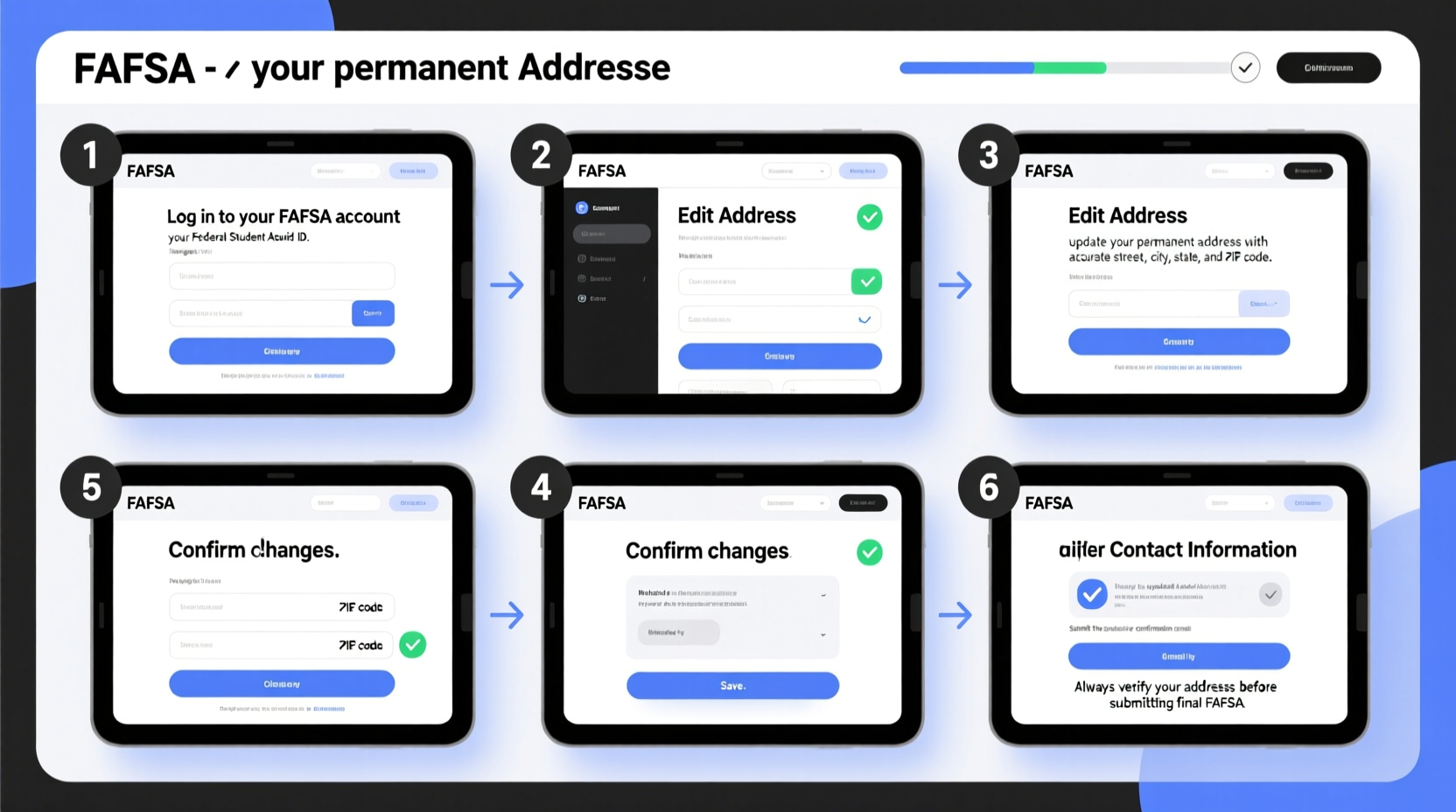
Updating your permanent address on the FAFSA is straightforward, but must be done carefully to avoid errors. Follow these steps exactly:
- Log in to your FAFSA account at studentaid.gov using your FSA ID. If you don’t have one, create it before proceeding.
- Select “Start or Continue Your FAFSA” from the dashboard. If you already have a saved draft, click “Continue” on that application.
- Navigate to the “Personal Information” section. Scroll down to the “Permanent Address” field. Do not confuse this with your mailing address, which can be different.
- Edit your address. Enter your updated street address, city, state, ZIP code, and country (if outside the U.S.). Ensure spelling and formatting match your government-issued ID and tax returns.
- Save your changes. Click “Save” at the bottom of the page. The system will prompt you to confirm the update.
- Review and submit. Go through the summary page to verify all information is correct. Submit the application or save as draft if more updates are needed.
If you're making changes to a submitted FAFSA, note that corrections can be made until the federal deadline (typically June 30). However, individual schools and states may have earlier cutoffs, so act quickly.
Common Mistakes and How to Avoid Them
Even small errors in address entry can trigger verification processes or misdirect vital documents. Below is a comparison of best practices versus frequent missteps:
| Do’s | Don’ts |
|---|---|
| Use your legal permanent residence—not a P.O. box or temporary housing | Enter a campus dorm address as your permanent address unless it’s truly your legal residence |
| Match the address format used on your tax returns and driver’s license | Abbreviate street names inconsistently (e.g., “St” vs “Street”) |
| Update your address on both FAFSA and CSS Profile (if applicable) | Assume your school will automatically receive the change—verify with your financial aid office |
| Double-check ZIP codes, especially in areas with multiple postal zones | Wait until after filing to make changes—update early to prevent delays |
Real Example: How One Student Avoided Aid Delays
Jamal, a first-generation college student from Chicago, moved to Indiana to live with his aunt while attending university. He initially listed his parents’ Chicago address on his FAFSA, assuming it was required as a dependent. However, he planned to stay in Indiana year-round and wanted in-state tuition benefits.
After consulting his financial aid advisor, Jamal learned he could update his permanent address to reflect his new residence, provided he could demonstrate intent to remain there. He gathered utility bills and a notarized residency affidavit, then logged into his FAFSA account and corrected the address before the renewal deadline. As a result, he qualified for Indiana state grants and received all correspondence at his aunt’s home without delay.
This case illustrates that while dependents typically use a parent’s address, exceptions exist—and proactive updates can expand financial aid opportunities.
Checklist: Updating Your FAFSA Address Successfully
Before finalizing your FAFSA submission or correction, run through this essential checklist:
- ✅ Confirm your permanent address matches your driver’s license, tax return, and voter registration
- ✅ Log in with the correct FSA ID (not your parent’s, unless assisting them)
- ✅ Distinguish between permanent and mailing addresses; only update the former if necessary
- ✅ Save and exit properly to ensure changes are recorded
- ✅ Notify your school’s financial aid office of the change, especially if close to a deadline
- ✅ Keep a printed or digital copy of your updated FAFSA confirmation page
Frequently Asked Questions
Can I use my college dorm address as my permanent address?
No, unless you consider the dorm your legal, year-round residence and have no other permanent home. Most students should use their family home or another long-term residence. Using a dorm may complicate state residency determinations.
What if I’m homeless or unaccompanied youth? How do I list an address?
Federal guidelines allow unaccompanied homeless youth to use the address of a shelter, temporary housing, or even a trusted friend’s home. You must document your status with your school’s financial aid office, which can designate you as independent and guide appropriate address selection.
Will changing my address affect my Expected Family Contribution (EFC)?
Not directly. However, your state of residence impacts eligibility for state grants and institutional aid. For example, moving from a state with limited aid programs to one with robust support (like New York’s TAP or California’s Cal Grant) can significantly increase your total aid package.
Final Steps and Ongoing Management
Changing your permanent address on the FAFSA is not a one-time task. As you progress through college, life circumstances may shift again—whether due to internships, study abroad, marriage, or employment. Make it a habit to review your FAFSA information each time you renew, typically every October.
Set calendar reminders ahead of the FAFSA opening date to gather updated documents and verify all personal details. Consider linking your FSA account to email and text alerts to receive notifications about deadlines, corrections, and aid offers.




 浙公网安备
33010002000092号
浙公网安备
33010002000092号 浙B2-20120091-4
Comments
No comments yet. Why don't you start the discussion?