
For federal employees and members of the uniformed services, the Thrift Savings Plan (TSP) is one of the most powerful tools available for building long-term retirement security. Yet, many contributors make deposits without fully understanding their account balance, investment choices, or growth potential. Knowing how to access your TSP account and interpret the data within it is essential for making informed financial decisions. This guide walks you through every step—from logging in to analyzing your portfolio—so you can take control of your retirement future.
Why Monitoring Your TSP Account Matters
The TSP functions much like a 401(k), offering tax-advantaged savings with employer matching contributions for eligible participants. However, unlike a bank account, your TSP balance isn't just about how much you've deposited—it reflects market performance, fund allocations, fees, and compounding interest. Regular monitoring helps you:
- Detect errors in contributions or loan payments
- Evaluate investment performance across different funds
- Adjust asset allocation based on life stage or risk tolerance
- Plan for retirement timelines and income needs
According to the Federal Retirement Thrift Investment Board, over 6 million active and former federal employees participate in the TSP, with combined assets exceeding $800 billion. Despite this scale, a 2023 Government Accountability Office report found that only 37% of participants review their accounts more than once per year. Staying engaged can significantly improve outcomes.
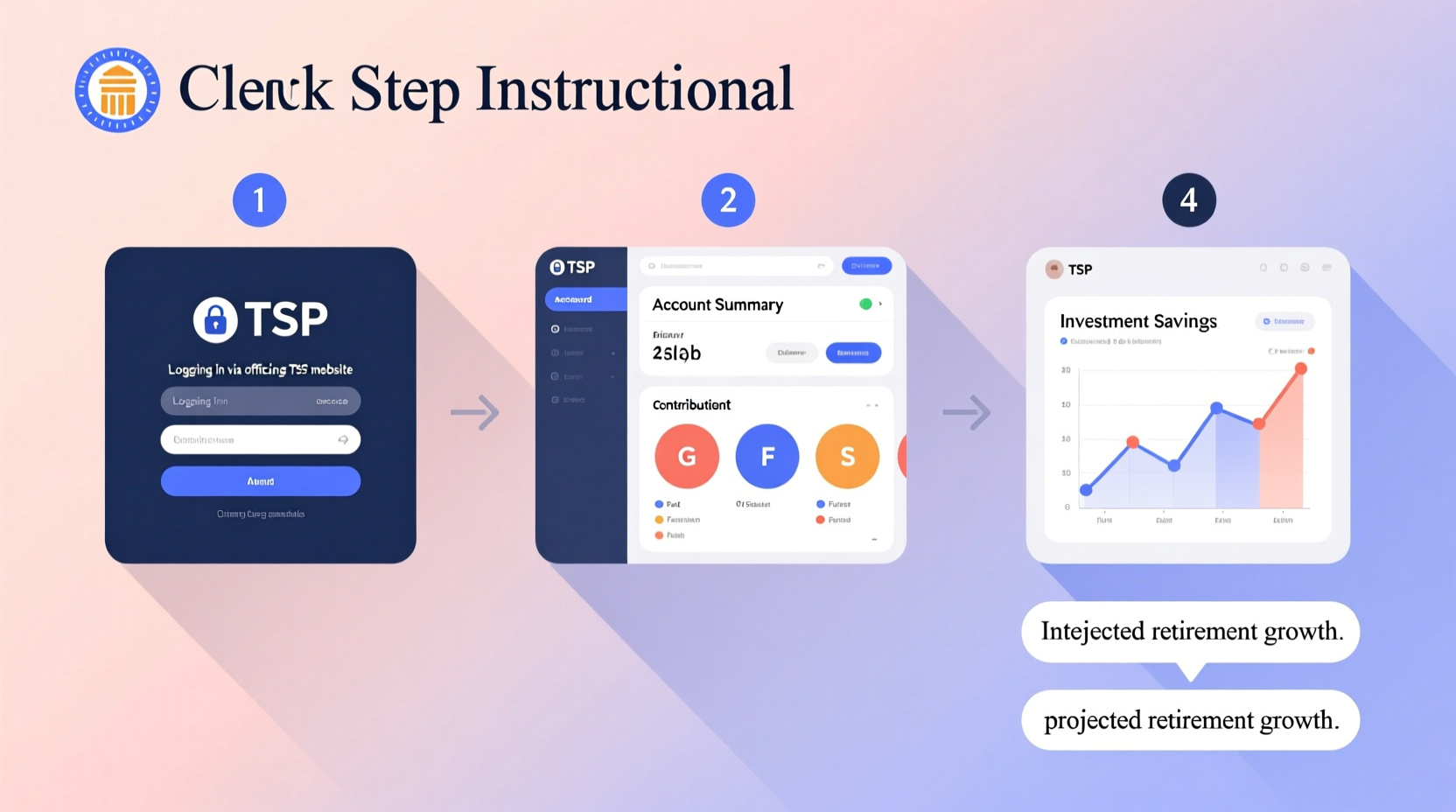
Step-by-Step: How to Log In and Access Your TSP Account
Gaining secure access to your TSP account is the first critical step. Whether you're a new employee or returning after years, follow this process carefully.
- Visit the official website: Go to www.tsp.gov. Always ensure you’re on the correct site to avoid phishing scams.
- Click “Log In”: Located at the top right corner of the homepage.
- Select your login method: Choose between Login.gov, ID.me, or DS Logon (for military). These are trusted identity providers used by U.S. government agencies. <4> Authenticate your identity: Complete multi-factor authentication using your phone, email, or security key as prompted.
- Set up profile preferences: Once logged in, set up contact information, notification settings, and preferred communication methods.
If you’ve never created an account, click “Register” during the login process. You’ll need your Social Security Number, date of birth, and agency-assigned TSP account number (found on pay stubs or SF-50 forms).
Understanding Your TSP Dashboard and Key Metrics
After logging in, you’ll land on your personalized dashboard. Here’s what each section means and why it matters:
| Metric | What It Shows | Why It Matters |
|---|---|---|
| Account Balance | Total value of all contributions, earnings, and losses | Reflects current net worth in the plan; includes both your contributions and any agency matching |
| Rate of Return (YTD and 1-year) | Performance of your selected funds over time | Helps assess whether your investment strategy is working; compare against benchmarks like S&P 500 |
| Fund Allocations | Percentage breakdown across G, F, C, S, I, and L Funds | Determines your exposure to risk and market volatility |
| Contribution Rate | Percentage or dollar amount deducted from your paycheck | Impacts how quickly your balance grows; higher rates accelerate savings |
| Loan Status | Outstanding loans and repayment schedule | Unpaid loans reduce your balance and may trigger taxes if not repaid before separation |
“Knowing your rate of return isn’t just about tracking gains—it’s about understanding whether your money is working hard enough for your goals.” — James Lee, Certified Financial Planner specializing in federal benefits
How to Review and Optimize Your Investment Strategy
Your default investment choice might not align with your long-term objectives. The TSP offers several options:
- L Funds (Lifecycle Funds): Automatically rebalance from aggressive to conservative as you near retirement. Ideal for hands-off investors.
- Individual Funds: G (government securities), F (fixed income), C (S&P 500 index), S (smaller companies), I (international). Allows full control but requires active management.
To evaluate your strategy:
- Check your current allocation under “My Account > Contributions & Exchanges.”
- Compare your portfolio’s performance against historical averages. For example, the C Fund has averaged about 10% annual return over the past 30 years, though past performance doesn’t guarantee future results.
- Consider your time horizon. If retiring in 25+ years, a heavier stock allocation (C, S, I) may be appropriate. Within 5–10 years, shifting toward G and F Funds can reduce risk.
- Use the TSP’s “Simulate” tool to model how changes affect projected balances.
Mini Case Study: Maria Adjusts Her Portfolio
Maria, a 42-year-old NOAA scientist with 18 years of federal service, had been enrolled in the L 2050 Fund since her hire. She assumed it was managing everything automatically—until she reviewed her account and noticed lower-than-expected returns during a strong bull market.
Upon closer inspection, she realized the L Fund had reduced its equity exposure earlier than expected due to its glide path design. Wanting more growth potential while still managing risk, Maria reallocated 20% of her balance into the C and I Funds manually, keeping the rest in L 2050 for diversification.
Two years later, her adjusted portfolio outperformed the pure L Fund by 2.3% annually, adding nearly $18,000 in additional growth. Her experience underscores the value of periodic reviews—even when using automated solutions.
Essential Checklist for Quarterly TSP Maintenance
To stay on track, conduct these actions every three months:
- ✅ Confirm payroll deductions match your elected contribution rate
- ✅ Verify agency matching contributions (if applicable) are posting correctly
- ✅ Review fund performance and overall rate of return
- ✅ Check loan balances and payment history (if applicable)
- ✅ Assess whether life changes (marriage, children, promotion) warrant adjustments to investments or beneficiaries
- ✅ Update contact info and security settings
Frequently Asked Questions
Can I access my TSP account after leaving federal service?
Yes. Former employees retain full access to view balances, manage investments, and initiate withdrawals. You can also roll over funds to an IRA or new employer’s plan.
How often should I change my investment allocation?
There’s no set rule, but most experts recommend reviewing at least annually. Major life events—like buying a home, nearing retirement, or experiencing market shocks—are valid reasons to reassess.
Is my TSP balance protected from creditors?
In most cases, yes. Under ERISA protections, TSP accounts are generally shielded from creditors and bankruptcy claims, though exceptions exist for court-ordered judgments like unpaid taxes or divorce settlements.
Take Control of Your Retirement Future Today
Your TSP account is more than a line item on your pay stub—it's the foundation of your financial independence in retirement. By logging in regularly, understanding your investment choices, and making intentional decisions, you turn passive saving into active wealth building. Don’t wait until five years before retirement to engage. The most successful savers aren’t those who contribute the most—they’re the ones who pay attention.




 浙公网安备
33010002000092号
浙公网安备
33010002000092号 浙B2-20120091-4
Comments
No comments yet. Why don't you start the discussion?