
Studying doesn’t have to be dull. For many students and lifelong learners, the right background music can transform hours of concentration into an immersive experience. Anime soundtracks—known for their emotional depth, cinematic quality, and genre diversity—offer a powerful yet often underutilized resource for enhancing focus during study sessions. Unlike mainstream pop or lyric-heavy tracks, instrumental anime scores provide energy without distraction. This guide walks you through building a personalized anime playlist tailored to your study rhythm, cognitive needs, and personal taste.
Why Anime Music Works for Studying
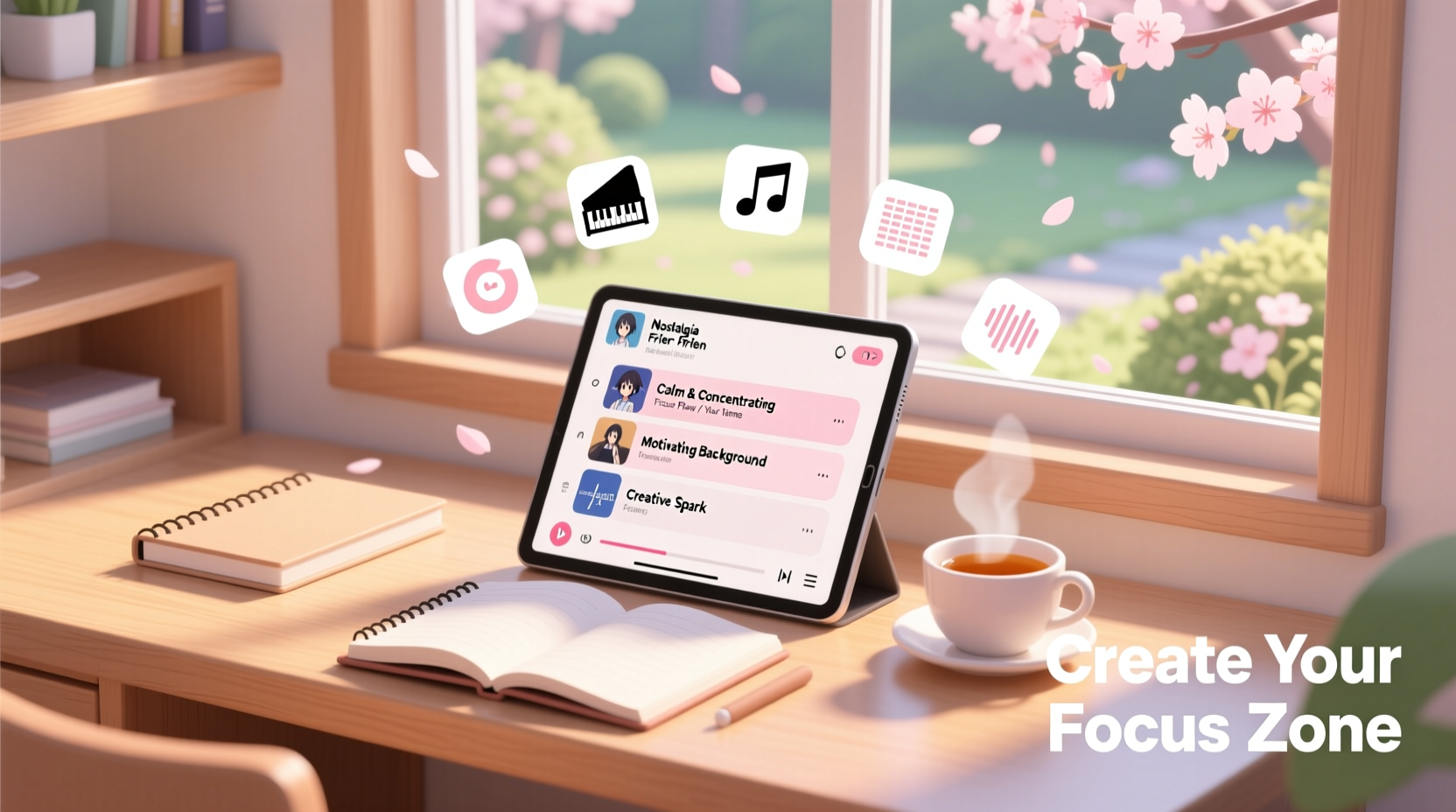
Anime soundtracks are uniquely suited to academic environments. Composers like Yuki Kajiura, Hiroyuki Sawano, and Joe Hisaishi craft music that balances intensity with subtlety. Their work spans orchestral epics, ambient textures, electronic pulses, and minimalist piano—genres proven to support deep work. Research in cognitive psychology suggests that music with moderate tempo (60–80 BPM), low lyrical interference, and consistent dynamics improves attention span and information retention.
Anime OSTs frequently meet these criteria. Whether it’s the driving strings of *Attack on Titan* or the serene piano melodies from *Clannad*, these tracks create an auditory \"bubble\" that shields against external distractions while maintaining mental alertness. Moreover, because fans often associate anime music with perseverance, growth, and triumph, the emotional resonance can subconsciously boost motivation during long study stretches.
Step 1: Define Your Study Environment and Goals
Before selecting any track, assess your learning context. Not all study modes require the same kind of soundtrack. A 20-minute flashcard review demands different energy than a three-hour coding session. Begin by answering three key questions:
- What type of work am I doing? (e.g., reading, problem-solving, writing, memorization)
- When do I study? (morning, late night, in a library, at home)
- What mood do I need? (calm, energized, focused, emotionally neutral)
For example, early morning revision may benefit from uplifting, moderately paced tracks to kickstart alertness. In contrast, late-night essay writing might call for ambient, repetitive instrumentals that prevent drowsiness without overstimulation.
Once you’ve mapped your typical study profile, categorize your sessions into types such as:
- Deep Focus: Long blocks requiring sustained attention (e.g., math, programming)
- Creative Flow: Writing, brainstorming, design work
- Active Recall: Flashcards, quizzes, language drills
- Transition Periods: Warm-ups, breaks, winding down
This framework allows you to build targeted playlists rather than one-size-fits-all mixes.
Step 2: Curate Soundtrack Themes by Genre and Mood
Anime music spans dozens of subgenres. The best playlists blend variety with coherence. Start by exploring iconic series known for high-quality, study-friendly scores:
| Anime | Composer | Best For | Sample Tracks |
|---|---|---|---|
| Ghost in the Shell: Stand Alone Complex | Yoko Kanno | Deep focus, analytical thinking | \"Inner Universe\", \"Rise\" |
| Death Note | Soundtrack Team (Various) | Intense concentration | \"Distress\", \"The First Passover\" |
| Violet Evergarden | Daisuke Yokota | Calm focus, reflective writing | \"Sincerely\", \"Echo\" |
| My Hero Academia | Yuki Hayashi | Motivation, active recall | \"Main Theme\", \"You Say Run\" |
| Spirited Away | Joe Hisaishi | Relaxation, creativity | \"One Summer's Day\", \"The Name of Life\" |
Use streaming platforms like Spotify, YouTube, or Apple Music to search for official soundtracks. Look for keywords like “OST,” “instrumental,” “no vocals,” or “study mix.” Avoid fan-made compilations labeled “epic anime music” unless carefully vetted—many include abrupt transitions or distorted audio that disrupt flow.
“Music acts as a cognitive anchor. When listeners associate certain tracks with productive states, they can trigger those mindsets on demand.” — Dr. Lena Torres, Cognitive Neuroscientist, University of Tokyo
Step 3: Structure Your Playlist Chronologically
A well-structured playlist mirrors the arc of a study session. Think of it like a film score: rising action, climax, resolution. Follow this timeline to sequence your selections effectively:
- Phase 1: Activation (5–10 min)
Choose light, engaging tracks to signal the brain that work is beginning. Opt for rhythmic but not overwhelming pieces. Example: \"Ghibli Jazz Night\" covers or soft piano renditions from *K-On!*. - Phase 2: Immersion (30–90 min)
Transition into longer instrumental suites with steady pacing. These should occupy the background without demanding attention. Ideal picks include ambient loops from *Serial Experiments Lain* or string arrangements from *Fate/stay night [Unlimited Blade Works]*. - Phase 3: Sustained Drive (Optional, for intense tasks)
If tackling complex material, insert one or two dynamic tracks with rising tension—such as \"BTS\" from *Attack on Titan*—to re-energize focus. Limit these to 3–4 minutes to avoid overstimulation. - Phase 4: Wind Down (5–10 min)
As your session ends, shift to gentle, resolving melodies. This helps transition out of study mode smoothly. Tracks like \"Sayonara no Natsu\" (*Your Name*) or \"Forest of Falling Leaves\" (*Natsume’s Book of Friends*) ease mental fatigue.
Step 4: Personalize Based on Emotional Triggers
The most effective playlists aren't just functional—they're emotionally intelligent. Reflect on which anime stories inspire perseverance, clarity, or calm in you. Do you feel empowered by *Demon Slayer*'s resilience arcs? Soothing watercolor scenes from *A Silent Voice* help you center? Leverage those associations.
One student, Maria Chen, a computer science major at Kyoto University, built her exam playlist around *Cowboy Bebop*. “Every time I hear ‘The Real Folk Blues,’ I remember the show’s theme of moving forward despite setbacks,” she says. “It doesn’t make studying fun, but it makes enduring it feel meaningful.” Her playlist cycles through muted jazz instrumentals during debugging sessions and switches to faster synth beats when compiling code.
This is the power of narrative-based soundtracking: familiar music tied to character journeys creates subtle psychological reinforcement. You’re not just listening—you’re aligning with a mindset of progress.
Step 5: Test, Refine, and Rotate
No playlist works perfectly on the first try. Treat your initial version as a prototype. Over the next week, use it across different subjects and times of day. After each session, rate its effectiveness:
- Did the music help maintain focus?
- Were there moments of distraction or irritation?
- Did any track feel too loud, slow, or emotionally heavy?
Adjust accordingly. Replace disruptive tracks, extend sections that worked well, and shorten transitions that broke flow. Also, avoid overexposure. Listening to the same 10 tracks daily can lead to habituation, reducing their cognitive impact. Rotate in new anime scores every 2–3 weeks to keep the auditory environment fresh.
📋 **Checklist: Building Your Anime Study Playlist**- ☐ Identify your primary study types and timing
- ☐ Select 3–5 anime series with strong instrumental soundtracks
- ☐ Gather at least 15 high-quality, vocal-free tracks
- ☐ Organize tracks into activation, immersion, drive, and wind-down phases
- ☐ Enable crossfading and disable shuffle mode
- ☐ Test the playlist over 3 real study sessions
- ☐ Remove or replace underperforming tracks
- ☐ Schedule monthly refreshes with new themes
Common Pitfalls to Avoid
Even well-intentioned playlists can backfire. Watch out for these mistakes:
| Do | Don’t |
|---|---|
| Choose tracks with consistent volume levels | Include songs with sudden loud drops or screams |
| Use full OST albums for continuity | Rely solely on popular opening themes with lyrics |
| Match tempo to task complexity | Play battle themes during reading comprehension |
| Keep playlists between 45–90 minutes | Create endless 5-hour mixes that lose thematic cohesion |
Remember: the goal isn’t entertainment. It’s cognitive support. If a track makes you want to pause and rewatch the scene, it’s probably too evocative for active studying.
Frequently Asked Questions
Can I use anime openings if I mute the video?
Only if they’re instrumental or you extract the backing track. Most openings contain vocals that engage language-processing centers in the brain, competing with reading and writing tasks. Stick to BGM (background music) or OST versions labeled “off-vocal” or “instrumental.”
How long should my playlist be?
Ideal length matches your average study block. For Pomodoro-style sessions (25–30 min), aim for 30–40 minutes of music. For deep work marathons (2+ hours), build a 90-minute core playlist and let it loop once. Avoid infinite playlists—predictability aids focus.
Is it okay to listen to sad or melancholic anime music while studying?
Proceed with caution. While tracks from *Angel Beats!* or *Clannad* are beautiful, emotionally heavy music can induce rumination or lower energy. Reserve these for reflective writing or creative projects. For logic-based work, prioritize neutral or uplifting tones.
Final Thoughts
Creating a personalized anime playlist is more than a hobby—it’s an act of self-awareness. By aligning music with your cognitive rhythms and emotional triggers, you turn passive listening into an active tool for mastery. The right score doesn’t just accompany your studies; it elevates them.
Start small. Build one focused 60-minute playlist this week. Test it during a challenging session. Notice how your attention shifts, how your stamina holds. Then refine, expand, and own your sonic study identity. In time, hearing that first piano note might be all it takes to enter the zone.




 浙公网安备
33010002000092号
浙公网安备
33010002000092号 浙B2-20120091-4
Comments
No comments yet. Why don't you start the discussion?