
A well-crafted business plan is more than a document—it’s a strategic roadmap. It aligns your vision with actionable steps, communicates credibility to investors, and sets the foundation for scalable growth. Too many entrepreneurs rush into funding pitches without a clear, compelling plan. The result? Rejected proposals and stalled momentum. This guide breaks down the process of building a business plan that not only secures capital but also guides your company toward measurable success.
1. Define Your Business Vision and Objectives
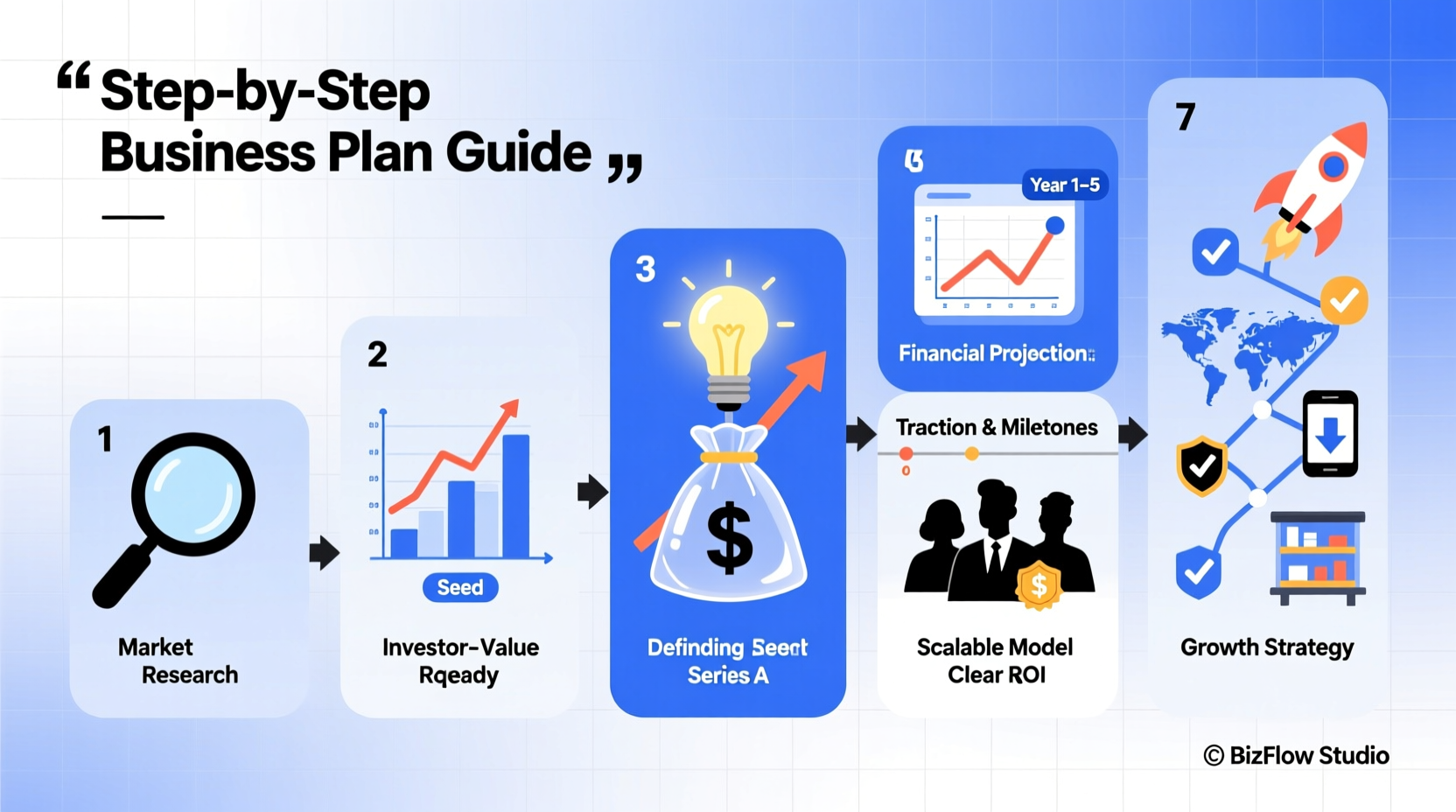
Every powerful business plan starts with clarity. Before diving into financial projections or market analysis, articulate your mission, vision, and core objectives. These elements shape the tone and direction of your entire plan.
Your mission statement should answer: Why does your business exist? What problem are you solving? Your vision describes where you want to be in five or ten years. Meanwhile, your objectives must be specific, measurable, achievable, relevant, and time-bound (SMART).
For example, instead of saying “We sell eco-friendly products,” say: “We empower urban households to reduce plastic waste through affordable, reusable home essentials.” Precision builds credibility.
2. Conduct Thorough Market Research
Investors don’t fund ideas—they fund validated opportunities. Demonstrating deep market understanding separates serious founders from hopeful dreamers.
Start by identifying your target audience. Who are they? What are their pain points? How do they currently solve the problem you’re addressing? Use primary research (surveys, interviews) and secondary data (industry reports, competitor websites) to build a comprehensive profile.
Analyze your competition. List direct and indirect competitors. Assess their strengths, weaknesses, pricing models, and customer reviews. This helps you identify gaps in the market and define your unique value proposition (UVP).
“Founders who understand their customers better than anyone else win. That insight is worth more than any prototype.” — Sarah Lin, Venture Partner at Founders First Capital
Your UVP should clearly state why customers will choose you over alternatives. For instance: “Our AI-powered fitness app delivers personalized workouts based on real-time biometrics—no other platform offers this level of customization at our price point.”
3. Structure Your Business Plan with Key Components
A winning business plan includes seven essential sections. Each serves a distinct purpose and answers critical questions investors have.
| Section | Purpose | Key Questions Answered |
|---|---|---|
| Executive Summary | Overview of the entire plan | What does your company do? What’s your goal? How much funding do you need? |
| Company Description | Background and legal structure | When was it founded? Where are you based? What stage are you in? |
| Market Analysis | Demonstrate industry knowledge | Who is your customer? What’s the market size? What trends matter? |
| Organization & Management | Showcase team strength | Who’s on the team? What experience do they bring? |
| Products or Services | Explain what you offer | How does it work? What’s the lifecycle? Any IP or patents? |
| Marketing & Sales Strategy | Detail customer acquisition | How will you reach customers? What channels will you use? |
| Financial Projections | Prove viability and ROI | What are your revenue forecasts? When will you break even? |
The executive summary is often written last, despite appearing first. It should be concise—no more than two pages—and include your mission, product, target market, competitive edge, financial highlights, and funding request.
4. Build Realistic Financial Models
This is where many plans fail. Overly optimistic revenue forecasts or vague cost estimates raise red flags. Investors want to see disciplined financial thinking.
Include three core documents: income statements, cash flow projections, and balance sheets—for at least three years. Use conservative assumptions. Base your numbers on real data: customer acquisition costs, average order value, churn rate, and gross margins.
If you're pre-revenue, rely on market benchmarks and pilot program results. For example, if similar startups in your sector acquire customers at $50 each, don’t assume you’ll do it for $10 unless you have proof.
Be transparent about risks. Include a sensitivity analysis that shows best-case, base-case, and worst-case scenarios. This demonstrates foresight and preparedness.
5. Refine, Test, and Present with Confidence
A perfect business plan isn’t static. It evolves. Share drafts with mentors, advisors, or experienced entrepreneurs. Ask them: Is the logic clear? Are the assumptions realistic? Would you invest based on this?
Use feedback to tighten your narrative. Eliminate jargon. Replace vague claims like “huge market potential” with specific metrics: “The global market for sustainable packaging is projected to reach $173 billion by 2028 (Grand View Research, 2023).”
When presenting to investors, focus on storytelling. Start with the problem, show how your solution works, prove demand, introduce your team, and conclude with a clear funding ask and use of funds. Practice until you can deliver it in under ten minutes.
Mini Case Study: GreenCycle Packaging
GreenCycle, a startup developing compostable food containers, struggled to secure seed funding. Their initial pitch lacked detailed unit economics and relied on broad environmental claims. After revising their business plan, they included:
- Survey data from 500 restaurant owners showing willingness to pay a 15% premium for certified compostable packaging
- Partnership letters from two regional distributors
- 12-month cash flow model with a break-even point at month 18
- Clear allocation of $250,000 funding: 40% manufacturing, 30% sales, 20% R&D, 10% admin
The revised plan led to a $300,000 investment from a sustainability-focused angel group. Within 18 months, they achieved profitability and expanded to three new markets.
Frequently Asked Questions
How long should a business plan be?
Ideal length is 15–25 pages. Executive summaries should be 1–2 pages. Appendices can include supporting data, resumes, or technical specs without cluttering the main document.
Do I need a business plan if I’m bootstrapping?
Yes. Even without external funding, a business plan keeps you focused, measures progress, and prepares you for future scaling or investment opportunities.
Can I use a template?
Templates are helpful starting points, but avoid generic fill-in-the-blank approaches. Customize every section to reflect your business’s unique context, strategy, and goals.
Final Checklist Before Submission
- ✅ Mission, vision, and SMART objectives clearly defined
- ✅ Target market thoroughly researched with supporting data
- ✅ Competitive analysis completed and UVP articulated
- ✅ Organizational structure and team bios included
- ✅ Marketing and sales strategy outlined with timelines
- ✅ Three-year financial projections with assumptions documented
- ✅ Break-even analysis and sensitivity scenarios added
- ✅ Executive summary polished and compelling
- ✅ Proofread for grammar, clarity, and consistency
- ✅ Reviewed by at least two trusted advisors
Take Action Today
A powerful business plan doesn’t guarantee success, but it dramatically increases your odds. It forces discipline, reveals blind spots, and positions you as a credible leader in your field. Whether you're approaching banks, angel investors, or venture capitalists, your plan is your first impression—make it count.




 浙公网安备
33010002000092号
浙公网安备
33010002000092号 浙B2-20120091-4
Comments
No comments yet. Why don't you start the discussion?