
Folding a fitted sheet has long been considered one of the great household mysteries—right up there with untangling necklaces or matching all the socks from a single load. The elastic corners stretch in every direction, the fabric resists neat creases, and most people end up balling it up and shoving it into the linen closet. But it doesn’t have to be that way. With the right method, anyone can fold a fitted sheet cleanly, consistently, and without frustration. This guide breaks down the process into simple, repeatable steps used by professional organizers, hotel staff, and laundry experts worldwide.
The ability to fold a fitted sheet neatly isn’t just about appearances—it’s practical. Properly folded sheets take up less space, stack better, and make changing beds faster and more organized. They also last longer because constant crumpling stresses the fabric and seams over time. Whether you're managing a family laundry routine or simply want to elevate your home organization game, mastering this skill pays off daily.
Why Fitted Sheets Are So Hard to Fold
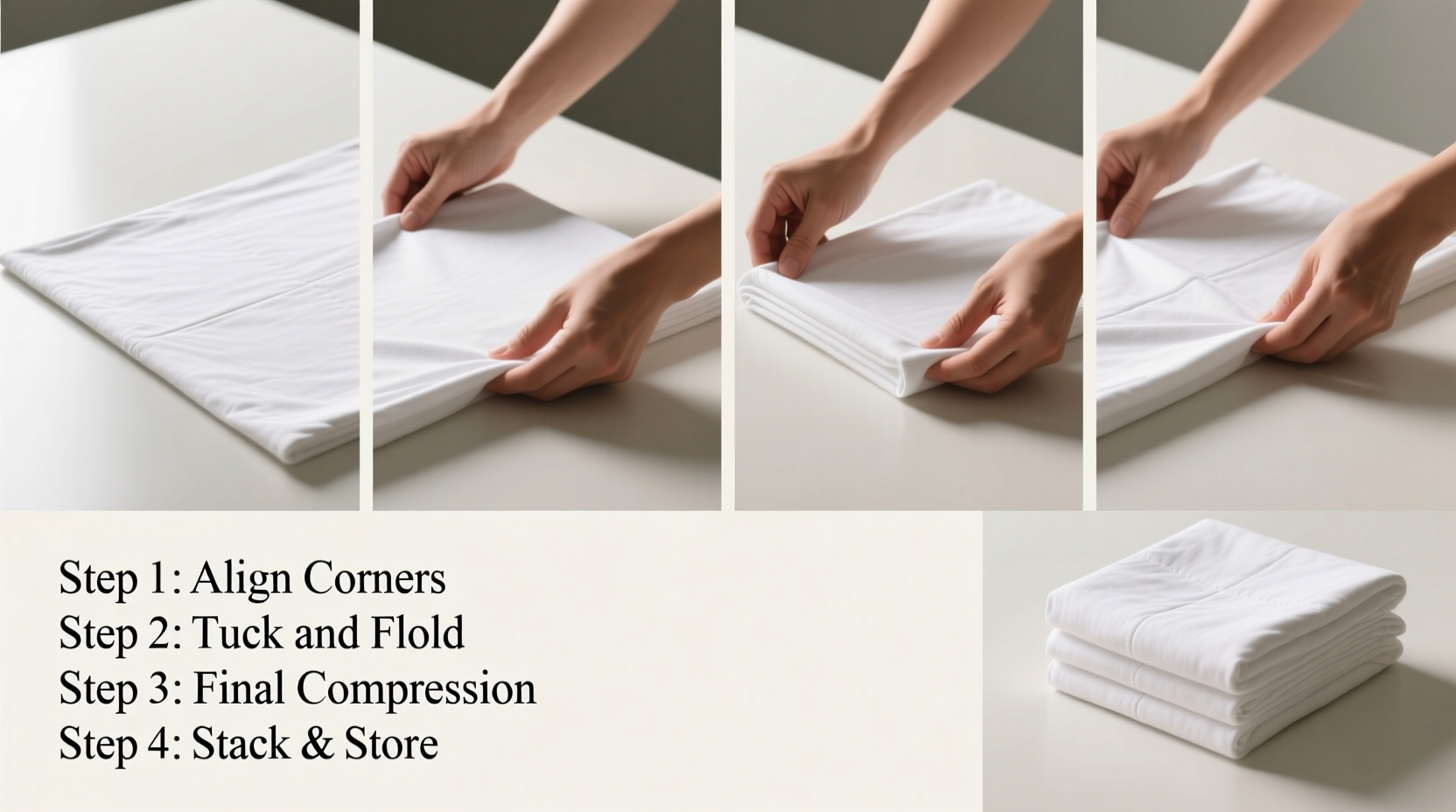
The challenge with fitted sheets lies in their design. Unlike flat sheets, which are rectangles with straight edges, fitted sheets have deep pockets and elasticized corners meant to grip mattress edges. When removed from the bed, these corners pull outward, creating an irregular shape that defies traditional folding logic. Without a clear starting point, most people try to fold them corner-to-corner while still stretched, resulting in lopsided bundles that won’t lie flat.
Additionally, many people approach the task too quickly, skipping alignment steps that ensure symmetry. A successful fold depends on matching corners precisely and smoothing out tension before any folding begins. Rushing leads to uneven folds and frustration.
Step-by-Step Guide to Folding a Fitted Sheet Like a Pro
The method described here is used in high-end hotels and endorsed by professional organizers for its consistency and clean results. It works for all standard sizes—twin, full, queen, and king—and takes under two minutes once mastered.
- Hold the sheet by two adjacent corners – Pick up the fitted sheet and locate two corners at one end (the “top” edge). Hold one corner in each hand, making sure the elastic edges face the same direction—either both inward or both outward. You should see a smooth curve forming between your hands.
- Turn one corner inside out – Take the right-hand corner and flip it over your left hand so that it completely covers the left corner. This nests the two corners together, aligning the elastic and fabric layers. The right side of the fabric should now be touching the right side of the other, with no exposed wrong sides yet.
- Repeat with the opposite end – Move to the other end of the sheet and locate the remaining two corners. Again, hold one in each hand, then turn the right corner over the left to nest them together. At this point, you’re holding two stacked corners in each hand, and the sheet forms a long rectangle hanging between them.
- Align the corners and drape over arms – Bring your hands together so all four corners are stacked. Slide one set of corners over your left forearm and the other over your right. Let the sheet drape down in front of you, forming two even panels.
- Smooth the surface – Use your hands to gently run down the front and back of the draped sheet, removing wrinkles and ensuring both layers are aligned. This step is crucial—if the fabric is twisted or bunched, the final fold will be uneven.
- Fold in thirds vertically – Starting from one side, fold approximately one-third of the sheet toward the center. Repeat with the opposite side, overlapping slightly if needed. You now have a tall rectangle about one-third of the original width.
- Fold horizontally in thirds or quarters – Begin folding from the bottom upward in even sections. For larger sheets (queen or king), fold in quarters. For twin or full, thirds may suffice. Smooth each fold as you go to maintain crisp edges.
- Store flat or upright – Place the folded sheet in your linen closet either stacked flat or stored vertically like a book. Vertical storage makes it easier to see and access individual sets.
This technique transforms a chaotic piece of fabric into a compact, rectangular bundle that stacks neatly with other linens. Practice it slowly at first, focusing on corner alignment and smoothing. Within three to five tries, the motions become muscle memory.
Common Mistakes to Avoid
Even with instructions, many people fall into familiar traps that undermine their efforts. Awareness of these pitfalls improves success rates dramatically.
| Mistake | Why It’s a Problem | How to Fix It |
|---|---|---|
| Folding while corners are stretched | Creates bulges and uneven layers | Always nest corners first before folding any part of the sheet |
| Not smoothing between folds | Traps air and wrinkles, leading to bulky storage | Run hands firmly over each layer to flatten before proceeding |
| Starting with mismatched sides | Wrong-side-out fabric ruins appearance and durability | Ensure all right sides are facing the same direction early in the process |
| Rushing through the steps | Leads to misalignment and frustration | Take 30 extra seconds to verify corner pairing and fabric lay |
Pro Tips for Consistent Results
Beyond the basic folding method, small adjustments can make a big difference in how your sheets look and store over time.
- Use gravity to your advantage – Hold the sheet higher when draping it over your arms; letting it hang helps remove subtle twists.
- Fold with a partner for large sizes – King-sized sheets can be unwieldy alone. One person holds the corners while the other smooths and folds.
- Invest in quality storage – Cotton-rich sheets respond better to folding than synthetic blends, which tend to retain static and resist creasing.
- Label shelves or bins – Especially useful in shared households where multiple sheet sets are rotated regularly.
Expert Insight: What Hotel Staff Know That You Don’t
Five-star hotels fold hundreds of sheets daily with near-perfect consistency. Their secret? Standardization and repetition.
“Consistency beats complexity. We train housekeeping staff to follow the same eight-step fold every time—no improvisation. That muscle memory eliminates errors.” — Daniel Ruiz, Director of Housekeeping at The Grand Meridian Hotel
Ruiz emphasizes that speed comes only after precision is mastered. “New hires spend their first week folding nothing but fitted sheets until they can do it blindfolded,” he says. “It sounds excessive, but when you’re managing 300 rooms, uniformity saves hours per week.”
Hotels also use reinforced linen closets with labeled compartments and often store folded sets in breathable cotton bags to protect against dust while allowing airflow—a practice easily adapted at home.
Mini Case Study: From Chaos to Calm in One Weekend
Sarah M., a mother of three in Portland, OR, had a linen closet she referred to as “the black hole.” Every time she changed a bed, she’d dig through a jumbled pile of mismatched, crumpled sheets, often spending ten minutes just finding a pair that matched. After watching a quick tutorial online, she decided to dedicate one Sunday morning to refolding her entire collection using the method outlined here.
She began with her oldest, most worn queen set—the one she assumed would be hardest to manage. To her surprise, after two failed attempts, the third try produced a clean, rectangular fold. Emboldened, she worked through the rest of her inventory, grouping each complete set together and placing them upright on a shelf.
The impact was immediate. Bed changes dropped from 15 minutes to under five. Her teenage daughter started putting away her own laundry correctly. Within a month, Sarah taught the method to her sister, who runs a vacation rental property, and now uses it across six units. “It’s not just about neatness,” Sarah says. “It’s about reducing daily friction. Something I used to dread now takes seconds.”
Checklist: Master the Fitted Sheet Fold in One Session
Use this checklist the next time you fold your laundry to ensure you don’t miss a critical step.
- ☐ Remove the fitted sheet from the dryer promptly
- ☐ Identify and hold two adjacent corners at one end
- ☐ Nest one corner over the other by turning it inside out
- ☐ Repeat with the opposite two corners
- ☐ Stack all four corners together and drape over forearms
- ☐ Smooth both sides of the fabric to eliminate wrinkles
- ☐ Fold vertically in thirds
- ☐ Fold horizontally in thirds or quarters
- ☐ Store with matching set (flat sheet and pillowcases)
- ☐ Test fold again in one week to reinforce memory
Frequently Asked Questions
Can I really fold a king-sized fitted sheet this way?
Yes. The method scales perfectly to larger sizes. If the sheet feels too wide to handle comfortably, fold it in half lengthwise after nesting the corners but before vertical folding. This reduces bulk and makes smoothing easier.
What if my sheet still comes out lopsided?
Lopsided folds usually result from mismatched corners or fabric twist. Double-check that you nested corners from the same end and that the sheet hangs evenly before folding. Also, ensure you’re not folding one side farther than the other during the vertical tuck.
Should I fold sheets when they’re completely dry?
Slightly warm and just-dry fabric folds best. Over-dried sheets become stiff and prone to static, making smoothing difficult. If your sheets are already cool, lightly dampen your hands before smoothing to reduce resistance.
Final Thoughts: Turn a Chore Into a Skill
Folding a fitted sheet isn’t magic—it’s mechanics. Once you understand how the corners interact and how tension affects the fabric, the process becomes logical and repeatable. This isn’t just about impressing guests with a tidy linen closet; it’s about building small efficiencies that compound over time. Every second saved, every moment of frustration avoided, contributes to a smoother, more intentional home life.
The first few attempts might feel awkward. You may unfold and restart. But persistence pays off. Within a week, you’ll fold without thinking, just like tying your shoes or buttoning a shirt. And when someone asks, “Wait—how did you do that?” you’ll smile, hand them a sheet, and say, “Let me show you.”




 浙公网安备
33010002000092号
浙公网安备
33010002000092号 浙B2-20120091-4
Comments
No comments yet. Why don't you start the discussion?