
Folding fitted sheets has long been considered one of the most frustrating household tasks. Unlike flat sheets or towels, their elastic edges resist symmetry, often ending up in a tangled heap no matter how many times you try. Yet in hotel housekeeping departments and professional laundries, neatly folded fitted sheets are standard practice. The difference? Technique. With the right method, anyone can fold fitted sheets cleanly and consistently. This guide breaks down the process into simple, repeatable steps, shares insider tips from linen professionals, and provides visual-free instructions that rely only on logic and precision.
The Problem with Fitted Sheets
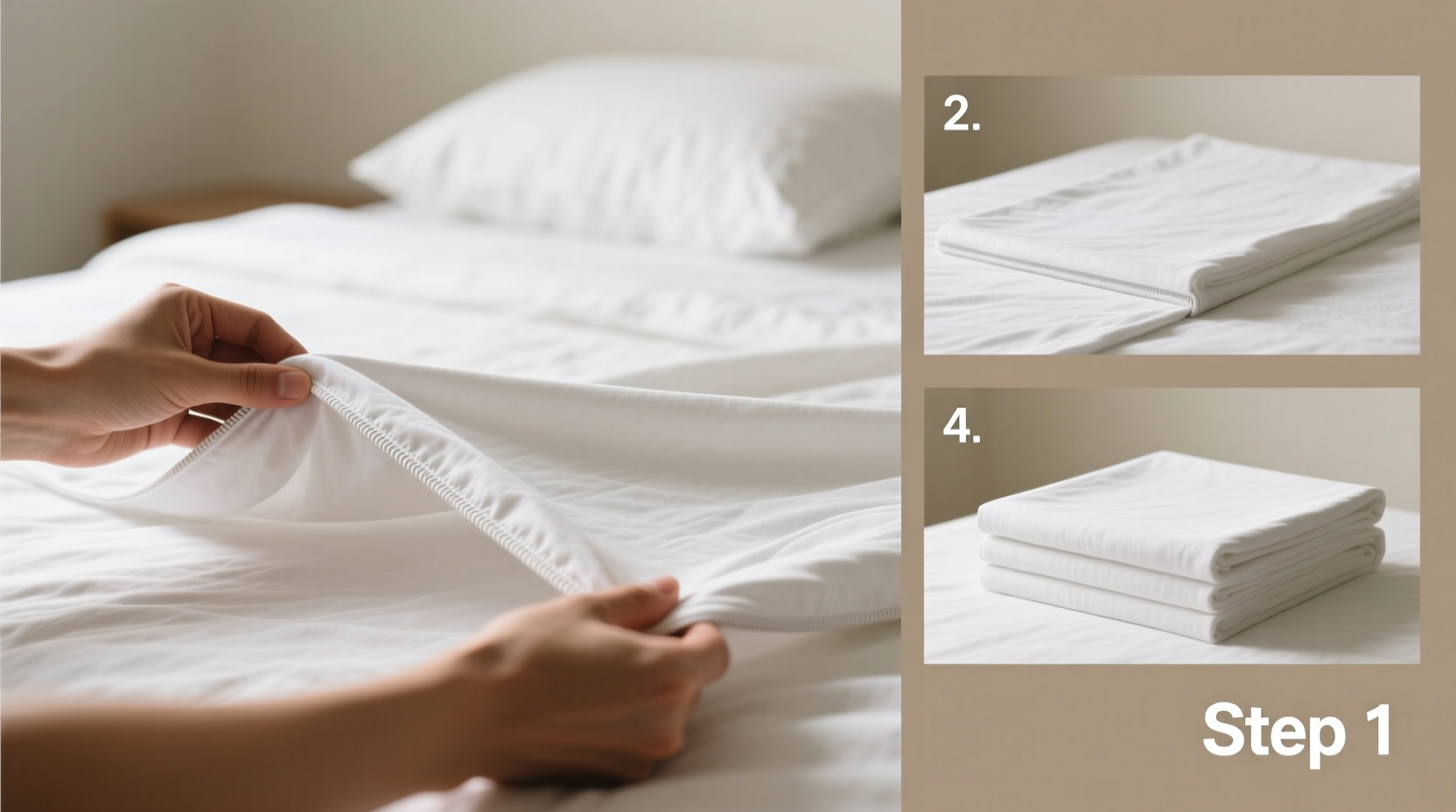
Fitted sheets are designed for function, not folding. Their elasticized corners grip mattress edges tightly, but that same elasticity makes them springy and awkward when removed. Most people attempt to fold them like flat linens, leading to uneven bundles that grow bulkier with each failed attempt. Over time, poorly folded sheets take up more space, wrinkle easily, and contribute to cluttered linen closets.
The key is not to fight the elastic but to work with it. By aligning the corners correctly and containing the stretch, you eliminate chaos and create a structured base for folding. Professional housekeepers use a method that prioritizes corner matching and incremental flattening—transforming a 3D shape into a 2D rectangle.
Step-by-Step Guide to Folding Fitted Sheets Perfectly
The following method is used in high-end hotels and taught in textile management programs. It takes less than two minutes once mastered and produces a compact, rectangular fold ideal for storage.
- Hold the sheet inside out – Pick up the fitted sheet and turn it inside out so the elastic and seams face outward. This hides wear marks and protects the visible surface.
- Locate two adjacent corners – Grasp the top two corners (e.g., head-left and head-right) in each hand. Bring your hands together so these corners meet, tucking one inside the other. You now have a single point where both corners are nested.
- Add the third corner – Keeping the first two corners paired, reach down and grab the next adjacent corner (foot-right). Pull it up and over, placing it directly on top of the existing pair. Align the edges as closely as possible.
- Complete the fourth corner – Finally, pick up the last corner (foot-left) and place it over the stack. All four corners should now be aligned, forming a loose bundle with all elastic edges contained at one end.
- Flip right-side out – Carefully turn the entire bundle so the original outer side of the sheet faces outward again. The elastic edges will now be neatly tucked underneath.
- Lay flat and smooth – Place the sheet on a table or bed. Press down gently to flatten any wrinkles. You now have a roughly square piece of fabric with defined edges.
- Begin accordion folding – Starting from one side, fold a 6–8 inch section toward the center. Repeat from the opposite side, overlapping slightly. This creates a narrow central panel.
- Final roll or fold – For compactness, roll the sheet tightly from top to bottom. Alternatively, fold in thirds like a business letter for a boxier shape.
This technique works regardless of sheet size—twin, queen, or king. Larger sheets may require an extra smoothing step, but the core principle remains unchanged: match corners, contain elasticity, then flatten.
Common Mistakes That Ruin the Fold
Even with instructions, small errors can derail the process. Below are frequent missteps and how to correct them.
| Mistake | Why It’s a Problem | Solution |
|---|---|---|
| Folding while still damp | Moisture causes fibers to cling and crease permanently | Dry completely before folding; use low heat if needed |
| Not aligning corners precisely | Creates lumps and uneven layers | Double-check each corner before proceeding |
| Skipping the inside-out step | Exposes elastic and seams, increasing snag risk | Always start inside out, flip later |
| Rushing the smoothing phase | Traps air and wrinkles under layers | Use palms to press firmly across the surface |
| Using too wide folds at the end | Results in bulky, unstable rectangles | Keep final folds between 6–8 inches for control |
Expert Insight: What Hotel Linen Staff Know
In commercial settings, efficiency and presentation are non-negotiable. High-turnover hotels must process hundreds of sheets daily, making standardized folding essential. We spoke with Lydia Chen, a senior linen manager at a five-star resort chain, about her team’s approach.
“Guests don’t see folded sheets, but they notice disorganization. If our closets look messy, it affects perceived cleanliness. We train new staff using the ‘corner-to-corner’ method because it’s replicable under pressure. The real secret? Consistency beats perfection. A slightly off-center fold that’s uniform across all sheets looks neater than one perfect outlier.” — Lydia Chen, Linen Operations Manager, Grand Haven Resorts
Chen emphasizes that speed comes from rhythm, not force. Her team uses a timed drill: workers aim to fold a complete set (fitted, flat, pillowcases) in under 90 seconds. This reinforces muscle memory and reduces hesitation.
Checklist: Fold Fitted Sheets Like a Pro
Use this checklist each time until the process becomes automatic:
- ✅ Ensure the sheet is fully dry and wrinkle-free
- ✅ Turn the sheet inside out before handling
- ✅ Match and nest all four corners precisely
- ✅ Flip the bundle right-side out without disturbing alignment
- ✅ Lay flat on a hard surface and smooth thoroughly
- ✅ Fold sides inward to create a central panel
- ✅ Complete with tight rolls or even letter folds
- ✅ Store immediately in a cool, dry linen closet
Real Example: From Chaos to Order
Sarah Thompson, a working mother of three in Portland, Oregon, used to stuff her family’s fitted sheets into a linen cabinet haphazardly. “I’d pull one out and it would unravel halfway down the hall,” she recalls. After watching a quick tutorial based on this method, she practiced during her weekly laundry routine.
Within two weeks, she had trained her teenage daughter to fold sheets the same way. “Now we challenge each other to see who can do it faster,” Sarah says. “It sounds silly, but having everything stacked neatly saves time when making beds. And honestly, it feels good to finally conquer something I’ve avoided for years.”
Her linen closet now features uniform stacks, with matching sets bundled together using fabric ties. The change improved both functionality and peace of mind.
Do’s and Don’ts of Sheet Storage
Folding is only half the battle. How you store sheets determines how well they stay organized and protected.
| Action | Recommended? | Reason |
|---|---|---|
| Store folded sheets vertically (like files) | ✅ Yes | Prevents crushing; easy access to any set |
| Keep in plastic bins long-term | ❌ No | Traps moisture; promotes mildew and yellowing |
| Place a sachet of lavender or cedar | ✅ Yes | Natural moth repellent; adds freshness |
| Fold along the same creases repeatedly | ❌ No | Weakens fibers over time |
| Store in direct sunlight | ❌ No | Causes fading and fiber degradation |
| Include a flat sheet and pillowcase inside the folded fitted sheet | ✅ Yes | Keeps sets together; saves space |
FAQ: Common Questions About Folding Fitted Sheets
Can this method work with deep-pocket sheets?
Absolutely. Deep pockets add extra fabric, but the folding logic remains the same. After aligning the corners, take an extra moment to tuck excess material inward before smoothing. The additional depth may require one more narrow fold at the end, but the result is just as tidy.
What if my sheet has torn elastic in one corner?
If the elastic is damaged but the fabric is intact, proceed with folding as usual. The key is maintaining corner alignment. Consider marking that sheet for personal use only and replacing it soon. Severely compromised elasticity can make folding difficult and reduce fit on the mattress.
Is rolling better than folding?
Rolling saves space and minimizes creases, especially for travel or drawer storage. However, folding allows for tighter stacking in shelves. Choose based on your storage system: roll for drawers or bins, fold for open cabinets. Both methods preserve fabric integrity when done correctly.
Final Thoughts: Mastery One Fold at a Time
Folding fitted sheets isn’t magic—it’s mechanics. Once you understand how elasticity and fabric tension interact, the process becomes intuitive. Like tying shoelaces or whisking eggs, it shifts from frustrating to automatic with practice. The benefits extend beyond aesthetics: neatly folded linens last longer, take up less room, and make bed-making smoother.
Start today. Pull out one fitted sheet and follow the steps slowly. Repeat the next week. Soon, you’ll fold without thinking, joining the ranks of laundry experts who know that even the smallest household skills can bring lasting order.




 浙公网安备
33010002000092号
浙公网安备
33010002000092号 浙B2-20120091-4
Comments
No comments yet. Why don't you start the discussion?