
In situations involving domestic violence, harassment, or threats, obtaining a restraining order—officially known as a protective order in Maryland—can be a crucial step toward ensuring personal safety. The process is designed to be accessible, but navigating the legal system can feel overwhelming without clear guidance. This comprehensive resource outlines exactly how to secure a protective order in Maryland, from initial eligibility to long-term enforcement.
Understanding Protective Orders in Maryland
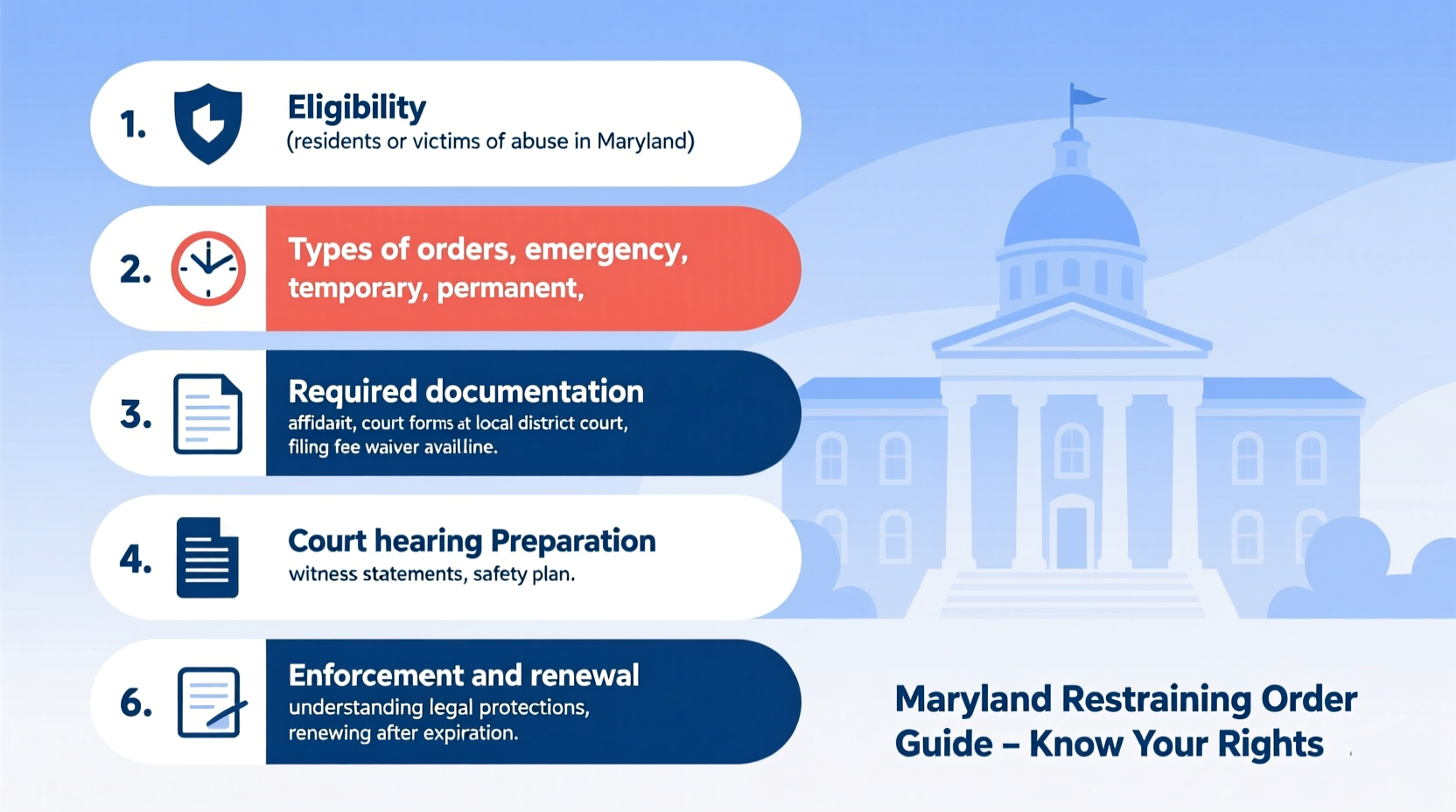
Under Maryland law, a protective order is a civil court order intended to protect individuals from abuse, stalking, harassment, or threats by someone they have a specific relationship with. These orders are issued by district court judges and can require the abuser (the respondent) to stay away from the victim (the petitioner), refrain from contact, surrender firearms, and even vacate a shared residence.
There are three types of protective orders available:
- Interim Protective Order: Issued by a judge outside of regular court hours when immediate protection is needed. Valid for up to 7 days.
- Temporary Protective Order (TPO): Granted during a same-day hearing if there’s evidence of abuse. Lasts up to 7 days until a final hearing.
- Final Protective Order: Issued after a full court hearing. Can last up to one year and may be extended under certain circumstances.
Eligibility depends on both the nature of the threat and the relationship between the parties. You may qualify if the abuser is a current or former spouse, cohabitant, someone with whom you share a child, or a family or household member.
“Protective orders are not just legal documents—they’re lifelines. In Maryland, over 25,000 petitions are filed annually, reflecting both the prevalence of domestic harm and the system’s responsiveness.” — Judge Karen L. Federman Henry, Chief Judge, District Court of Maryland
Step-by-Step Process to Obtain a Restraining Order
Filing for a protective order in Maryland follows a structured legal pathway. Each step is time-sensitive and requires careful attention to detail.
- Determine Eligibility: Confirm that your situation involves abuse or credible threats and that the respondent qualifies under Maryland’s definition of a covered relationship.
- Gather Evidence: Collect photos of injuries, threatening texts or voicemails, medical records, witness statements, and any prior police reports.
- Complete the Petition: Visit your local District Court commissioner’s office (available 24/7) or file online via the Maryland Judiciary’s website. Fill out form CC-DCM-001 (Petition for Protective Order).
- Attend the Ex-Parte Hearing: A commissioner will review your petition. If abuse is evident, a temporary order will be issued immediately.
- Serve the Respondent: The court will arrange for the respondent to be legally served with notice of the TPO and the upcoming final hearing date.
- Attend the Final Hearing: Both parties appear before a judge. Present your evidence and testimony. The judge will decide whether to issue a final protective order.
What Happens During the Final Hearing?
The final hearing typically occurs within seven days of the temporary order being issued. It is a formal court proceeding where both the petitioner and respondent can present their sides.
You should be prepared to:
- Tell your story clearly and chronologically.
- Submit documented evidence (texts, emails, photos).
- Call witnesses who can corroborate your claims.
The judge will evaluate whether abuse occurred and whether a final protective order is necessary. If granted, the order can include provisions such as:
- No contact (in-person, phone, text, social media).
- Stay-away requirements (e.g., 100 feet from home, workplace, school).
- Exclusive use of a shared residence.
- Custody of minor children.
- Firearm surrender and prohibition on future possession.
It’s important to understand that failure to appear at the final hearing may result in dismissal of your case. If the respondent does not show up, the judge may still grant the order based on your evidence.
Checklist: Preparing for Your Protective Order Hearing
Being well-prepared increases the likelihood of a favorable outcome. Use this checklist in the days leading up to your final hearing:
- ✅ Organize all evidence in chronological order.
- ✅ Make at least two copies of each document for the judge and court file.
- ✅ Rehearse your testimony—focus on facts, not emotions.
- ✅ Contact witnesses and confirm their availability.
- ✅ Dress professionally to convey seriousness.
- ✅ Bring photo ID and your case number.
- ✅ Review the exact location and time of your hearing.
Enforcement and Violations
A protective order is only effective if it is enforced. In Maryland, violating any provision of a protective order is a criminal misdemeanor punishable by up to 90 days in jail and/or a $1,000 fine. Repeat violations can lead to felony charges.
If the respondent contacts you or comes near you:
- Do not engage. Move to a safe location.
- Document the incident (time, location, what was said or done).
- Contact local police immediately and provide a copy of your order.
- File a violation report with the court.
Law enforcement officers are trained to enforce protective orders and must act when a violation is reported. Carry a copy of your order at all times or store it securely on your phone through the Maryland eCourts Mobile app.
| Type of Order | Duration | How It's Issued | Can Be Extended? |
|---|---|---|---|
| Interim | Up to 7 days | After hours by judge | No |
| Temporary (TPO) | Up to 7 days | Same-day hearing | No—leads to final hearing |
| Final | Up to 1 year | After full hearing | Yes—up to 3 years or indefinitely |
Real Example: Maria’s Path to Safety
Maria, a 34-year-old mother of two from Prince George’s County, endured emotional and physical abuse from her ex-partner for over a year. After he broke her front door during a late-night confrontation, she went to the local District Court the next morning. With help from a court advocate, she filed a petition detailing past incidents and submitted photos of damage and injury.
She received a temporary protective order the same day. At the final hearing, Maria presented text messages showing threats and called her neighbor as a witness. The judge granted a final protective order for one year, including custody of the children and firearm surrender. Six months later, when her ex approached her at a grocery store, police were called and he was arrested for violation of the order.
Maria’s experience underscores the importance of documentation and prompt action.
Frequently Asked Questions
Can I get a protective order against a roommate or friend?
Yes, if you’ve lived together within the past year or share a child, you may qualify. However, general acquaintances or coworkers without a familial or domestic connection may not meet eligibility criteria.
What if I want to drop the order later?
You can request to modify or dismiss the order by filing a motion with the court. However, the judge has the final say and may deny the request if public safety is a concern.
Do I need a lawyer to get a protective order?
No. Many people successfully file on their own. However, free legal assistance is available through organizations like Maryland Legal Aid and the House of Ruth. Advocates are often present at courthouses to assist petitioners.
Conclusion: Taking Control of Your Safety
Obtaining a restraining order in Maryland is a powerful legal tool for those facing abuse or threats. While the process involves several steps, the courts are structured to respond quickly in emergencies. By understanding your rights, gathering strong evidence, and preparing thoroughly for your hearing, you can take meaningful action to protect yourself and your loved ones.




 浙公网安备
33010002000092号
浙公网安备
33010002000092号 浙B2-20120091-4
Comments
No comments yet. Why don't you start the discussion?