
A cluttered closet doesn’t just make mornings stressful—it can quietly erode your sense of control and confidence. The good news? You don’t need new bins, fancy hangers, or a renovation budget to fix it. With thoughtful planning and disciplined sorting, you can transform even the most chaotic wardrobe space into an efficient, calming system—using only what you already own. This guide walks you through each phase of the process, offering real strategies that work in real homes.
1. Prepare with Purpose: Set Clear Goals
Before pulling anything out of your closet, take five minutes to define why you’re doing this. Is it to save time getting dressed? To rediscover clothes you’ve forgotten? To reduce decision fatigue? Your “why” will keep you focused when the task feels overwhelming.
Next, assess the physical space. Stand in front of your closet and observe:
- What’s spilling over or crumpled?
- Are items stacked on the floor or piled on shelves?
- Do you have unused zones (like high shelves or behind the door)?
This visual audit helps you identify patterns—overbuying, poor folding habits, lack of categories—that contribute to clutter. Awareness is the first step toward change.
2. Empty and Sort: The Foundation of Organization
Yes, empty the entire closet. Every shirt, shoe, scarf, and belt comes out. Place items on your bed or floor in broad categories: tops, bottoms, dresses, outerwear, shoes, accessories, and seasonal storage.
Now, sort each category into four piles:
- Keep: Items you wear regularly, fit well, and are in good condition.
- Donate/Sell: Clothes in decent shape but no longer serving you.
- Repair/Alter: Fixable items like missing buttons or broken zippers.
- Discard: Stained, torn, or worn-out pieces beyond repair.
Be ruthless. If you haven’t worn something in over a year—and it’s not a special occasion piece—it likely doesn’t belong back in your daily closet.
As you sort, ask yourself:
- Does this reflect who I am now?
- Do I feel confident when I wear it?
- Would I buy this again today?
If the answer is no, let it go. Clutter isn’t just physical; it includes emotional baggage disguised as clothing.
“Decluttering isn’t about perfection. It’s about creating space for what truly matters.” — Marie Kondo, Organizing Consultant
3. Reorganize Using What You Already Own
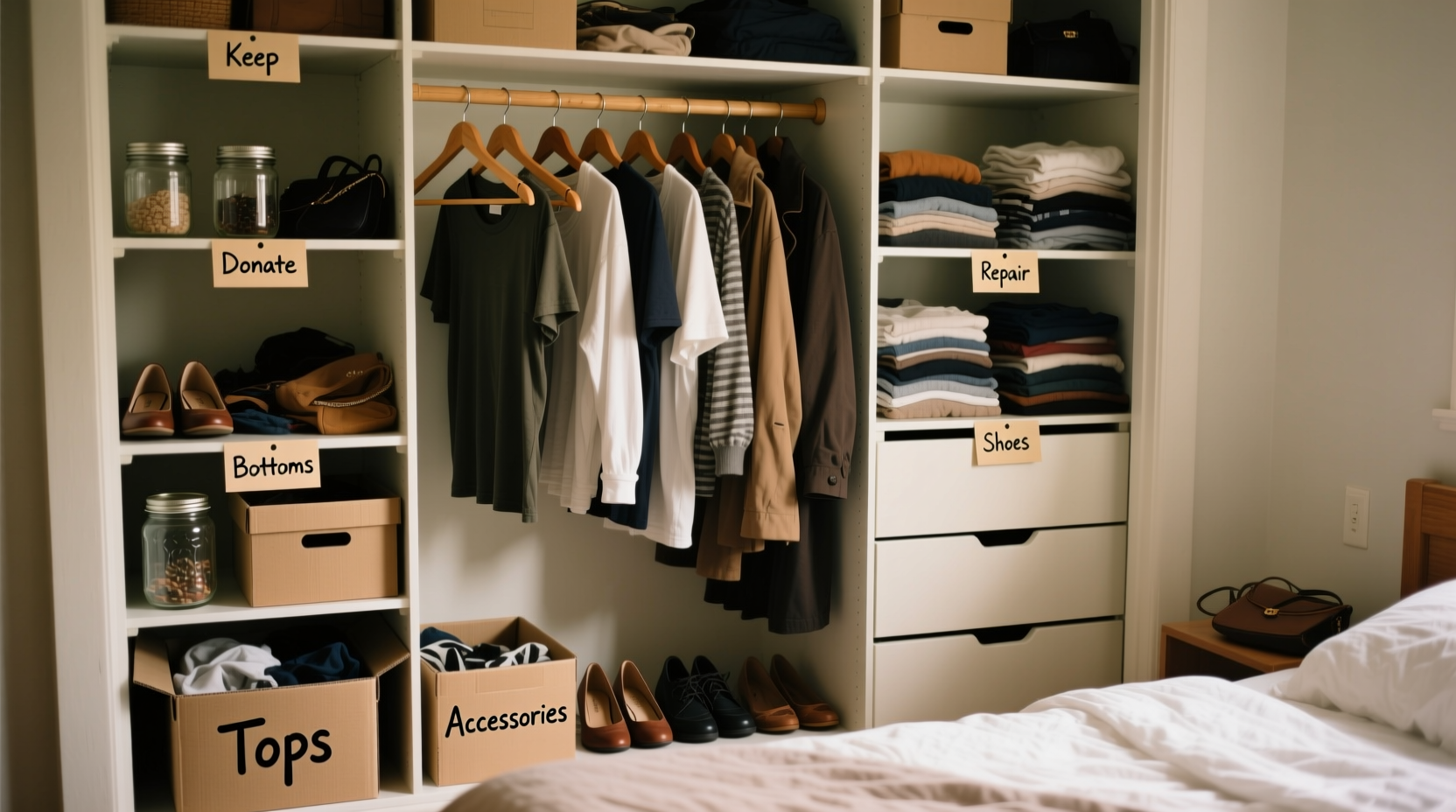
You don’t need labeled bins or matching hangers. Use containers already in your home: shoeboxes, gift boxes, tote bags, or drawers from other furniture. Repurpose them creatively.
Start by returning the “Keep” pile to the closet with intention. Follow these principles:
- Group by category, then frequency: Everyday tops together, formal wear separate, workout clothes accessible.
- Use vertical space: Hang frequently used items at eye level. Store off-season clothes higher up or lower down.
- Fold intelligently: Use the KonMari fold for t-shirts, jeans, and sweaters so they stand upright in drawers or boxes.
- Double your hanging capacity: Hang tank tops, scarves, or belts from existing hangers using the S-hook method (drape one hanger’s hook over another).
For small accessories like socks or underwear, use clean yogurt cups or cut plastic bottles in half to create dividers inside drawers.
| Item Type | Best Storage Method (No-Cost) | Avoid |
|---|---|---|
| T-shirts & Sweaters | Folded upright in drawer or box | Piling loosely—causes mess |
| Dresses & Blazers | On sturdy hangers, grouped by formality | Crowding—causes wrinkles |
| Belts & Scarves | Looped over hanger hooks or rolled in a jar | Loose tangles in a bin |
| Shoes | Heel-to-toe in lines or stacked if flat | Scattered under clothes |
| Off-Season Clothes | In sealed boxes under bed or top shelf | Taking prime closet space |
4. Maximize Space with Smart Layouts
Your closet layout should match how you actually live. Most people waste valuable real estate on unused shelves or single rods. Here’s how to optimize without tools or purchases:
Reassign Zones Based on Usage
Divide your closet into functional zones:
- Entry-Level Zone (Eye to Hip Height): Daily wear, favorite outfits, work staples.
- Upper Shelves: Off-season storage, rarely used accessories, or luggage.
- Lower Level (Floor or Bottom Shelf): Shoes, handbags, or folded jeans.
- Door or Back Wall: Hooks for robes, towels, or next-day outfits.
If you have double rods, use the upper one for shirts and the lower for pants or skirts. If not, hang longer items on one side and use the remaining space for folded stacks on a shelf or crate.
Create a Capsule Core
Select 10–15 versatile pieces that mix and match easily—neutral tops, classic jeans, a blazer, little black dress. Keep these front and center. A capsule reduces decision fatigue and highlights what you actually wear.
Rotate Seasonally
Store winter coats and sweaters in a blanket press or under-bed container when not in use. Free up space for current-season clothes. Rotate twice a year—no cost, maximum impact.
5. Maintain the System Long-Term
Organization isn’t a one-time event. It’s a habit. The key to lasting results is consistency, not perfection.
The One-In, One-Out Rule
Every time you bring a new clothing item into your home, remove one. This keeps volume stable and forces mindful consumption. Even if you don’t shop often, apply this rule to gifts or hand-me-downs.
Weekly 10-Minute Reset
Set a recurring reminder for 10 minutes every Sunday. During this time:
- Refold any messy stacks.
- Return misplaced items.
- Check for clothes needing repair or laundry.
- Remove anything you didn’t wear that week.
This micro-habit prevents clutter from creeping back in.
Monthly Review
Once a month, scan your closet and ask: “What didn’t I wear this month?” If the answer includes multiple items, consider donating them. Non-worn clothes are taking up mental and physical space.
Mini Case Study: Sarah’s Overhaul in 3 Hours
Sarah, a teacher from Portland, had a closet overflowing with clothes she hadn’t worn in years. She avoided opening it because it felt like failure. On a Saturday morning, she followed this guide:
- She emptied everything and sorted into four piles.
- Donated 3 large trash bags of clothes she kept “just in case.”
- Used old shoeboxes to store socks and scarves.
- Reorganized by category and frequency.
After three focused hours, her closet was not only tidy but functional. For the first time in years, she could see all her options. Within a week, she noticed she was dressing faster and wasting less time deciding what to wear. Six months later, she still uses the weekly reset and has not re-cluttered.
“The moment I saw my clothes neatly visible and accessible, I felt lighter. It wasn’t just the closet that changed—it changed how I started my day.” — Sarah T., Oregon
FAQ
What if I don’t have drawers or shelves?
No problem. Use sturdy cardboard boxes, crates, or baskets you already own. Label them clearly and stack them neatly on the floor or a low surface. Elevating clothes off the ground creates instant organization.
How do I deal with sentimental items?
It’s okay to keep a few meaningful pieces—but limit them. Store them separately, perhaps in a memory box under the bed. Wearing something out of guilt doesn’t honor it; preserving it with care does.
Can I organize a shared closet this way?
Absolutely. Apply the same steps, but designate clear zones for each person. Use color-coded hangers or labels (even sticky notes) to avoid mix-ups. Agree on shared rules, like the one-in, one-out principle.
Final Checklist: Your No-Cost Closet Transformation
Follow this checklist from start to finish:
- Define your goal: Why are you organizing?
- Empty the entire closet.
- Sort into Keep, Donate, Repair, Discard.
- Repair essential items within a week.
- Donate items immediately—don’t let them linger.
- Group “Keep” items by category and frequency.
- Use existing containers for storage (boxes, jars, trays).
- Assign zones: daily wear, seasonal, accessories.
- Fold using upright methods; hang wisely.
- Label bins with tape and pen.
- Take a before-and-after photo.
- Set a weekly 10-minute reset.
- Review monthly and edit ruthlessly.
Conclusion: A Clear Closet, A Clearer Mind
Organizing a cluttered closet without spending money proves that simplicity and discipline are more powerful than purchases. You already have everything you need—space, time, and intention. By following these steps, you’re not just tidying a closet; you’re reclaiming time, reducing stress, and building a daily environment that supports your best self.
The transformation begins the moment you pull out the first item. Don’t wait for the perfect day. Start small, stay consistent, and watch order emerge from chaos. Your future self will open that closet door and smile—not because it looks perfect, but because it works.




 浙公网安备
33010002000092号
浙公网安备
33010002000092号 浙B2-20120091-4
Comments
No comments yet. Why don't you start the discussion?