
Streaming services have become essential in modern households. From Netflix and Hulu to Disney+, HBO Max, and Apple TV+, most people subscribe to multiple platforms. Each account requires login credentials, and managing them manually is not only inconvenient but also risky. Weak or reused passwords, unsecured notes, and password fatigue make users vulnerable to breaches. The solution? A systematic, secure approach to organizing your streaming passwords.
This guide walks you through a practical, foolproof method to store, manage, and protect your streaming service logins. Whether you're sharing accounts with family, juggling subscriptions across devices, or simply tired of resetting forgotten passwords, this process will save time and reduce digital risk.
Why Secure Password Management Matters for Streaming Services
Streaming accounts may seem low-stakes compared to banking or email, but they are valuable targets. Hackers exploit weak credentials to resell access, distribute pirated content, or use compromised accounts as entry points into broader personal data networks. In 2023, over 2.6 million streaming account credentials were found exposed on the dark web, according to cybersecurity firm Surfshark.
Moreover, many people reuse passwords across platforms. If your Hulu password matches your PayPal or social media, one breach can compromise everything. Securing your streaming logins isn’t just about convenience—it’s a critical layer in your overall digital hygiene.
“Even entertainment accounts can serve as footholds for identity theft. Never underestimate the value of layered password security.” — Dr. Lena Patel, Cybersecurity Analyst at DigitalShield Labs
Step-by-Step: How to Organize Your Streaming Service Passwords Securely
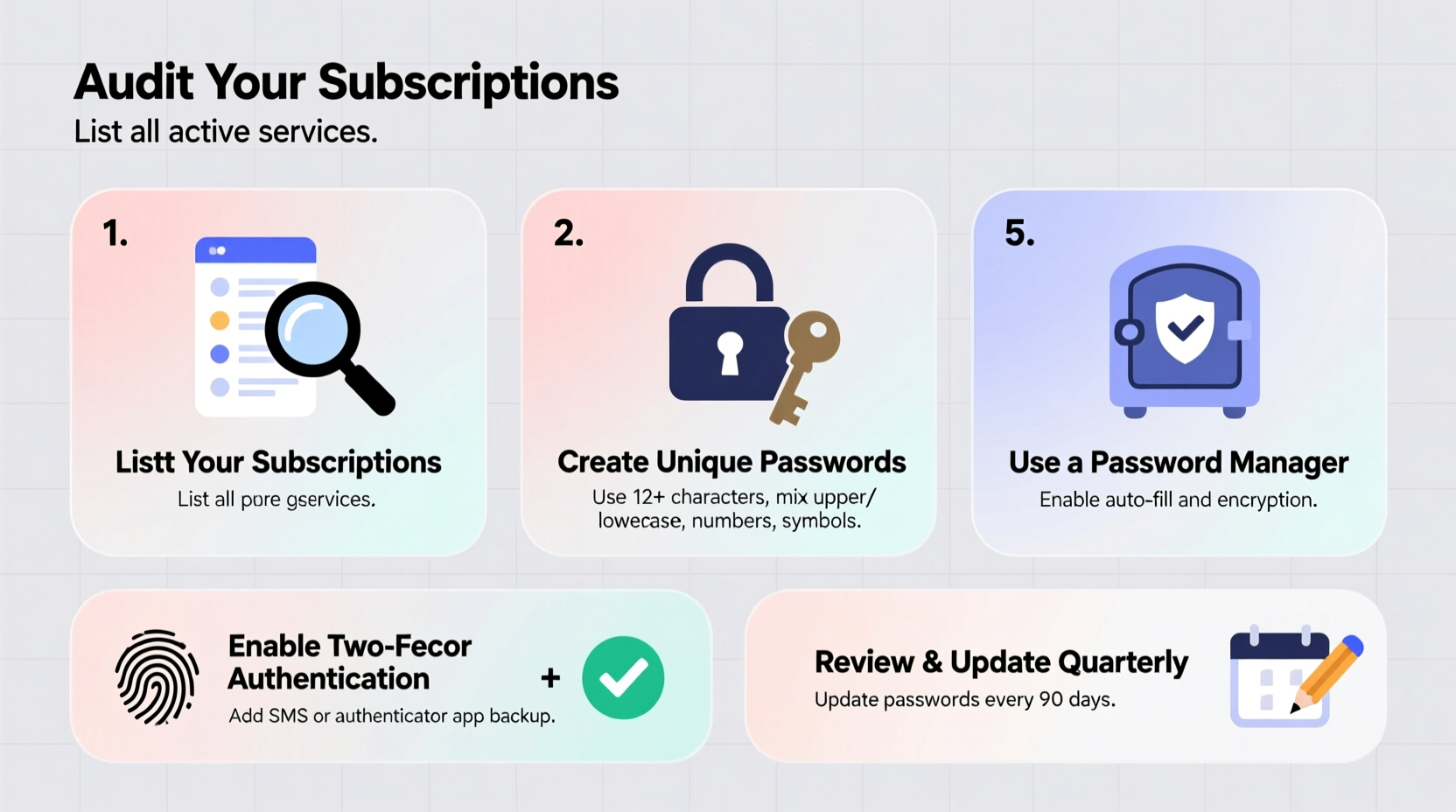
Follow this five-phase process to bring order and protection to your streaming credentials. Each step builds on the last, ensuring long-term usability and safety.
Phase 1: Inventory All Your Streaming Accounts
Begin by listing every streaming service you use. Include both active and inactive subscriptions. This audit reveals how many accounts you actually manage—and which ones you might have forgotten.
- Gather all devices (smart TVs, tablets, phones, laptops) where you’ve logged in.
- Check email confirmations for subscription receipts.
- Review bank or credit card statements for recurring charges.
- Create a temporary list with:
- Service name (e.g., Amazon Prime Video)
- Email used for registration
- Current password (if known)
- Subscription status (active, paused, expired)
- Shared with household members? (Yes/No)
Phase 2: Audit and Strengthen Existing Passwords
Once listed, evaluate the strength of each password. Look for red flags:
- Uses common words like “password123” or “stream2024”
- Reused across multiple services
- Shorter than 10 characters
- Contains personal info (birth year, pet names)
Replace weak passwords immediately. Create strong ones using this formula:
| Element | Example |
|---|---|
| At least 12 characters | Yes → \"Moon$ky!Blu3Str3am\" |
| Mix uppercase, lowercase, numbers, symbols | Avoid → \"netflix123\" | Use → \"H@lo+Galaxy9!\" |
| No dictionary words alone | Avoid → \"dragonballz\" | Use → \"Dr@g0nB@llZ!!\" |
| Avoid personal identifiers | Don't use your city, birthdate, or child’s name |
Change passwords directly from each platform’s account settings. Log out afterward to ensure the new credentials work when you re-enter them.
Phase 3: Choose a Secure Storage Method
Never save passwords in unencrypted files, sticky notes, or text messages. Instead, use one of these trusted methods:
Option A: Password Manager (Recommended)
A dedicated password manager like Bitwarden, 1Password, or Dashlane encrypts and stores all your credentials behind one master password. These tools auto-fill logins, generate strong passwords, and sync across devices.
- Install the app on your phone and computer.
- Set up biometric authentication (fingerprint or face ID).
- Add each streaming service as a “login” entry with URL, username, and updated password.
- Use the built-in password generator to create unique strings for future use.
Option B: Encrypted Offline Document
If you prefer not to use cloud-based tools, store credentials in an encrypted file using VeraCrypt or a password-protected PDF. Keep it on a USB drive stored in a secure location—like a home safe.
Phase 4: Enable Two-Factor Authentication (2FA)
Even the strongest password can be compromised. Add an extra layer by enabling two-factor authentication wherever available.
Many streaming platforms now support 2FA via authenticator apps (Google Authenticator, Authy) or SMS codes. Here’s how to set it up:
- Go to the account’s security settings.
- Find “Two-Factor Authentication” or “2-Step Verification.”
- Choose app-based verification over SMS when possible (more secure).
- Scan the QR code with your authenticator app.
- Store backup recovery codes in your password manager or printed form in a safe place.
Note: Not all services offer 2FA. As of 2024, Netflix, Hulu, and YouTube Premium do; others like Discovery+ are still rolling it out. Prioritize securing those that do.
Phase 5: Establish a Maintenance Routine
Password security isn’t a one-time task. Set habits to keep your system effective over time.
- Quarterly Review: Every three months, revisit your inventory. Cancel unused subscriptions and update any changed passwords.
- Annual Reset: Once a year, rotate passwords for high-value accounts—even if there’s no breach.
- New Subscriptions: Immediately add new services to your password manager upon signup.
- Family Access: If sharing logins, avoid sending passwords via text or email. Use your password manager’s secure sharing feature instead.
“Automation is key. Let your tools handle complexity so you don’t cut corners under pressure.” — Marcus Tran, Identity Security Consultant
Real-Life Example: How One Family Regained Control
The Rivera family had seven streaming subscriptions shared among four members. They kept passwords in a shared Google Doc—unencrypted and accessible to anyone with the link. After a phishing attempt targeted their daughter’s email, the entire account cluster was at risk.
They followed this guide: inventoried all services, replaced 11 reused passwords, adopted Bitwarden, and enabled 2FA on five platforms. Now, each member has their own vault-accessible login, and the parents approve new subscriptions. They reduced monthly costs by identifying two forgotten active plans and cut login frustration by 80%.
“We didn’t think streaming passwords mattered,” said Ana Rivera. “But cleaning this up stopped constant ‘I forgot my password’ calls during movie night.”
Do’s and Don’ts of Streaming Password Management
| Do | Don’t |
|---|---|
| Use a password manager with encryption | Save passwords in plain text files or notes apps |
| Enable 2FA on supported platforms | Rely solely on email reset links for access |
| Create unique passwords for each service | Use variations of the same base password |
| Review and clean up subscriptions quarterly | Keep paying for inactive services “just in case” |
| Share access via secure vault-sharing features | Text or email passwords to family members |
Essential Checklist: Secure Your Streaming Logins in One Hour
Complete this checklist to finish organizing your passwords efficiently:
- ☐ List all streaming services and associated emails
- ☐ Identify weak or reused passwords
- ☐ Update all passwords to strong, unique combinations
- ☐ Install and configure a password manager
- ☐ Store each login in the manager with correct URLs
- ☐ Enable two-factor authentication where available
- ☐ Save recovery codes in a secure location
- ☐ Remove old access from unused devices
- ☐ Educate household members on secure access methods
- ☐ Schedule next review date (e.g., 90 days from now)
Frequently Asked Questions
Can I trust password managers with my streaming logins?
Yes. Reputable password managers like Bitwarden, 1Password, and Keeper use end-to-end encryption. Your data is encrypted locally before syncing, meaning even the provider cannot see your passwords. These tools are audited regularly and often more secure than manual storage.
What if I forget my master password?
You will lose access to all stored passwords. That’s why choosing a memorable—but strong—master password is crucial. Some managers offer emergency access or recovery keys. Store these offline, such as printed and locked away, but never digitally unencrypted.
Is it safe to share streaming passwords with family?
Sharing isn’t inherently unsafe, but how you share matters. Avoid messaging apps or email. Instead, use your password manager’s secure sharing function, which logs access and allows revocation. Also, consider whether your subscription plan permits sharing—some services limit concurrent streams.
Take Control of Your Digital Life—One Password at a Time
Organizing your streaming service passwords isn’t just about avoiding frustration during Friday night movie time. It’s about taking ownership of your digital footprint. With a clear system, the right tools, and consistent habits, you reduce risk, save money, and simplify your online experience.
You don’t need advanced tech skills—just intention and action. Start today with one account. Then another. Within an hour, you’ll have a safer, smoother way to enjoy the content you love. And when the next service asks for a password, you’ll know exactly where to look—without hesitation or fear.




 浙公网安备
33010002000092号
浙公网安备
33010002000092号 浙B2-20120091-4
Comments
No comments yet. Why don't you start the discussion?