
Deleting your Facebook account is a significant decision, especially if you’ve used the platform for years to connect with friends, share memories, or promote a business. Unlike deactivating your profile, which temporarily hides your presence, permanent deletion removes all your data—photos, posts, messages, and personal information—from Facebook’s servers over time. This process cannot be undone. If you're certain about leaving the platform for good, this guide walks you through every step required to permanently erase your account using a computer.
Understanding Deactivation vs. Permanent Deletion
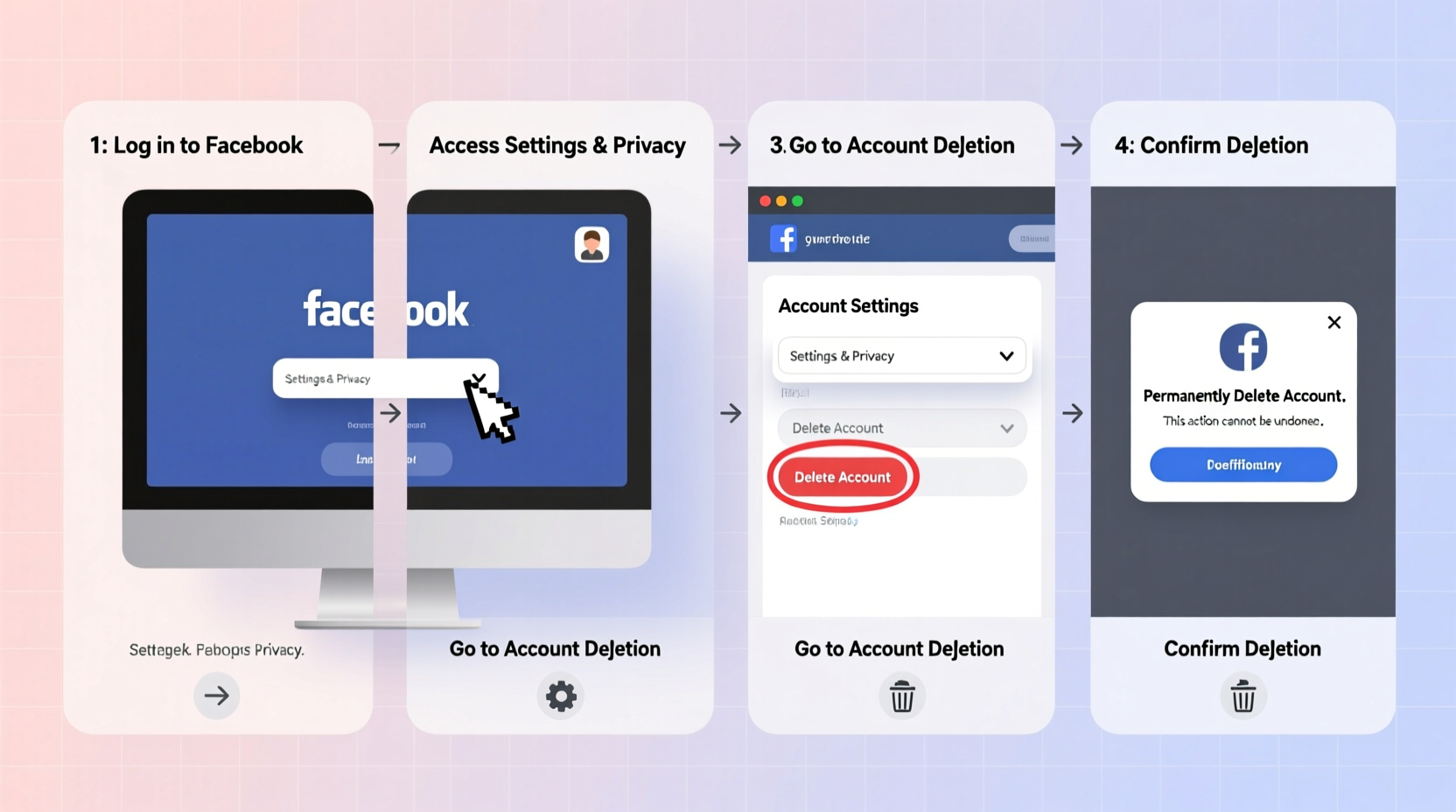
Before initiating deletion, it's crucial to understand the difference between deactivating and deleting your account.
- Deactivation is reversible. Your profile disappears from search results and others can't interact with you, but your data remains stored on Facebook’s servers. You can reactivate anytime by logging in.
- Permanent deletion starts a process that removes your account and associated data from Facebook’s systems. After 30 days, recovery is no longer possible.
“Once you initiate permanent deletion, Facebook begins purging your data from backup systems within 90 days. There is no undo button.” — Meta Privacy Policy Documentation
Step-by-Step Guide to Permanently Delete Your Facebook Account
The deletion process must be completed entirely through Facebook’s website on a computer. Mobile apps do not support permanent account removal. Follow these steps carefully:
- Log in to your Facebook account using a web browser on your computer. Go to facebook.com and enter your credentials.
- Navigate to Settings & Privacy. Click the downward arrow in the top-right corner of the screen, then select “Settings & Privacy,” followed by “Settings.”
- Access Your Account Center. In the left-hand menu, click “Your account” under “Accounts Center.”
- Select “Account ownership and control”. Scroll down to find this option and click it.
- Choose “Deactivation and deletion”. Under “What do you want to do?” select “Delete account permanently.”
- Click “Continue to account deletion”. You’ll be prompted to re-enter your password to confirm identity.
- Select a reason for leaving (optional). Facebook asks why you’re deleting your account. This helps improve their service but is not required.
- Confirm deletion. Check the box confirming you understand the consequences, then click “Delete account.”
After confirmation, Facebook displays a message stating your deletion request has been received and will take effect in 30 days unless canceled.
What Happens During the 30-Day Waiting Period?
Facebook enforces a mandatory 30-day grace period after you initiate deletion. During this time:
- Your account is locked. No one can log in or view your profile.
- You cannot recover your data through standard means.
- If you log in during this window, the deletion process is automatically canceled.
- After 30 days, your account enters irreversible deletion phases across active databases and backups.
Data removal isn’t instantaneous. While your profile vanishes from public view immediately, backend systems may retain fragments temporarily for technical reasons. According to Meta, most user content is fully purged within 90 days.
Essential Checklist Before Deleting
Deleting your account erases everything. To avoid losing valuable memories or contacts, complete this checklist beforehand:
- Download your Facebook data archive via Settings → Your Facebook Information → Download Your Information
- Save important photos, videos, and event dates locally or to cloud storage
- Export contact details of close friends or family members connected only through Facebook
- Inform key people you’re leaving so they can stay in touch via other channels
- Unlink third-party apps or services connected to your Facebook login (e.g., Spotify, Instagram if standalone)
- Cancel any active subscriptions or marketplace listings tied to your account
Common Pitfalls and What Not to Do
Mistakes during the deletion process can lead to unintended outcomes. Avoid these common errors:
| Do’s | Don’ts |
|---|---|
| Use a trusted computer and private network when deleting | Don’t use public Wi-Fi or shared devices |
| Download your data before starting deletion | Don’t assume Facebook will keep your photos forever |
| Double-check that auto-login is disabled on browsers | Don’t leave logged-in sessions open after deletion |
| Wait out the full 30 days without logging back in | Don’t test whether your profile is gone by asking others—just wait |
Real Example: Sarah’s Digital Detox Journey
Sarah, a 34-year-old graphic designer from Portland, decided to delete her Facebook account after realizing she spent an average of 90 minutes per day scrolling through newsfeeds filled with curated content that made her feel inadequate. She began by downloading her entire photo library and messaging history, particularly conversations with her late grandmother preserved in old chat threads. Over two weeks, she informed clients and collaborators of her new email address and transitioned her freelance portfolio to a personal website. On day 28, she initiated deletion. Though tempted to log back in during the waiting period, she resisted. Three months later, she reported improved focus, better sleep, and stronger real-world relationships.
Her experience underscores that deletion isn’t just technical—it’s emotional and psychological. Planning ahead makes the transition smoother.
Frequently Asked Questions
Can I recover my account after deletion?
No. Once the 30-day cancellation window passes, your account and all associated data are permanently removed. Logging in during those 30 days cancels the deletion, but afterward, recovery is impossible.
Will my messages disappear from other people’s inboxes?
No. Messages you sent remain visible in recipients’ inboxes, though your name appears as “Facebook User.” Content attached to those messages, like photos, may eventually be removed.
Does deleting Facebook also delete my Instagram account?
Not necessarily. If your Instagram account uses Facebook login but has its own password and was set up independently, it remains active. However, if both accounts were merged under one login system, check Instagram settings separately to ensure independence.
Final Steps and Moving Forward
After successfully deleting your Facebook account, consider taking additional digital hygiene steps. Update passwords for other online accounts that used Facebook as a sign-in method. Review privacy settings on remaining social platforms. Reflect on how disconnecting impacts your mental well-being and daily habits.
Many users report feeling lighter and more present once they sever ties with algorithm-driven feeds. The space created often allows room for deeper connections, creative pursuits, or simply quiet reflection.




 浙公网安备
33010002000092号
浙公网安备
33010002000092号 浙B2-20120091-4
Comments
No comments yet. Why don't you start the discussion?