
A chronograph watch is more than a timepiece—it’s a precision instrument. Whether you use it for timing laps, monitoring intervals, or simply appreciating mechanical craftsmanship, maintaining its accuracy is essential. Over time, even the finest chronographs can drift out of sync due to shocks, magnetism, or routine wear. Resetting and calibrating your watch ensures that the main hands and subdials align perfectly and operate in harmony. This guide walks you through the exact process professionals use, so you can restore your chronograph to factory-level performance at home.
Understanding Chronograph Mechanics
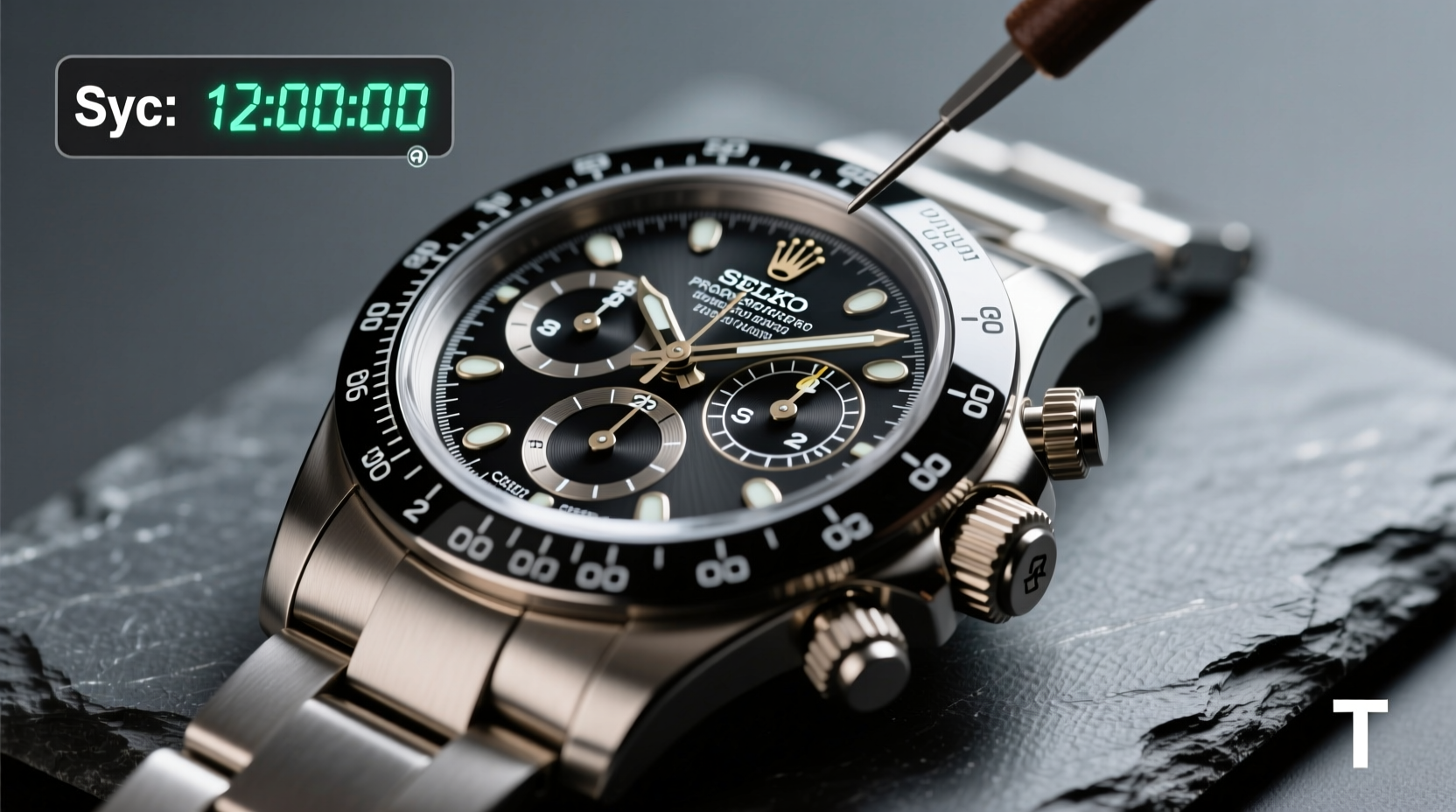
Before diving into calibration, it's important to understand how a chronograph works. Unlike standard watches, chronographs feature additional mechanisms to start, stop, and reset a stopwatch function independently of the main time display. These are controlled by pushers on the side of the case and connected to a complex system of gears, levers, and springs.
The central chronograph seconds hand tracks elapsed time, while subdials typically measure minutes and hours (or fractions of a second). For accurate readings, all these components must start from zero and move in unison when activated. Misalignment—where the chronograph hand doesn’t return fully to zero or subdials lag—is common after impacts or battery changes in quartz models.
“Precision in a chronograph isn’t just about timekeeping—it’s about synchronization. A misaligned sweep hand undermines both function and credibility.” — Daniel Reeves, Master Watchmaker, Geneva Institute of Horology
Step-by-Step Guide to Resetting Your Chronograph
Resetting returns all chronograph hands to their zero positions. This should be done before calibration, especially if the watch has been idle or recently serviced.
- Pull the crown to time-setting position: Gently unscrew the crown (if applicable) and pull it out to the first or second detent, depending on your model. On most chronographs, this stops the main time but does not affect the chronograph mechanism.
- Stop the chronograph: Press the top pusher to ensure the stopwatch function is halted. If it’s running, it cannot be reset properly.
- Reset to zero: Press and hold the bottom pusher for 2–3 seconds. You should hear a soft click, and all chronograph hands (central seconds and subdial hands) will snap back to zero. Do not force the button; repeated pressing may damage the mechanism.
- Verify alignment: Inspect each hand under good lighting. The central seconds hand should point exactly to 12 o’clock. Subdials should rest precisely at their zero markers (usually 60, 30, or 12).
- Resume normal operation: Push the crown back in and screw it down (if water-resistant). Test the chronograph by starting, stopping, and resetting again to confirm smooth operation.
Calibrating for Accuracy: Mechanical vs. Quartz
Calibration adjusts the rate at which the watch keeps time. While resetting handles hand positioning, calibration fine-tunes the underlying timekeeping mechanism. The method varies significantly between mechanical and quartz chronographs.
Mechanical Chronographs
These rely on a balance wheel and hairspring. Calibration involves adjusting the regulator lever to speed up or slow down oscillations. Most modern mechanical chronographs have -/+ markings near the balance wheel accessed via the case back. However, this requires demagnetizing tools and a timegrapher for precision.
- Place the watch on a timegrapher to measure beat error and amplitude.
- If gaining time, move the regulator toward the minus (-) side.
- If losing time, shift toward plus (+).
- Adjust in small increments—one degree at a time—and retest.
Quartz Chronographs
Quartz movements use a stepper motor regulated by a microchip. They’re inherently more accurate but can still drift due to low battery or circuit issues. Some high-end quartz models (e.g., Seiko Kinetic or Longines VHP) allow trimmer capacitor adjustments using a tiny screwdriver on the circuit board. For standard models, replace the battery and reset to clear any timing lag.
| Aspect | Mechanical | Quartz |
|---|---|---|
| Time Adjustment Method | Regulator lever on balance wheel | Battery replacement or trimmer cap |
| Accuracy Range | +/- 5 to +10 seconds per day | +/- 15 seconds per month |
| Tools Required | Timegrapher, demagnetizer, tweezers | Screwdriver, battery tool |
| User-Calibratable? | Limited without training | Yes, for basic resets |
Mini Case Study: Restoring a Vintage Omega Speedmaster
James, an amateur horologist, inherited a 1978 Omega Speedmaster Moonwatch. After winding it manually, he noticed the chronograph seconds hand rested at 10 seconds past zero. He followed the reset procedure: stopped the function, held the lower pusher—but the hand only returned to 5 seconds. Suspecting a stuck lever, he gently tapped the case side to dislodge debris. On the second attempt, the hand snapped cleanly to zero. He then used a smartphone timegrapher app to compare ticking precision against atomic time. It was gaining 8 seconds daily. With careful regulator adjustment over three days, he brought it within 2 seconds per day—restoring vintage reliability with modern precision.
Essential Checklist Before You Begin
Ensure your workspace and tools are ready. Rushing leads to mistakes.
- Work in a clean, dust-free area
- Use non-magnetic tools (tweezers, screwdrivers)
- Have a magnifying loupe or jeweler’s glass
- Keep a soft cloth or watch holder
- Ensure adequate lighting
- For quartz: Have correct battery size on hand
- For mechanical: Know your movement type (e.g., Valjoux 7750, ETA 2892)
Frequently Asked Questions
Why won’t my chronograph hand return to zero completely?
This is often due to a misaligned heart-cam or worn reset hammer. Repeated resetting may help minor cases. If persistent, the movement may need servicing to realign internal components. Avoid forcing the reset—this can bend pivots.
Can I calibrate my chronograph without special tools?
You can reset it without tools, but true calibration—especially for mechanical models—requires a timegrapher for accuracy. Smartphone apps like Lepsi offer basic rate analysis and are helpful for amateurs. However, they don’t replace professional equipment for fine adjustments.
How often should I reset and calibrate my chronograph?
Reset as needed—after long storage or heavy use. Calibration frequency depends on the movement: mechanical watches benefit from checks every 6–12 months; quartz models every 2–3 years or after battery changes.
Pro Tips for Long-Term Performance
Maintaining your chronograph goes beyond one-time calibration. Regular habits extend lifespan and preserve accuracy.
- Avoid magnetic fields: Keep away from speakers, phones, and laptops. Magnetization disrupts timing and causes erratic behavior.
- Service every 5–7 years: Even with perfect care, lubricants dry out and parts wear. Professional cleaning prevents internal damage.
- Use pushers carefully: Don’t press them underwater unless the watch is rated for it. Water pressure can force liquid into the stem seals.
- Wind regularly: For automatic chronographs, wear or use a winder weekly to keep oils circulating.
“A well-maintained chronograph isn’t just accurate—it tells a story of discipline and respect for engineering.” — Clara Nguyen, Curator, Horological Society of New York
Final Thoughts: Take Control of Your Time
Your chronograph is a blend of art and science. Resetting and calibrating it isn’t just maintenance—it’s engagement with the mechanics that make analog timekeeping timeless. With patience and attention to detail, you can achieve results that rival professional service. Start with simple resets, learn your watch’s behavior, and gradually build confidence in deeper adjustments. Whether you own a classic Rolex Daytona or a modern Tissot PRX, precision is within reach.




 浙公网安备
33010002000092号
浙公网安备
33010002000092号 浙B2-20120091-4
Comments
No comments yet. Why don't you start the discussion?