
Instagram remains one of the most powerful platforms for personal branding, business growth, and community engagement. However, no matter how compelling your content is, it won’t reach its full potential if your account is set to private. A public Instagram profile opens the door to discovery, broader engagement, and long-term audience growth. Unlike private accounts, which restrict content to approved followers only, public profiles allow anyone on Instagram—and even search engines—to view your posts, stories, and highlights. This simple switch can dramatically increase your visibility and accelerate your digital presence.
This guide walks you through the exact steps to transition from a private to a public account, explains why this change matters, and provides best practices to maximize your exposure once your profile is open to the world.
Why Go Public? The Visibility Advantage
Instagram’s algorithm favors discoverability when accounts are public. Your content becomes eligible for features like the Explore page, hashtag feeds, and search results—critical pathways through which new users find creators. When your account is private, only your current followers can see your posts in their feeds, and even then, Instagram limits distribution to maintain privacy integrity.
Public accounts benefit from:
- Search engine indexing: Google and other search engines can index your bio, username, and public content, making you discoverable beyond the app.
- Hashtag reach: Anyone searching or following relevant hashtags can come across your posts.
- Explore page inclusion: High-engagement public posts are more likely to appear in curated recommendation feeds.
- Easier collaboration: Brands, influencers, and media outlets prefer working with public profiles for transparency and reach verification.
“Switching to public was the single most impactful change for my growth. Within three weeks, my follower count doubled just from being visible in hashtag searches.” — Jasmine Rivera, Lifestyle Content Creator
Step-by-Step: How to Make Your Instagram Account Public
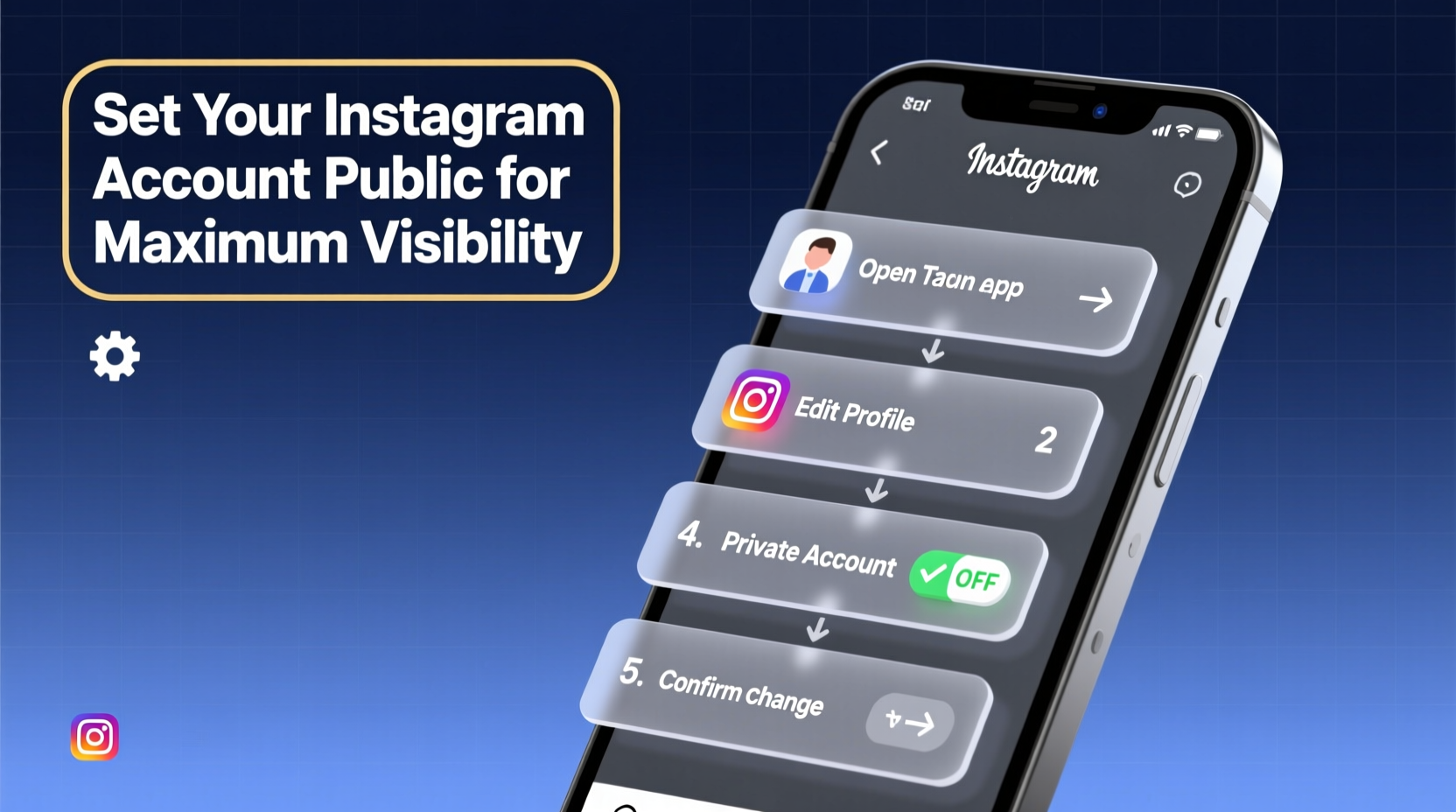
Changing your account from private to public is a quick process, but it must be done correctly to ensure immediate visibility. Follow these steps carefully using the official Instagram app (available on iOS and Android). Note that this cannot be done via desktop browsers as of 2024.
- Open the Instagram app and log into your account.
- Navigate to your profile by tapping the person icon in the bottom-right corner.
- In the top-right corner of your profile, tap the menu icon (three horizontal lines).
- Select “Settings and privacy” from the dropdown menu.
- Scroll down to the “Account” section and tap “Privacy”.
- Look for the option labeled “Private account.” If there’s a blue checkmark next to it, your account is currently private.
- Tap the toggle to disable “Private account.”
- Confirm the change when prompted. Instagram will notify you that your posts and stories will now be visible to everyone.
Once completed, your profile will instantly become public. All existing posts will be visible to any user who visits your profile, and future content will appear in followers’ feeds and relevant discovery spaces.
What Happens After You Go Public?
Making your account public doesn’t automatically guarantee viral success, but it removes the primary barrier to organic growth. Now, your content can be found through multiple channels:
- Hashtags: Use targeted, niche-specific hashtags (e.g., #PlantBasedRecipes, #MinimalistHome) to attract engaged communities.
- Geotags: Tagging locations helps local audiences discover your content.
- Engagement loops: Likes, comments, and shares from non-followers boost post visibility in algorithms.
However, going public also means your content is accessible to everyone—including competitors, trolls, or unwanted attention. It’s essential to monitor comments and direct messages regularly. Instagram offers tools to filter offensive language, block users, and restrict suspicious activity under Settings > Privacy > Hidden Words and Interactions.
Do’s and Don’ts After Switching to Public
| Do | Don't |
|---|---|
| Use a clear, keyword-rich bio to improve searchability | Leave your bio vague or outdated |
| Post consistently with high-quality visuals | Spam hashtags or overuse irrelevant ones |
| Engage with comments and DMs promptly | Ignore feedback or negative interactions |
| Review tagged photos and mentions daily | Allow inappropriate content to remain tagged |
| Optimize captions with CTAs (e.g., “Tag someone who needs this!”) | Post without a strategy or measurable goal |
Real Example: From Private to 10K Followers in 90 Days
Sophia Kim, a freelance graphic designer based in Portland, kept her Instagram private for over a year, sharing only with close friends. Her portfolio grew, but client inquiries remained low. After reading about visibility limitations, she switched to public and optimized her profile: she rewrote her bio to include “Freelance Brand Designer | Helping Startups Look Professional,” added a link to her portfolio, and began posting case studies with hashtags like #LogoDesign and #BrandIdentity.
Within two weeks, her posts started appearing in hashtag feeds. A video showing her design process went moderately viral (over 40K views), leading to seven direct client messages. By focusing on consistency and engagement, Sophia reached 10,000 followers in 90 days—all organically. “I didn’t change my content,” she said. “I just let people actually see it.”
Frequently Asked Questions
Can I switch back to private after going public?
Yes. You can toggle between public and private at any time in Settings > Privacy > Private account. However, each time you go private, your content disappears from public feeds and search results until you reopen access.
Will my old posts be visible to everyone after switching?
Yes. All posts published while your account is public—or those posted before switching, unless deleted—are immediately visible to anyone visiting your profile.
Does going public affect who can message me?
It changes messaging permissions slightly. With a public account, anyone can send you a message request. You’ll receive these in your Message Requests folder, where you can approve or ignore them. To limit this, adjust settings under Privacy > Messages to allow only followers to message you directly.
Maximizing Visibility: Pro Tips for Public Accounts
Simply being public isn’t enough. To truly leverage your newfound visibility, adopt these strategies:
- Optimize your username: Include keywords related to your niche (e.g., @TravelWithMaria instead of @maria12345).
- Pin high-performing posts: Highlight three of your best or most representative posts at the top of your grid.
- Post during peak hours: Use Instagram Insights (for Business/Creator accounts) to determine when your audience is most active.
- Encourage tagging: Run small campaigns like “Tag us in your coffee art using #MyMorningBrew” to generate user-generated content.
Final Checklist Before Going Public
- Back up important direct messages or private conversations.
- Review all past posts for sensitive or outdated content.
- Update your bio with a clear value proposition and contact info.
- Ensure your profile photo is professional and recognizable.
- Set up two-factor authentication for added security.
- Enable Story sharing to followers to encourage interaction.
- Plan your next 7–10 posts to maintain momentum post-transition.
Conclusion
Setting your Instagram account to public is a foundational step toward building a visible, influential presence on one of the world’s most visual social networks. It unlocks discovery, supports organic growth, and aligns your profile with professional standards expected by collaborators and customers alike. While privacy has its place, visibility fuels opportunity. Once your account is public, combine consistent content with strategic engagement to turn casual viewers into loyal followers.




 浙公网安备
33010002000092号
浙公网安备
33010002000092号 浙B2-20120091-4
Comments
No comments yet. Why don't you start the discussion?