
Understanding the rate of interest is essential whether you're evaluating a personal loan, comparing mortgage offers, or assessing an investment opportunity. The interest rate determines how much you'll pay over time—or earn—on borrowed or invested capital. While financial institutions often provide this figure, knowing how to calculate it yourself empowers better decision-making and reveals hidden costs or returns. This guide walks through the logic, formulas, and practical steps needed to solve for the interest rate in any scenario.
Why Calculating Interest Rate Matters
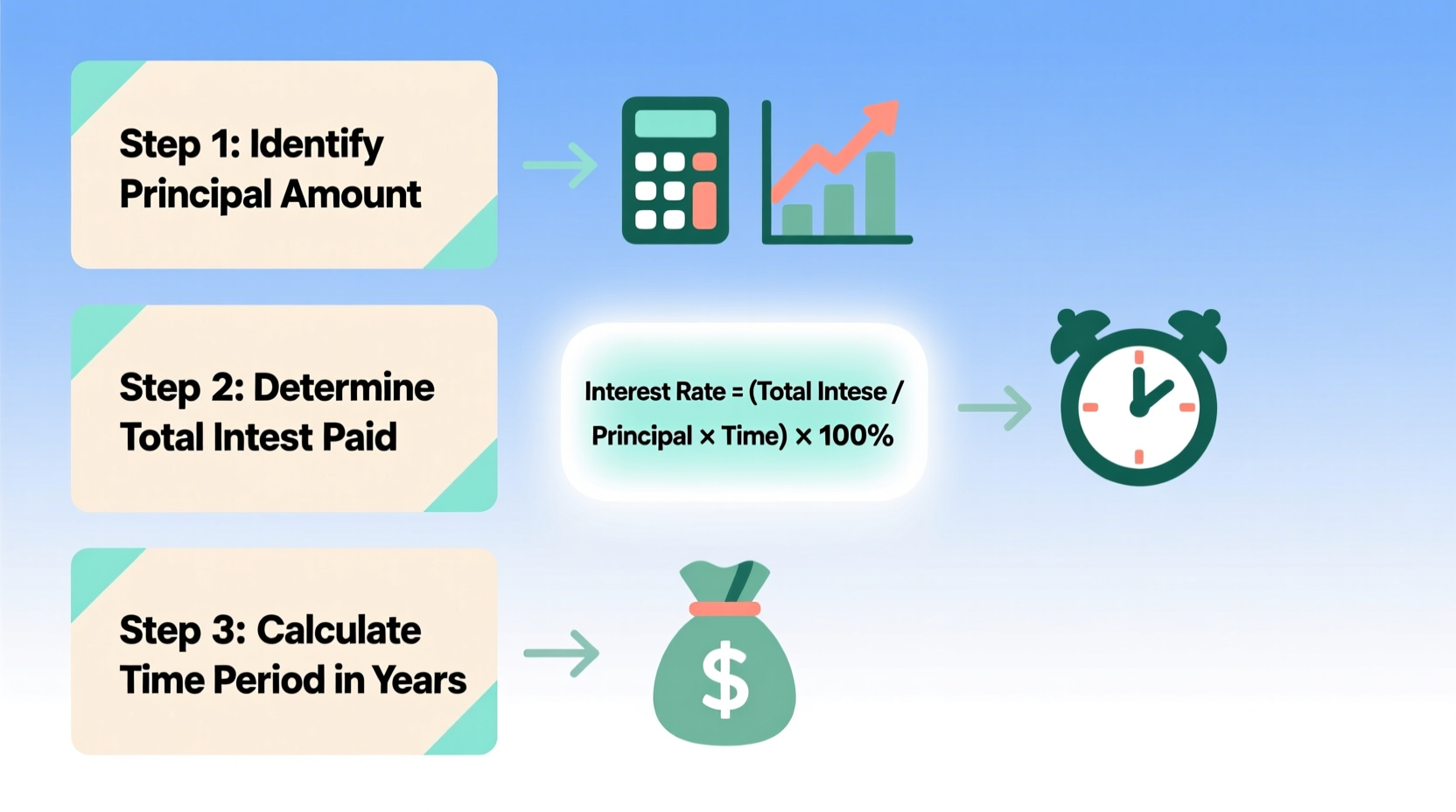
The advertised interest rate isn’t always the full story. Fees, compounding frequency, and repayment terms can distort the true cost or return. By learning to reverse-engineer the interest rate from known values like principal, time, and total payments, you gain transparency. For instance, two loans may have the same nominal rate but different effective rates due to compounding differences. Similarly, investments promising high returns might underdeliver when annualized properly.
“Knowing how to compute your actual rate of return separates informed investors from passive ones.” — Dr. Alan Zhou, Financial Mathematics Professor, MIT
Core Concepts: Principal, Time, and Compounding
Before solving for interest, clarify these foundational elements:
- Principal (P): The initial amount of money borrowed or invested.
- Time (t): Duration of the loan or investment, typically in years.
- Future Value (FV): Total amount accumulated after interest.
- Compounding Frequency (n): How often interest is applied per year (e.g., annually = 1, monthly = 12).
- Interest Rate (r): What we aim to solve for—the percentage growth per period.
These variables feed into standard models such as simple interest, compound interest, and annuities. Each requires a slightly different approach to isolate the rate.
Step-by-Step Guide to Solving for Interest Rate
Follow this structured process depending on the type of financial instrument involved.
Step 1: Identify the Type of Interest Model
Determine whether the situation involves:
- Simple Interest – interest only on principal
- Compound Interest – interest on principal and accumulated interest
- Annuity or Loan Payments – regular payments over time (like mortgages)
Step 2: Gather Known Values
Collect all available data:
- Present value (PV) or principal
- Future value (FV), final balance, or total payout
- Number of periods (years, months)
- Payment amounts (if applicable)
- Compounding frequency
Step 3: Apply the Correct Formula
For Simple Interest:
Use the formula:
FV = P(1 + rt)
Rearranged to solve for r:
r = (FV / P - 1) / t
For Compound Interest:
Formula:
FV = P(1 + r/n)^(nt)
To solve for r:
- Divide both sides by P: FV/P = (1 + r/n)^(nt)
- Take the nt-th root: (FV/P)^(1/(nt)) = 1 + r/n
- Subtract 1: (FV/P)^(1/(nt)) - 1 = r/n
- Multiply by n: r = n × [(FV/P)^(1/(nt)) - 1]
For Loans with Regular Payments (Annuities):
Use the present value of annuity formula:
PV = PMT × [1 - (1 + r)^(-n)] / r
This cannot be algebraically isolated for r. Instead, use:
- Financial calculator
- Spreadsheet function (e.g., Excel’s RATE)
- Iterative approximation (trial and error or Newton-Raphson method)
Step 4: Verify with Real Numbers
Plug your calculated rate back into the original equation to ensure it produces the correct future value or payment schedule.
Real Example: Calculating the True Rate on a Personal Loan
A borrower takes out a $10,000 personal loan with monthly payments of $212.47 over 5 years (60 months). The lender claims a “low rate,” but doesn’t disclose the APR. What’s the actual interest rate?
We use the annuity formula:
PV = PMT × [1 - (1 + r)^(-n)] / r
Given:
- PV = $10,000
- PMT = $212.47
- n = 60 months
Since we can’t solve algebraically, use trial values:
| Assumed Monthly Rate | Calculated PV | Comparison to $10,000 |
|---|---|---|
| 0.75% | $10,002.30 | Very close |
| 0.80% | $9,928.45 | Too low |
| 0.70% | $10,078.10 | Slightly high |
The rate that gives exactly $10,000 is approximately 0.75% per month. To get the annual percentage rate (APR):
APR = 0.75% × 12 = 9%
The effective annual rate (EAR), accounting for compounding, is:
EAR = (1 + 0.0075)^12 - 1 ≈ 9.38%
This means the borrower pays an effective 9.38% annually—even though the loan may advertise 9% APR.
Common Pitfalls and Best Practices
Many people miscalculate interest rates due to overlooked details. Avoid these errors:
| Do’s | Don’ts |
|---|---|
| Adjust time units consistently (e.g., convert months to years if needed) | Assume monthly rates are simply 1/12 of annual rates without compounding |
| Use EAR (Effective Annual Rate) when comparing products with different compounding | Compare only nominal rates across lenders |
| Include fees in total cost when calculating effective rate | Ignore origination fees or service charges |
Checklist: How to Accurately Solve for Interest Rate
- ✅ Determine if the problem involves simple interest, compound interest, or annuity payments
- ✅ Collect all known variables: principal, future value, payment amount, term, compounding frequency
- ✅ Choose the correct formula based on the model
- ✅ Rearrange the formula to solve for r—or use numerical methods if necessary
- ✅ Convert periodic rates to annual rates (APR or EAR) for comparison
- ✅ Validate your result by plugging it back into the original equation
- ✅ Consider all associated fees to determine the true cost of borrowing
FAQ: Frequently Asked Questions
Can I solve for interest rate without a financial calculator?
Yes, for simple and compound interest, algebraic solutions exist. For loans with fixed payments, manual iteration works—start with a guess, test it, and refine until the present value matches. Alternatively, use free online tools or spreadsheet functions like Excel’s RATE or Goal Seek.
What’s the difference between APR and effective interest rate?
APR (Annual Percentage Rate) is the nominal yearly rate without compounding. Effective interest rate includes compounding effects and reflects the true annual cost. For example, 12% APR compounded monthly results in an effective rate of about 12.68%.
How does inflation affect the real rate of return?
The real rate of return adjusts the nominal interest rate for inflation. Use the Fisher equation: real rate ≈ nominal rate – inflation rate. For precise calculation: (1 + r_real) = (1 + r_nominal) / (1 + inflation). A 6% return during 3% inflation yields roughly 2.9% real growth.
Conclusion: Take Control of Your Financial Decisions
Mastering the calculation of interest rates transforms you from a passive participant to an informed decision-maker in personal finance. Whether you're choosing a student loan, evaluating a CD, or analyzing an installment plan, the ability to derive and verify interest rates protects your wealth and enhances returns. These skills require practice, but once internalized, they become second nature—saving thousands over a lifetime.




 浙公网安备
33010002000092号
浙公网安备
33010002000092号 浙B2-20120091-4
Comments
No comments yet. Why don't you start the discussion?