
Chopping an onion is one of the most fundamental skills in cooking. It forms the aromatic base of countless dishes across global cuisines—from soups and stews to sauces, stir-fries, and salsas. Yet, despite its ubiquity, many home cooks approach the task inefficiently or inconsistently, leading to uneven pieces, wasted time, or even injury. More than just a kitchen chore, mastering the art of onion chopping improves flavor distribution, cooking precision, and overall efficiency in meal preparation. This comprehensive guide breaks down the process into clear, repeatable steps, explains the science behind minimizing tears, and offers professional insights that elevate a simple task into a refined culinary skill.
Definition & Overview
An onion, botanically classified as Allium cepa, is a bulbous vegetable belonging to the Allium genus, which includes garlic, leeks, and shallots. It consists of layered, fleshy scales enclosed in a papery outer skin, typically white, yellow, or red in color. Onions are biennial plants grown as annuals and have been cultivated for over 5,000 years, originating in Central Asia before spreading globally due to their storage longevity and pungent flavor.
In culinary terms, onions serve as a foundational ingredient—what the French call *mirepoix* (with carrots and celery) and the Spanish refer to as *sofrito*. When chopped and cooked, they undergo chemical transformations that develop sweetness, depth, and umami. Even when used raw, their sharp bite adds texture and complexity to salads, relishes, and garnishes. The way an onion is chopped—whether finely minced, coarsely diced, or sliced—directly affects how it behaves during cooking and contributes to the final dish.
Key Characteristics of Onions
Understanding the onion’s physical and chemical makeup helps explain both its culinary value and the challenges associated with handling it. Below is a breakdown of its core attributes:
| Characteristic | Description |
|---|---|
| Flavor Profile | Sharp, pungent when raw; sweetens significantly when sautéed, caramelized, or roasted. |
| Aroma | Pronounced sulfurous scent released upon cutting due to enzymatic reactions. |
| Color Variants | Yellow (most common, best for cooking), red (vibrant, ideal for raw applications), white (mild, often used in Mexican cuisine). |
| Heat Level | Mild to high pungency depending on variety and freshness; decreases with age and cooking. |
| Culinary Function | Aromatic base, flavor enhancer, textural component, coloring agent. |
| Shelf Life | 2–3 months in cool, dry, dark conditions; cut onions last 7–10 days refrigerated in a sealed container. |
The Science Behind Tears: Why Onions Make You Cry
When an onion is cut, its cells rupture and release enzymes—specifically alliinase—that react with sulfur-containing compounds naturally present in the bulb. This reaction produces a volatile gas called syn-propanethial-S-oxide. Upon contact with moisture in the eyes, this gas forms sulfuric acid, triggering the lacrimal glands to produce tears as a protective response.
Several methods can reduce tear production without compromising technique:
- Chill the onion in the refrigerator (not freezer) for 30 minutes before cutting—this slows enzyme activity.
- Use a sharp knife to minimize cell damage and gas release.
- Cut near a vent, open window, or under a range hood to disperse the gas.
- Keep the root end intact as long as possible—the highest concentration of enzymes resides there.
“The difference between an amateur and a professional cook isn’t just speed—it’s control. A properly chopped onion reflects consistency, respect for ingredients, and attention to detail.” — Chef Elena Martinez, Culinary Instructor at San Francisco Cooking Academy
Practical Usage: How to Chop an Onion Correctly – Step by Step
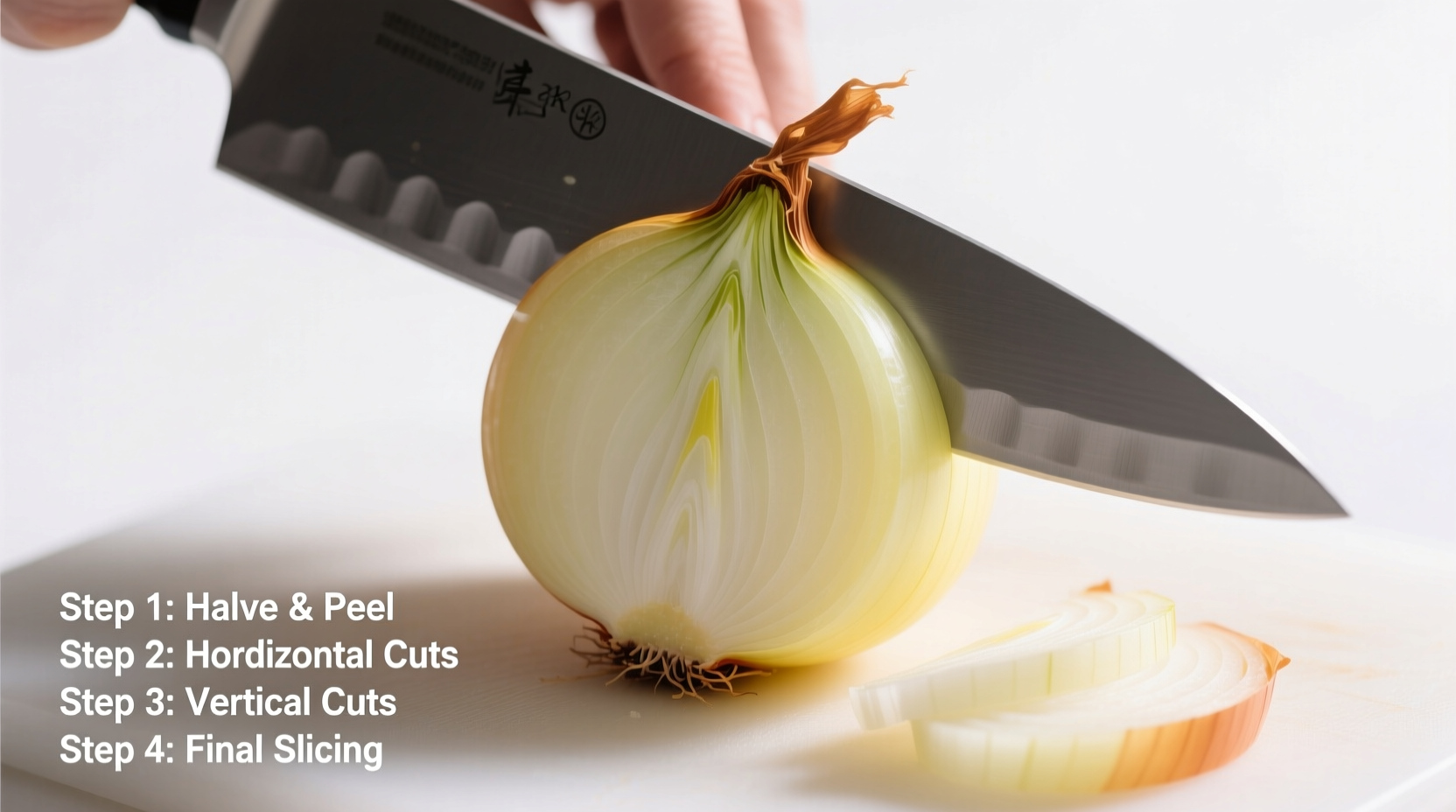
Proper onion chopping ensures uniformity, safety, and efficiency. Follow these steps to achieve restaurant-quality results every time.
- Gather tools: Use a sharp chef’s knife (8–10 inches), a stable cutting board (preferably non-slip), and a bowl for the chopped pieces.
- Trim the top: Place the onion on the board and slice off the stem end (top), leaving about ¼ inch. Do not remove the root end yet.
- Peel the onion: Remove the papery outer skin and any dry layers beneath. Rinse briefly if needed, but pat dry to maintain knife grip.
- Cut in half: Stand the onion upright and slice vertically through the root, dividing it into two equal halves.
- Create flat surfaces: Lay one half cut-side down. Slice from the top toward the root, making vertical cuts while keeping the root intact to hold layers together.
- Make horizontal cuts (optional for dicing): For a fine dice, make one or two horizontal cuts parallel to the board, again stopping short of the root.
- Final crosswise cuts: Slice perpendicular to the previous cuts, moving from root to tip. As you cut, the pieces will fall away uniformly.
- Discard the root: Once diced, discard the small root portion containing the fibrous core.
Professional Tip: Maintain a claw grip with your non-knife hand—tuck fingertips inward and use knuckles to guide the blade. This protects your fingers and ensures consistent thickness. Always pull the knife toward you through the cut rather than pushing forward.
Different Cuts and Their Applications
The method of chopping varies depending on the desired outcome. Here are the most common techniques and their culinary uses:
- Fine Dice (Brunoise): ~⅛-inch cubes. Ideal for sauces, stuffings, and dishes requiring quick, even cooking.
- Medium Dice: ~¼-inch cubes. Standard for soups, stews, and sautés where texture matters.
- Rough Chop: Irregular ½-inch pieces. Suitable for stocks, braises, or any recipe where onions will be strained out later.
- Slices: Thin rounds, separated into rings. Used in burgers, sandwiches, or pickling.
- Julienned Strips: Long, thin matchsticks. Perfect for stir-fries or garnishes.
- Minced: Very small, almost paste-like pieces. Best for marinades, dressings, or spice pastes where seamless integration is key.
Variants & Types of Onions
Not all onions are interchangeable. Each type has distinct characteristics that influence how and when it should be chopped and used.
| Type | Flavor | Best Used For | Chopping Notes |
|---|---|---|---|
| Yellow Onion | Strong, pungent when raw; deeply sweet when cooked | General cooking, roasting, caramelizing | Most versatile; standard for mirepoix and base sauces |
| White Onion | Bright, crisp, slightly hotter than yellow | Mexican cuisine, salsas, tacos, ceviche | Hold shape well when chopped raw; less likely to discolor |
| Red Onion | Mildly sweet with a peppery finish | Salads, grilling, pickling, garnishes | Adds color; chop just before serving to preserve vibrancy |
| Shallot | Delicate, garlicky, subtle sweetness | Vinaigrettes, reductions, fines herbes | Finely mince; treat like a concentrated onion-garlic hybrid |
| Green Onions (Scallions) | Mild, fresh, grassy | Garnishes, stir-fries, cold dishes | Slice diagonally or into rings; separate white and green parts if needed |
Comparison with Similar Ingredients
Onions are often confused with other members of the Allium family. While related, each plays a unique role in cooking.
| Ingredient | How It Differs from Onion | Substitution Guidance |
|---|---|---|
| Garlic | More intense, spicy-sweet aroma; used in smaller quantities | Not interchangeable; use garlic for punch, onion for bulk and sweetness |
| Leek | Milder, sweeter, with a delicate texture; requires thorough cleaning | Can replace onion in soups and braises, but won’t caramelize the same way |
| Shallot | Finer grain, more nuanced flavor; higher cost | Use 1:1 in raw applications; substitute ¾ shallot for 1 onion in sauces |
| Chives | Herbaceous, very mild; only the green part is used | Never a base ingredient; always a finishing garnish |
Practical Tips & FAQs
How do I prevent my hands from smelling like onion?
Wash hands with stainless steel (e.g., rubbing the sink while rinsing) or a mixture of salt and lemon juice. Stainless steel binds to sulfur compounds, neutralizing odor effectively.
Can I chop onions in advance?
Yes. Store chopped onions in an airtight container in the refrigerator for up to five days. Yellow and white onions hold better than red, which may darken slightly. For longer storage, freeze chopped onions (they’ll lose crispness but work well in cooked dishes).
Is it safe to use a dull knife?
No. A dull knife requires more force, increasing the risk of slipping and injury. It also crushes cells instead of slicing them cleanly, releasing more irritants and accelerating spoilage.
What size onion equals one cup chopped?
Approximate yields:
- Small onion (2\" diameter): ~½ cup chopped
- Medium onion (2½\" diameter): ~1 cup chopped
- Large onion (3\" diameter): ~1½ cups chopped
Are red onions harder to chop than yellow?
No, the technique is identical. However, red onions may stain hands and boards slightly due to anthocyanin pigments. Rinse immediately to prevent set-in color.
Can I use a food processor?
Yes, but with caution. Pulse carefully to avoid turning onions into mush. Use the chopping blade, not the shredder, and pulse in batches. Hand-chopping offers superior control and texture.
Efficiency Hack: Chop multiple onions at once and store in labeled containers. Prepping aromatics in bulk saves significant time during weekday cooking. Keep in mind that pre-chopped onions oxidize faster and lose some brightness.
Common Mistakes to Avoid
- Removing the root too early: The root acts as a hinge. Removing it prematurely causes the onion to fall apart, making controlled cuts difficult.
- Using a rocking motion with a large knife: While common, excessive rocking reduces precision. Instead, anchor the tip and lift the heel for cleaner, safer cuts.
- Ignoring knife sharpness: Dull blades crush fibers, increase friction, and heighten tear-inducing compound release.
- Cutting too quickly: Rushing leads to uneven pieces and compromised safety. Focus on rhythm and control, not speed.
Advanced Techniques for Professional Results
For those seeking precision beyond basic dicing, consider these advanced approaches:
Concassé Cut
Used primarily for tomatoes but applicable to onions in fine cuisine. Involves peeling, coring, and dicing into perfectly uniform pieces. Achieved by first halving, then using precise cross-hatch cuts followed by straight slicing.
Julienne for Sautéing
Thin, even strips allow onions to cook rapidly and evenly. Ideal for dishes like French onion soup or stir-fries where visual appeal and texture matter.
Layer-Separated Rings
After slicing into rounds, gently separate the rings. Useful for frying (onion rings) or layering in casseroles. Soak in ice water for 10 minutes to curl rings attractively and mellow flavor.
“In a professional kitchen, consistency is king. If one onion is diced larger than the rest, it won’t cook at the same rate—and that imbalance can ruin a sauce.” — Jacques Renard, Executive Sous Chef, Le Jardin Blanc
Summary & Key Takeaways
Chopping an onion correctly is more than a basic kitchen task—it’s a cornerstone of skilled cooking. Mastery begins with understanding the onion’s structure and chemistry, continues with proper tool selection and technique, and culminates in consistent, efficient results.
Key points to remember:
- Always use a sharp knife and keep the root end intact until the final cut.
- Chill onions briefly to reduce tearing, but never freeze them before chopping.
- Uniformity in size ensures even cooking—critical in sauces, soups, and sautés.
- Choose the right onion variety based on whether it will be cooked or served raw.
- Store pre-chopped onions properly to maintain freshness and flavor.
- Practice the claw grip and controlled cutting motion to enhance safety and precision.
Next time you reach for an onion, take a moment to apply these principles. With repetition, the process becomes second nature—transforming a simple act into a mark of culinary competence. Share your best chopping tip in the comments or challenge yourself to perfect the brunoise dice this week.




 浙公网安备
33010002000092号
浙公网安备
33010002000092号 浙B2-20120091-4
Comments
No comments yet. Why don't you start the discussion?