
Reapplying sunscreen throughout the day is essential for maintaining skin protection against UV damage. But when you're wearing makeup, the process becomes more complicated. Rubbing in a traditional lotion can disrupt your foundation, blur your concealer, or leave a greasy residue. This has led many people to turn to sunscreen sticks as a convenient alternative. Yet, the question remains: are stick sunscreens truly better than lotions for reapplication over makeup? The answer depends on several factors, including formulation, application method, active ingredients, and individual skin needs.
The Challenge of Reapplying Sunscreen Over Makeup
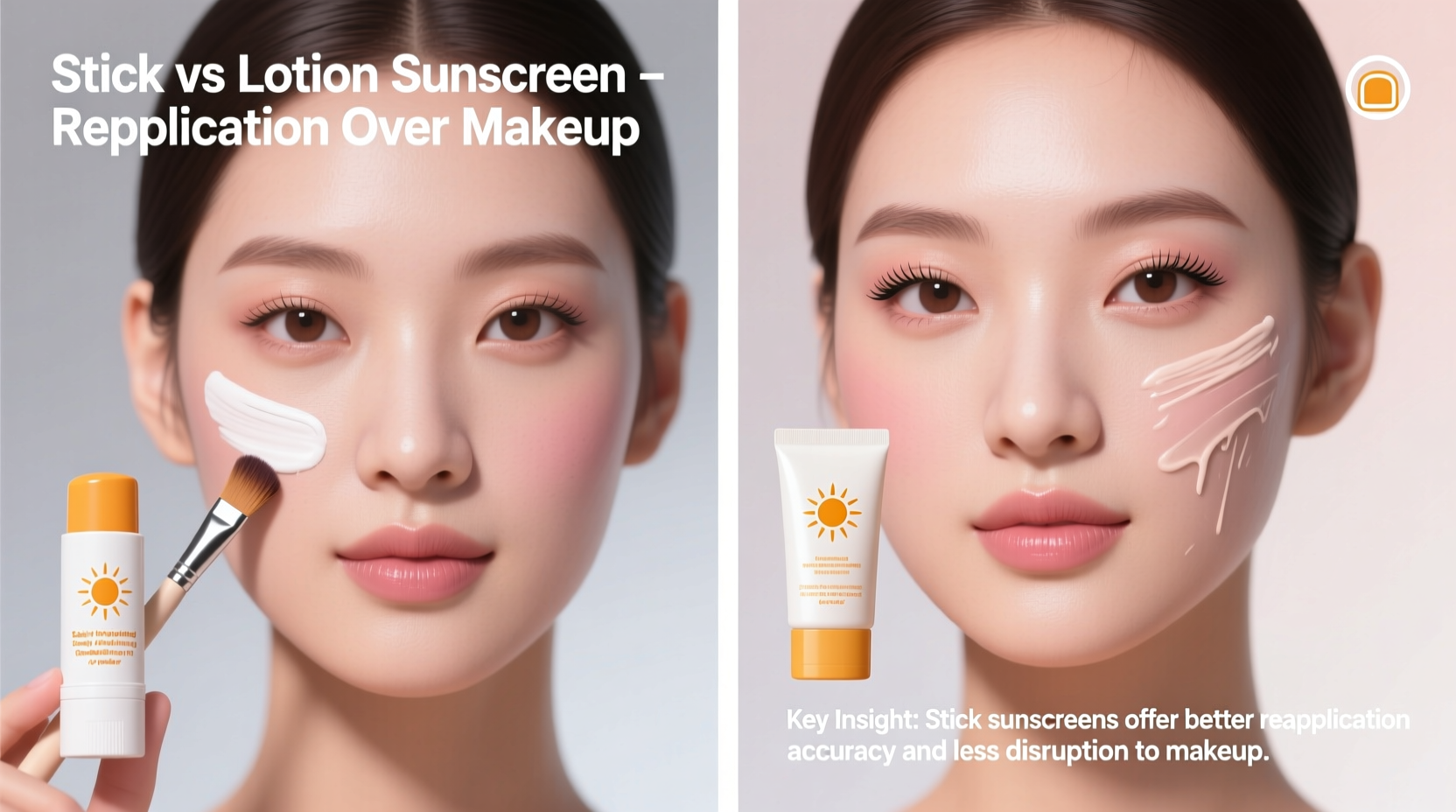
Most dermatologists recommend reapplying sunscreen every two hours when exposed to sunlight. However, few people follow this rule consistently—especially when wearing a full face of makeup. Traditional liquid or cream sunscreens often require rubbing, blending, and sometimes even removing existing layers of product, which defeats the purpose of a quick top-up.
This friction-based application can cause makeup to streak, settle into fine lines, or oxidize unevenly. It may also dilute the SPF efficacy if not applied evenly. As a result, consumers have increasingly turned to solid formats like sunscreen sticks for midday touch-ups. These portable, mess-free options promise a no-rub solution that preserves makeup integrity while boosting UV protection.
How Sunscreen Sticks Work
Sunscreen sticks are formulated with waxes (like beeswax or carnauba), oils, and emollients that solidify at room temperature. They deliver a concentrated dose of active ingredients in a compact form. To use, you glide the stick directly onto the skin and gently pat or press the product into place—no rubbing required.
Because they’re less likely to liquefy or slide off the skin, sticks offer precise application around sensitive areas such as the nose, eyes, and lips. Many come in twist-up tubes similar to deodorants, making them travel-friendly and hygienic.
Mineral-based stick sunscreens typically contain zinc oxide or titanium dioxide, which sit on the skin’s surface and physically block UV rays. While effective, some users report white cast or difficulty blending, especially on deeper skin tones. Newer formulations have improved dispersion technology to minimize this issue.
“Sticks are excellent for targeted reapplication, especially on high-exposure zones like the nose and cheeks. Their low-movement design makes them ideal over makeup.” — Dr. Lena Patel, Board-Certified Dermatologist
Lotion Sunscreens: Strengths and Limitations for Reapplication
Lotion sunscreens remain the gold standard for initial daily protection. They spread easily, absorb quickly, and are available in both chemical and mineral forms. When applied correctly during your morning routine, lotions provide broad-spectrum coverage with minimal residue.
However, reapplying lotion over makeup presents challenges. Pump or squeeze bottles require fingers or tools to transfer product, increasing contamination risk. Applying enough volume without disturbing makeup demands precision. Even lightweight gels or milks can move foundation or cause pilling when layered.
Some brands now offer spray or mist sunscreens designed for over-makeup use, but these raise concerns about inhalation risks and inconsistent coverage. Lotions in pump dispensers with sponge applicators or cushion-style compacts attempt to bridge the gap, but availability is limited.
When Lotion Still Makes Sense
- At-home reapplication: If you’re able to remove or refresh makeup, a fresh layer of lotion ensures optimal protection.
- High-sweat environments: Lotions generally offer better water resistance and broader coverage than sticks.
- Full-face coverage needs: Sticks may miss spots; lotions ensure uniform film formation when applied properly.
Comparing Performance: Stick vs Lotion for Over-Makeup Use
| Feature | Sunscreen Stick | Lotion Sunscreen |
|---|---|---|
| Makeup Compatibility | High – minimal disruption | Low to Moderate – risk of smudging |
| Portability | Excellent – compact, leak-proof | Fair – bottles may leak in bags |
| Application Speed | Fast – glide-and-go | Slower – requires spreading |
| Coverage Accuracy | Moderate – risk of missing areas | High – easier to cover large zones |
| SPF Consistency | Depends on pressure and blending | More consistent with proper use |
| Skin Types Suited | All, especially oily/acne-prone | All, but heavier formulas may clog pores |
| Ease of Reapplication | ★★★★★ | ★★★☆☆ |
While sticks win in convenience and makeup preservation, they require careful technique to ensure adequate SPF delivery. A light swipe isn’t enough—you need multiple passes and fingertip pressing to achieve the recommended 2 mg/cm² thickness. Without proper pressure, protection drops significantly.
Step-by-Step Guide: How to Reapply Sunscreen Over Makeup Without Ruining Your Look
Whether you choose a stick or a lotion, technique matters. Follow this timeline for seamless daytime reapplication:
- Blot Excess Oil (Daytime Reset)
Use a tissue or oil-absorbing sheet to gently remove shine from the T-zone. This prevents product sliding and creates a clean surface. - Choose Your Product Wisely
Select a non-comedogenic, fragrance-free sunscreen stick or setting-spray hybrid with SPF 30 or higher. Avoid alcohol-heavy sprays that dry out skin. - Apply the Stick with Precision
Draw thick lines across key sun-exposed areas: forehead, nose, cheeks, chin, neck. Don’t forget ears and hairline. - Press, Don’t Rub
Use clean fingertips or a damp beauty sponge to gently press the product into the skin. Circular tapping motions help blend without lifting makeup. - Set If Needed
Finish with a light dusting of translucent powder if shine returns, especially on oily skin types. - Repeat Every Two Hours
Set a reminder to reapply, particularly between 10 a.m. and 4 p.m., when UV intensity peaks.
Real-World Example: Office Worker Commuting Through Summer
Sophia, a marketing executive in Miami, spends her mornings indoors but walks 15 minutes to lunch and back daily. She wears full coverage foundation and doesn’t want to carry a mirror or touch-up kit. After experiencing sunburn on her cheekbones despite morning SPF, she switched to a mineral sunscreen stick.
Now, after lunch, she pulls out her sunscreen stick, glides it over her face, and presses it in using her ring finger. Her makeup stays intact, and she feels confident about UV protection. “I used to skip reapplication because I didn’t want to look shiny or messy,” she says. “The stick changed that—it takes 30 seconds and looks invisible.”
Over six months, Sophia noticed fewer dark spots forming along her cheekbones and reduced redness after long days outside. Her dermatologist confirmed improved photoprotection during checkups.
Expert Recommendations for Choosing the Right Format
Dermatologists agree: consistency beats perfection. “If using a stick means you’ll reapply regularly, then it’s the better choice—even if theoretically a lotion offers broader coverage,” says Dr. Rajiv Gupta, a cosmetic dermatology specialist.
He recommends looking for products labeled “broad-spectrum SPF 30+” with photostable filters. For sensitive skin, mineral sticks with micronized zinc oxide are preferable. Those with dry skin should seek out hydrating variants containing squalane or ceramides.
Chemical sunscreen sticks are emerging but less common due to melting point challenges. When available, they offer lighter finishes and no white cast—ideal for deeper skin tones. However, they require strict formulation controls to prevent irritation.
Checklist: What to Look for in an Over-Makeup Sunscreen
- SPF 30 or higher, broad-spectrum protection
- Non-comedogenic and fragrance-free
- Compact, leak-proof packaging
- Smooth glide without tugging
- No heavy white cast (especially important for melanin-rich skin)
- Water and sweat resistance (if outdoors frequently)
- Easy to press into skin without rubbing
Frequently Asked Questions
Can I rely solely on a sunscreen stick for all-day protection?
No single application lasts all day. Regardless of format, sunscreen must be reapplied every two hours under direct sun. A stick is excellent for touch-ups but should complement—not replace—a proper morning application of lotion or serum-based SPF.
Do sunscreen sticks provide enough coverage?
Yes—if applied correctly. Studies show most people apply only 25–50% of the needed amount. To get full SPF value from a stick, make multiple passes and press the product into the skin rather than just swiping.
Will a sunscreen stick clog my pores?
Potentially, depending on the formula. Waxy bases can trap sebum and debris, especially around the nose and chin. Look for non-comedogenic labels and avoid heavy fragrances or lanolin if you’re acne-prone.
Final Verdict: Which Is Better?
For reapplication over makeup, **sunscreen sticks are generally superior** to lotions. Their portability, precision, and non-disruptive application make them ideal for on-the-go use. While lotions offer better overall coverage when applied initially, their practicality diminishes once makeup is on.
The real advantage of sticks lies in adherence to routine. Because they’re fast, clean, and fuss-free, people are more likely to use them consistently. And in sun protection, consistency is everything. You can’t benefit from SPF you don’t apply.
That said, the best approach combines both formats: start with a well-applied lotion in the morning, then maintain protection with a stick at lunch, mid-afternoon, and before heading home. Think of the stick as your maintenance tool—the guardian of sustained defense.




 浙公网安备
33010002000092号
浙公网安备
33010002000092号 浙B2-20120091-4
Comments
No comments yet. Why don't you start the discussion?