
For decades, creative builders—both young and old—have turned to construction toys as a way to relax, problem-solve, and express themselves. Two dominant formats have emerged: traditional model kits and modern building blocks like LEGO or compatible systems such as Stitch Building Blocks. While both offer rewarding experiences, many enthusiasts wonder: are building blocks actually more fun to build than model kits? The answer isn’t just about complexity or end results—it’s about process, flexibility, and emotional engagement.
The Nature of the Build: Flexibility vs Precision
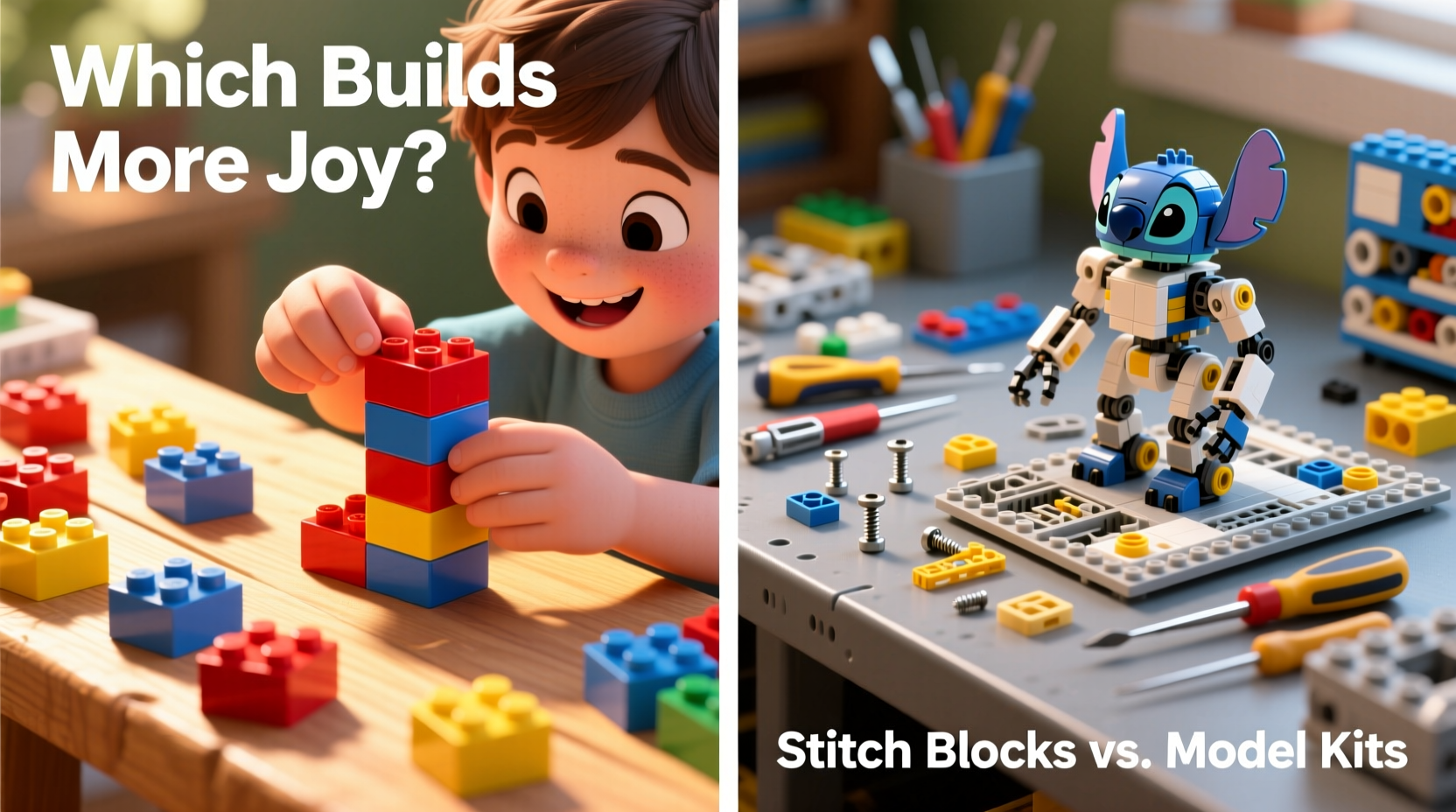
Building blocks, including systems like Stitch, thrive on modularity. Each piece is designed to connect seamlessly with others, allowing for open-ended creation. You can start with instructions and veer off into your own design, rebuild the same set multiple times in different ways, or combine sets to create something entirely new.
In contrast, model kits—whether plastic snap-together models, wooden puzzles, or resin-based builds—emphasize precision and fidelity to a pre-designed outcome. These kits often require careful alignment, glue, paint, or delicate handling. The goal is usually to replicate a specific vehicle, structure, or character as accurately as possible.
This fundamental difference shapes the experience. Blocks encourage experimentation; model kits reward patience and attention to detail.
Comparing the Fun Factor: Engagement Over Time
\"Fun\" is subjective, but it often correlates with engagement, flow state, and personal reward. Building blocks tend to score higher in long-term engagement because they don’t lock you into a single path. A child (or adult) can spend an afternoon building a spaceship, then disassemble it and turn it into a castle. This adaptability keeps the activity fresh.
Model kits, while deeply satisfying upon completion, are typically one-and-done projects. Once assembled and displayed, there's little incentive—or possibility—to rebuild them differently. However, the sense of accomplishment from finishing a complex 3D puzzle or a detailed diorama can be immense.
Stitch Building Blocks, which follow the same interlocking principle as other major brands, amplify this playful potential. Their compatibility with existing systems means users aren’t limited by proprietary constraints. This interoperability expands creative freedom, making the building experience feel less restrictive.
Learning and Cognitive Benefits
Both formats support cognitive development, but in different ways. Building blocks enhance spatial reasoning, fine motor skills, and divergent thinking—the ability to generate multiple solutions to a problem. Because they allow freeform construction, children learn through trial and error, iteration, and imaginative storytelling.
Model kits, on the other hand, develop convergent thinking—finding the single correct solution. They improve focus, reading comprehension (through instruction manuals), and understanding of symmetry and engineering principles. Advanced kits may even introduce concepts like gear mechanics or structural balance.
A study published in the Journal of Educational Psychology found that children who regularly played with open-ended construction toys showed greater creativity in problem-solving tasks compared to those using fixed-design kits.
“Open-ended building systems foster what we call ‘generative play’—the kind that leads to innovation later in life.” — Dr. Lena Patel, Child Development Researcher, University of Edinburgh
Practical Comparison: Blocks vs Kits
| Feature | Stitch Building Blocks | Model Kits |
|---|---|---|
| Rebuildability | High – endless reconfiguration | Low – usually permanent assembly |
| Difficulty Curve | Scalable – simple to complex builds | Fixed – depends on kit level |
| Creative Freedom | Very high – encourages improvisation | Limited – follows strict design |
| Storage & Organization | Requires sorting bins or cases | Easier – fewer small parts |
| Average Build Time | Variable – minutes to hours | Predictable – based on complexity |
| Skill Development | Divergent thinking, creativity | Attention to detail, precision |
Real Example: Emma’s Weekend Builds
Emma, a 34-year-old architect and mother of two, uses both building blocks and model kits as part of her weekend routine. On Saturdays, she builds official Stitch sets with her kids, enjoying the guided process and shared laughter when pieces click together. But on Sundays, she clears the table for freeform block sessions—designing miniature homes, bridges, and abstract sculptures.
“With the model kits I bought last year,” she says, “I loved how detailed the finished car looked. But once it was done, I boxed it up. With the blocks, I’m always tweaking something. Last week I redesigned my coffee table display three times. It’s not about finishing—it’s about playing.”
Her experience reflects a broader trend: people return to building blocks again and again, not just for nostalgia, but because the process itself is inherently replayable.
Step-by-Step: Choosing What’s Right for You
If you're deciding between investing in building blocks or model kits, consider this sequence:
- Assess your goals: Do you want a display piece or a tool for ongoing creativity?
- Evaluate time availability: Model kits often require dedicated blocks of time; blocks can be built in short bursts.
- Consider age and skill level: Younger builders benefit from the tactile feedback of blocks; older hobbyists may appreciate the challenge of intricate kits.
- Think about storage: Blocks need organization; kits take up space once completed. <5> Test both: Try a mid-level Stitch block set and a 100–200-piece model kit to compare enjoyment levels.
Checklist: Is Building Blocks the Right Choice?
- ✅ You enjoy changing your mind during a project
- ✅ You like reusing materials across multiple builds
- ✅ You value creativity over exact replication
- ✅ You build with children or collaborate with others
- ✅ You prefer activities you can pause and resume easily
If most of these apply, building blocks—especially flexible systems like Stitch—are likely more fun for you than traditional model kits.
Frequently Asked Questions
Can Stitch Building Blocks be combined with other brands?
Yes. Stitch Building Blocks are designed to be compatible with leading brick-based systems. You can mix them freely, allowing for expanded color options and part variety without sacrificing stability.
Are model kits better for developing patience?
They can be. Model kits often require sustained focus, especially when gluing or painting small components. However, building complex block sets—such as large modular buildings or motorized vehicles—also demands significant patience and planning.
Which is more cost-effective over time?
Building blocks win in the long run. While initial investment may be higher, their reuse across countless builds reduces per-project cost. Model kits, once completed, cannot be repurposed, making each kit a one-time expense.
Conclusion: Fun Is in the Process, Not Just the Product
The question isn't whether building blocks are objectively better than model kits—it's whether they’re more fun for you. For those who value exploration, adaptability, and repeated engagement, Stitch Building Blocks offer a dynamic, evolving experience that model kits simply can’t match. The joy comes not just from finishing, but from inventing, adjusting, and rebuilding.
Model kits have their place: as meditative projects, collectible displays, or technical challenges. But if you crave a toy that grows with your imagination, responds to your mood, and invites collaboration, building blocks provide a richer, more enduring form of fun.




 浙公网安备
33010002000092号
浙公网安备
33010002000092号 浙B2-20120091-4
Comments
No comments yet. Why don't you start the discussion?