
Transforming a blank wall into a luminous backdrop can elevate the mood of any space—whether it’s a bedroom, patio, wedding venue, or seasonal display. Two popular lighting solutions dominate this decorative niche: string light curtains and net lights. Both offer sparkle and ambiance, but they differ significantly in structure, coverage, ease of installation, and visual impact. Choosing between them isn’t just about preference—it’s about understanding how each performs when draped across vertical surfaces to create that sought-after magical effect.
The goal is uniform, enchanting illumination—like stars woven into fabric. But not all lighting systems deliver equal results. One may leave dark gaps; the other might be too rigid for creative shaping. This guide breaks down the real-world performance of string light curtains versus net lights when used on walls, helping you make an informed decision based on coverage, flexibility, durability, and overall aesthetic payoff.
Understanding the Basics: What Are String Light Curtains?
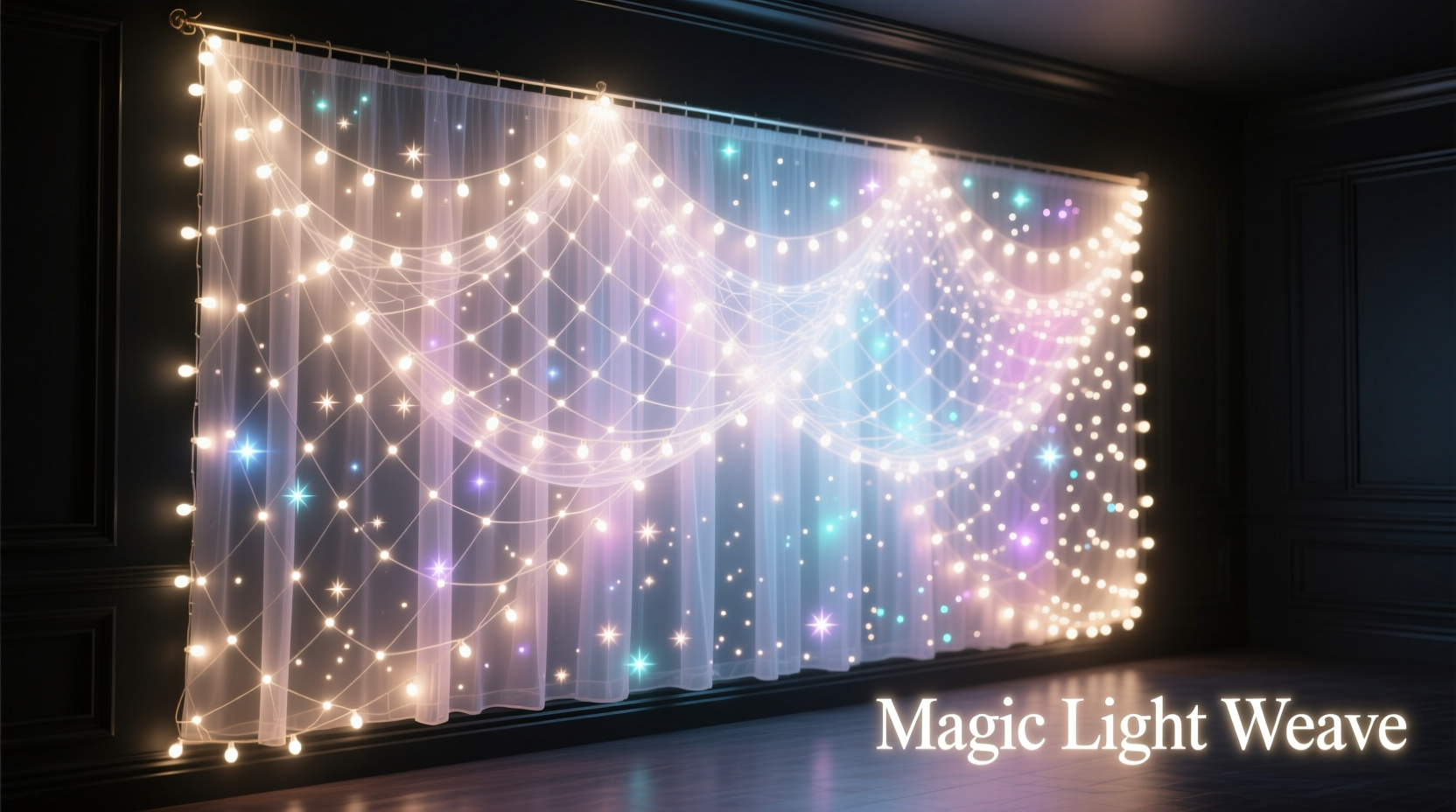
String light curtains are vertical strands of evenly spaced bulbs suspended from a horizontal wire or rod, resembling a curtain of light. Each strand hangs independently, typically ranging from 3 to 10 feet wide with drop lengths of 6 to 15 feet. The bulbs—often LED—are connected in series along each vertical line, with spacing between strands usually around 6 inches.
These are commonly used behind stages, along patios, or as photo backdrops at events. Their design mimics traditional drapery, offering a waterfall-like glow. Because the strands hang freely, they allow some movement in the breeze, adding dynamism outdoors.
Installation involves mounting hooks or clips along an overhead support, then threading each vertical line through or over them. While effective for creating depth, the open spacing between strands means parts of the wall remain unlit unless multiple panels are overlapped—a factor that affects both cost and complexity.
What Are Net Lights and How Do They Work?
Net lights consist of a grid of interconnected wires forming a mesh pattern, with bulbs placed at each intersection. Resembling a fishing net embedded with LEDs, these lights are designed to lie flat against surfaces. Available in various sizes—commonly 6x6 feet or 6x12 feet—they provide dense, even coverage ideal for covering large wall areas without visible gaps.
Because the bulbs are arranged in a square matrix (e.g., every 6 inches horizontally and vertically), net lights eliminate the “striped” effect sometimes seen with string curtains. This makes them especially effective for indoor accent walls, holiday displays on house exteriors, or creating glowing backdrops in studios.
They’re typically installed using transparent clips, adhesive hooks, or zip ties attached directly to the wall or fence. Since the entire panel lies flush, wind resistance is low, making them suitable for semi-exposed outdoor use. However, their rigidity limits draping ability—unlike string curtains, they can’t sway or flow like fabric.
“Net lights give designers control over pixel-perfect illumination. When you need zero dead zones on a wall, they’re unmatched.” — Jordan Lee, Lighting Designer & Event Producer
Comparative Analysis: Coverage, Density, and Visual Impact
The core question—*which covers walls better?*—comes down to three factors: bulb density, continuity of light, and adaptability to surface shape.
String light curtains offer elegance and motion but sacrifice fullness. With only vertical lines illuminated, the horizontal plane remains partially dark. A standard 6-foot-wide curtain with 6-inch spacing yields just 12 lit columns. That leaves nearly half the wall area in shadow, especially noticeable up close or under scrutiny.
In contrast, a 6x6 foot net light panel with 6-inch spacing contains 11 rows and 11 columns—121 individual points of light in a tightly packed grid. This creates a near-solid field of illumination, mimicking a starry sky rather than isolated streaks.
For sheer wall coverage and elimination of blind spots, net lights win decisively. But aesthetics aren't solely about density. Some prefer the linear rhythm of curtain lights—their verticality draws the eye upward, enhancing ceiling height perception in rooms. Net lights, while comprehensive, can appear static or grid-like if viewed too closely.
| Feature | String Light Curtain | Net Lights |
|---|---|---|
| Bulb Density (per sq ft) | ~1.5–2.0 | ~2.5–3.0 |
| Wall Gap Visibility | Moderate to High | Low to None |
| Natural Movement | Yes – sways gently | No – fixed grid |
| Installation Complexity | Moderate – requires alignment | Low – lay flat and secure |
| Ideal Use Case | Backdrops, high ceilings, dramatic drops | Walls, fences, flat surfaces, full coverage |
Real-World Application: A Mini Case Study
A boutique event planner in Portland was tasked with transforming a brick courtyard wall into a dreamy evening feature for a summer wedding. The client wanted “a galaxy come to life” across a 20x10 foot surface.
The team first tested a string light curtain setup using four 5-foot-wide panels spaced end-to-end. From a distance, the effect was pleasing—vertical streams of white twinkles evoked falling stardust. But upon closer inspection, guests noticed wide dark corridors between strands, breaking the illusion. Photos taken at night revealed uneven exposure, with bright lines cutting through darkness.
They reinstalled using three overlapping 6x8 foot net light panels. The transformation was immediate. The entire wall shimmered uniformly, with no discernible pattern disruption. Even under camera flash, the light appeared natural and immersive. Wind caused minimal flutter, and the flat profile stayed aligned throughout the night.
The planner noted: “We learned that coverage matters more than drama when the goal is magic, not mechanics. Net lights disappeared into the experience—they became the atmosphere itself.”
Step-by-Step Guide: Installing for Maximum Wall Coverage
Whether you choose string light curtains or net lights, proper installation determines success. Follow this sequence to ensure optimal results:
- Measure the Wall Area: Record width and height. Note any obstructions (outlets, vents, windows).
- Select Panel Size and Layout: Choose configurations that minimize seams. For net lights, aim for full-panel coverage. For curtains, plan overlap zones.
- Determine Power Access: Identify nearest outlet. Use outdoor-rated extension cords if needed. Avoid daisy-chaining beyond manufacturer limits.
- Mark Mounting Points: Use removable tape or chalk to outline clip positions. For net lights, space clips every 12–18 inches around edges and intersections. For curtains, mark overhead anchor points every 6 inches.
- Attach Support Hardware: Install plastic hooks, adhesive mounts, or screw-in brackets. Ensure outdoor fixtures are weather-resistant.
- Hang and Adjust: Drape net lights smoothly; avoid sagging. Hang curtain strands straight—use a level if necessary.
- Test Before Finalizing: Turn on lights at dusk to evaluate brightness, color, and gap visibility. Make adjustments before securing permanently.
- Conceal Cords: Route power cables along baseboards or behind trim using cord covers for a clean look.
When to Choose Which: Decision Checklist
Still unsure which option suits your project? Use this checklist to decide:
- ✅ You want complete, uninterrupted wall coverage → Choose net lights
- ✅ Your wall is flat, rectangular, and unbroken → Choose net lights
- ✅ You're decorating outdoors with wind exposure → Choose net lights (less flutter)
- ✅ You have a high ceiling and want vertical emphasis → Choose string light curtains
- ✅ You desire a soft, flowing effect with gentle movement → Choose string light curtains
- ✅ You're working with a tight budget and limited panels → Consider curtains (fewer units may suffice for narrow zones)
- ✅ You plan to reuse lights frequently → Choose net lights (more durable, easier storage)
Frequently Asked Questions
Can I connect multiple net light panels together?
Some models are designed for safe interconnection (check product specs), but many require separate circuits. Daisy-chaining too many panels can overload transformers or cause dimming. Always follow manufacturer guidelines and consider using a power distribution strip.
Are string light curtains suitable for indoor accent walls?
Yes, but only if the design accommodates visible gaps. In bedrooms or living rooms where viewers are close, the spaced-out nature of curtain lights may look sparse. Consider layering with other lighting or using them as part of a larger scheme rather than sole wall treatment.
Which type lasts longer?
Net lights generally have a longer lifespan due to protected wiring grids and reduced strain from wind. String light curtains, with their dangling strands, are more prone to tangling, snagging, and connection wear over time—especially with frequent setup/teardown.
Final Thoughts: Prioritize Purpose Over Trend
The choice between string light curtains and net lights shouldn’t hinge on popularity or packaging appeal. It should stem from intent. If your goal is to bathe a wall in seamless, ethereal radiance—where every inch contributes to the spell—net lights are superior. Their structured layout ensures no corner is left in shadow, delivering the kind of immersive glow that feels intentional and polished.
String light curtains serve a different purpose. They shine brightest (literally) in settings where vertical motion and theatrical drop matter more than total coverage. Think stage backdrops, balcony railings, or architectural features where elongation enhances design.
For most wall-centric applications—bedrooms, patios, restaurants, seasonal facades—net lights offer unmatched practicality and beauty. They turn ordinary masonry into something transcendent with minimal effort. And in the pursuit of magic, simplicity often wins.




 浙公网安备
33010002000092号
浙公网安备
33010002000092号 浙B2-20120091-4
Comments
No comments yet. Why don't you start the discussion?