
For travelers, commuters, and digital nomads, handheld gaming offers a reliable escape during long train rides, flights, or daily journeys. The Nintendo Switch has revolutionized portable gaming since its 2017 launch, but choosing between the original Switch and the Switch Lite can be tricky—especially when comfort, convenience, and endurance matter most on extended trips.
Both consoles deliver access to the same stellar library of games, from The Legend of Zelda: Breath of the Wild to Super Mario Odyssey. However, their design philosophies differ significantly. The original Switch blends home console versatility with portability, while the Switch Lite was built from the ground up as a dedicated handheld. For someone spending hours each week in transit, these differences aren't just technical—they're practical, ergonomic, and even psychological.
Portability and Design: Built for Travel?
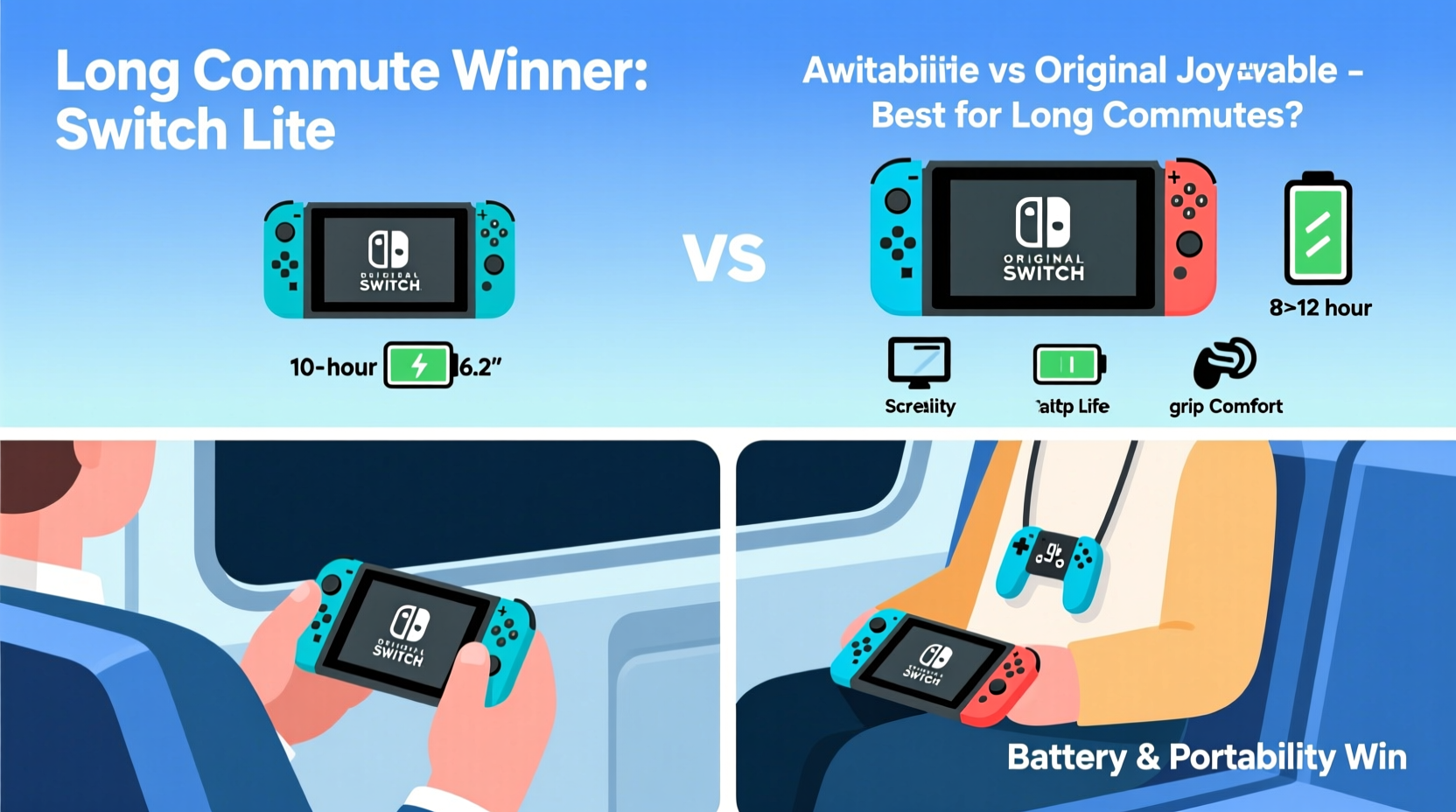
The core distinction lies in form factor. The Switch Lite weighs approximately 275 grams (9.7 oz) and measures 208 x 91 x 13.9 mm. In contrast, the original Switch clocks in at around 297 grams (10.5 oz), slightly wider and thicker, especially when attached to the dock or Joy-Con controllers. While the weight difference may seem minor, over several hours of use, every gram counts.
The Switch Lite integrates controls directly into the unit—no detachable Joy-Cons. This makes it more compact and less prone to losing parts in a backpack. It also lacks kickstands and HDMI output, reinforcing its identity as a pure handheld. On a crowded train or cramped airplane seat, this streamlined profile means easier storage and one less accessory to manage.
In contrast, the original Switch’s modular design introduces flexibility—but also complexity. Detachable Joy-Cons are great for multiplayer but increase the risk of misplacement. They also require reattachment for single-player mode, adding friction when you’re trying to squeeze in gameplay between stops.
Battery Life Comparison: How Long Will It Last?
Long commutes demand long battery life. Here, both models have evolved since launch, but real-world performance varies by game intensity.
| Model | Avg. Battery Life (Mixed Use) | Heavy Use (e.g., Zelda, AAA Titles) | Light Use (e.g., Indie Games, 2D Platformers) |
|---|---|---|---|
| Switch Lite | 3–7 hours | ~3 hours | Up to 7 hours |
| Original Switch (OLED & V2) | 4.5–9 hours | ~4.5 hours | Up to 9 hours |
Despite being smaller, the original Switch generally outlasts the Lite thanks to a larger internal battery. The OLED model, released in 2021, improved efficiency and brightness without sacrificing longevity. For a six-hour flight or cross-country bus ride, those extra two hours could mean finishing a boss battle instead of staring at a black screen.
However, battery isn’t everything. The Switch Lite charges via USB-C and supports fast charging with compatible adapters. Many travelers report successfully topping up mid-commute using power banks. Its lower power draw also means faster recharge times compared to the original model under similar conditions.
“Battery optimization is critical in mobile devices. Smaller screens consume less power, but thermal constraints limit sustained performance.” — Dr. Alan Zhou, Embedded Systems Engineer
Ergonomics and Comfort During Extended Play
How a device feels in your hands after an hour—or three—matters immensely during long trips. The Switch Lite features a fixed grip with rounded edges designed for continuous play. Its buttons and analog sticks are positioned ergonomically, though some users with larger hands report slight thumb fatigue over time.
The original Switch, especially when used handheld with attached Joy-Cons, has a wider stance. Some find this more comfortable; others complain about wrist strain due to the spread-out controller layout. Third-party grips and aftermarket cases can mitigate discomfort, but they add bulk—something many commuters aim to avoid.
Screen size is another key differentiator. The Switch Lite has a 5.5-inch LCD display, while the original Switch uses a 6.2-inch panel (OLED version upgraded to 7 inches with better color contrast). A larger screen enhances immersion, particularly in expansive open-world titles. But it also demands more attention: eye strain becomes noticeable in dimly lit subway cars or under flickering overhead plane lights.
Glare resistance is moderate on both models, though the OLED screen performs better in bright environments. If your commute includes outdoor walking segments or sunny windowsides, visibility will favor the original Switch.
Real Commuter Scenario: Maria’s Daily Train Ride
Maria works in downtown Tokyo and spends 90 minutes each way on the Yamanote Line. She bought a Switch Lite six months ago primarily for her commute. “I play puzzle games like Tetris 99 and retro collections,” she says. “It fits perfectly in my tote bag, and I never worry about losing Joy-Cons. I charge it once every three days.”
When visiting family, she occasionally borrows her brother’s original Switch. “It’s nice to plug into the TV, but carrying it feels awkward. I dropped a Joy-Con once in the station—it scared me.”
For Maria, simplicity wins. Her routine doesn’t involve multiplayer sessions or docked play, so the Lite’s limitations don’t hinder her experience. Instead, its reliability and ease of use make it ideal for repetitive, high-frequency travel.
Durability and Travel Safety
Commuting means exposure to bumps, jostles, temperature changes, and accidental drops. The Switch Lite’s monolithic design gives it structural advantages. Fewer moving parts mean fewer failure points. There's no rail system for Joy-Cons to loosen or disconnect unexpectedly.
That said, if the Lite’s screen cracks, repair costs can outweigh value, especially since Nintendo does not sell standalone replacement screens. The original Switch faces similar issues, though third-party repair kits are slightly more available due to earlier market presence.
Both systems benefit greatly from protective gear. A snug-fitting silicone case and tempered glass screen protector are non-negotiable for frequent travelers. Avoid placing either console loose in a bag alongside keys or hard objects.
Checklist: Preparing Your Switch for Travel
- ✅ Install all system and game updates before departure
- ✅ Charge fully the night before (or pack a 10,000mAh power bank)
- ✅ Use a durable case with corner protection
- ✅ Enable Airplane Mode when Wi-Fi isn’t needed to extend battery
- ✅ Back up save data via Nintendo Cloud (requires subscription)
- ✅ Pack headphones with a 3.5mm jack or Bluetooth adapter
- ✅ Label your device with contact info in case it’s lost
Gaming Experience and Game Compatibility
While both consoles run the same software, not all games function identically across devices. The Switch Lite cannot support titles requiring detached Joy-Con controllers. This includes:
- Zelda: Breath of the Wild – Motion-controlled aiming still works, but HD Rumble features are reduced.
- 1-2-Switch – Entirely incompatible (relies on IR camera and separate Joy-Cons).
- Ring Fit Adventure – Requires leg strap and Ring-Con; not playable on Lite.
- Just Dance – Possible only if you own additional controllers.
If your commute gaming leans toward party, fitness, or motion-heavy titles, the original Switch offers broader compatibility. But for story-driven adventures, platformers, RPGs, and indie darlings—which dominate most commuters’ libraries—the Lite handles them flawlessly.
Additionally, local multiplayer is limited on the Lite. You can still play online co-op or connect with friends via internet, but spontaneous couch-style gaming on a train requires extra hardware. The original Switch shines here, allowing split Joy-Con play without additional purchases.
Step-by-Step Guide: Optimizing Battery for Long Trips
- Lower screen brightness: Reduce to 50% or auto-brightness to conserve power.
- Disable vibration: Go to System Settings > Controllers and Sensors > Disable HD Rumble.
- Turn off motion controls: Unless necessary (e.g., aiming in Metroid Dread), disable gyroscope input.
- Use Airplane Mode: Prevent background downloads and wireless searching.
- Close unused apps: Hold Home button and close running software.
- Carry a portable charger: Choose one with at least 18W output for efficient top-ups.
- Download games locally: Avoid streaming or cloud loading delays.
Cost and Value Consideration
The Switch Lite retails for $199.99, while the original Switch starts at $299.99 ($349.99 for OLED). That $100 gap matters—not just upfront, but in how you use the device.
If your primary goal is portable entertainment and you rarely engage in TV-mode gaming, the Lite delivers excellent value. It’s cheaper, lighter, and simpler. For students, budget-conscious travelers, or secondary household users, it’s often the smarter pick.
But if you want one device that transitions seamlessly from suitcase to living room, the original Switch justifies its price. Dual functionality eliminates the need for multiple systems. Over time, that versatility can save money and reduce clutter.
Frequently Asked Questions
Can I use Bluetooth headphones with both models?
Yes, both the Switch Lite and original Switch support Bluetooth audio. However, native support was added later via firmware update. Ensure your system is updated to at least version 10.0.0. Note: Only one pair of headphones can be connected at a time, and audio latency may vary.
Is the Switch Lite suitable for children on road trips?
Absolutely. Its compact size, lower price point, and lack of removable parts make it ideal for younger users. Parents appreciate that there’s nothing to lose, and the built-in controls prevent confusion. Pair it with a kid-friendly game library and parental controls for stress-free travel entertainment.
Does screen size really affect gameplay on long commutes?
It depends on personal preference and visual acuity. Larger screens enhance detail and reduce eye strain for some, but demand more focus and lighting. The 5.5-inch screen on the Lite is sufficient for most games, especially those not reliant on fine textures. Try both in-store if possible before deciding.
Final Verdict: Which Is Better for Long Commutes?
The answer hinges on your priorities.
If you value **simplicity, portability, and cost-efficiency**, the **Switch Lite** is superior for long commutes. It’s lighter, more compact, and purpose-built for handheld play. You won’t miss docked mode if you rarely use it, and the reduced risk of lost accessories adds peace of mind during hectic travel days.
But if you seek **maximum flexibility, longer battery life, and full game compatibility**, the **original Switch (preferably OLED)** is worth the trade-offs. Despite being heavier and more complex, its larger screen, stronger battery, and ability to double as a home console offer unmatched adaptability. For frequent travelers who also game at home, it remains the more complete package.
Ultimately, neither option is objectively “better.” They serve different lifestyles. For the commuter who plays daily in short bursts, the Lite excels. For the hybrid user who shifts between transit and home entertainment, the original Switch earns its place.




 浙公网安备
33010002000092号
浙公网安备
33010002000092号 浙B2-20120091-4
Comments
No comments yet. Why don't you start the discussion?